


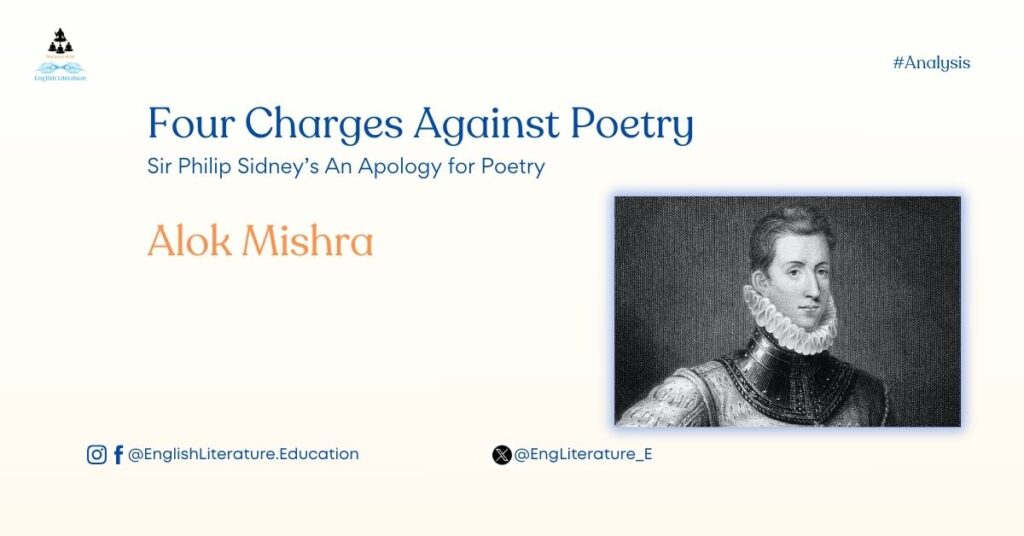
One of the earliest literary critics in English, Sir Philip Sidney’s passionate defence of poetry, also known as “the defense of poesy,” came out with the famous title “An Apology of Poetry” in the year 1595. Though the assertions extended by the touted poet himself may not fit today’s intellectual frameworks, there are many universal assumptions about poets and poetry in this well-known work of criticism. In this article, moreover, I will address how Sidney defends the four charges against poetry.
A careful reading of Philip Sidney’s An Apology for Poetry reveals that his defence of poetry is not merely rhetorical but systematically structured against four major accusations commonly made by his contemporaries. These charges are that poetry is a waste of time, that it is the mother of lies, that it corrupts morals, and that it is inferior to other branches of learning, such as philosophy and history. Sidney addresses each of these with remarkable clarity, blending classical authority with humanist conviction. Below, you can read how Sidney defends against each of these charges levied against poetry.
1. Charge One: Poetry is a Waste of Time
Sidney begins by confronting the accusation that poetry is trivial and unproductive, unworthy of serious intellectual engagement. This criticism was particularly strong among those who privileged logic, science, and moral philosophy over imaginative literature. He acknowledges that poetry had been reduced to triviality by intellectuals and learned persons of the society because they lacked an acute understanding of it. He writes:
“And yet I must say so that, as I have just cause to make a pitiful defense of poor poetry, which from almost the highest estimation of learning is fallen to be the laughing-stock of children, so have I need to bring some more available proofs, since the former is by no man barred of his deserved credit, is the silly latter hath had even the names of philosophers used to the defacing of it, with great danger of civil war among the Muses.”
(An Apology for Poetry 2)
Sidney responds by repositioning poetry at the very foundation of all learning. He reminds us that in ancient Greece, the earliest teachers were poets such as Homer and Hesiod. These figures did not merely entertain; they shaped moral understanding, historical consciousness, and intellectual curiosity. Poetry, in this sense, is not a distraction but the beginning of education itself. Sidney ascribes to poetry the high praise and calls it the first “light-giver to ignorance,” and the “first nurse” of human wit. In his own words, it becomes apparent how high regard Sidney holds for poetry:
“Let learned Greece in any of her manifold sciences be able to show me one book before Musæus, Homer, and Hesiod, all three nothing else but poets.”
(ibid 2)
And it is true! The earliest recorded works in writing are mostly poetic. Homer for Greeks, Valmiki and Ved Vyas for Indians, Virgil, Horace and Ovid for Romans, and many others for their geographies were poets, the poets who laid the foundations to understand society, human civilisation, human desires, vices and this world in totality. From this perspective, Philip Sidney’s defence holds merit and substantial ground against the charge of futility levied on poetry.
He also makes a psychological argument that remains strikingly modern. Human beings are naturally drawn to pleasure. Poetry attracts through delight and then gently leads the reader toward knowledge. Unlike dry academic discourse, poetry engages both emotion and intellect. It makes learning memorable and desirable. Sidney gives the famous example of societies where the lack of writing could not stop poets from singing the praises of valiants, imparting moral lessons, appreciating God and virtues, and denouncing evil.
“Even among the most barbarous and simple – Indians, where no writing is, yet have they their poets, who make and sing songs (which they call areyfos), both of their ancestors’ deeds and praises of their gods, — a sufficient probability that, if ever learning come among them, it must be by having their hard dull wits softened and sharpened with the sweet delights of poetry; for until they find a pleasure in the exercise of the mind, great promises of much knowledge will little persuade them that know not the fruits of knowledge.”
(ibid 4)
Based on these extracts, it becomes apparent that Sidney is arguing for the pedagogical power of literature. Poetry succeeds because it does not feel like instruction, even while it is deeply instructive. This is like concealing the moral lessons and social instruction behind the veils of delight and a compelling narrative… and yet making things accessible to the masses, albeit in a way that keeps the audience engaged rather than bored or daunted by the pedantry.
To conclude, Sidney defends the first charge on poetry in a very persuasive and compelling manner. He rescues poetry from the adjectives and abstractions ascribed to it by his peers and the ancient scholars before him.
2. Charge Two: Poetry is the Mother of Lies
This is perhaps the most famous accusation against poetry, inherited from Plato. The argument is that poetry deals in fiction and therefore promotes falsehood. Though Aristotle defended the art of poetry, arguing against Plato’s charges, Philip Sidney adds new dimensions to this discussion.
Sidney’s rebuttal is both subtle and powerful. He begins by redefining what it means to lie. A lie, he argues, is an assertion of something false presented as truth. He argues that physicians, astronomers, and scientists often indulge in lying because they have to give fixed numbers, figures, and facts. And as they claim things to be true, even after knowing their mathematics could be a lie, their truth may not be true, after all! The poet, however, never claims that his inventions are factual. When a poet writes of a golden world or an ideal hero, he does not insist that such things exist in reality. Therefore, he cannot be accused of lying. Sidney writes:
“… the poet’s persons and doings are but pictures what should be, and not stories what have been, they will never give the lie to things not affirmatively but allegorically and figuratively written. And therefore, as in history looking for truth, they may go away full-fraught as with falsehood, so in poesy looking but for fiction, they shall use the narration but as an imaginative ground-plot of a profitable invention.”
(ibid 36)
In fact, Sidney turns the accusation on its head. After rescuing the poets, he suggests that historians and even philosophers are more prone to falsehood. Historians may record events inaccurately or rely on biased sources. Philosophers may construct abstract systems that do not correspond to lived reality. The poet, by contrast, openly operates in the realm of imagination. The poet never claims to present truth to the world! More importantly, poetic truth is not factual truth but universal truth. Poetry expresses what could be and what ought to be, rather than what merely is. It reveals deeper patterns of human behaviour, ethical ideals, and emotional realities.
For students, it is useful to understand that Sidney is distinguishing between literal truth and imaginative truth. Poetry does not deceive. It illuminates.
3. Charge Three: Poetry Corrupts Morals
Another serious accusation was that poetry encourages vice by depicting immoral behaviour, passionate excess, or romantic indulgence. Yes, that was the charge! As Sydney’s “Apology” was way longer than one could write, he vehemently defended poetry against this accusation, too.
Sidney’s defence here rests on his central claim that poetry teaches and delights. (As you must know, Robert Frost, later, laid the foundation of his poetic philosophy on this belief – “A poem begins in delight and ends in wisdom.”) Sidney rightly argues that poetry does not glorify vice but presents it in a way that leads to moral reflection. When we encounter characters who suffer because of their flaws, we are not encouraged to imitate them. Instead, we learn to recognise the consequences of wrongdoing.
Sidney is successful in establishing that poetry is not merely ornamental but fundamentally pedagogical, defining it as “an art of imitation… a speaking picture, with this end, to teach and delight (ibid)”. This formulation is crucial because it frames poetry as a medium that engages both intellect and emotion, thereby making moral instruction more effective. Sidney recognises that abstract moral philosophy often fails because it lacks emotional appeal, whereas poetry attracts readers through delight and gradually guides them toward ethical awareness. He therefore asserts that “delight… moveth men to take that goodness in hand, which without delight they would fly as from a stranger (ibid)”. In this sense, poetry does not impose morality but cultivates a voluntary inclination toward virtue. It prepares the reader to embrace goodness by rendering it desirable.
He also emphasises the positive power of poetry. Poetry presents vivid examples of virtue. It gives us ideal figures who embody courage, loyalty, wisdom, and justice. These figures are more effective than abstract moral principles because they engage the imagination. We do not simply understand virtue. We see it in action. For example, we can always remember Shakespeare’s heroes, heroines, and villains – the perfect embodiments of the virtues and vices of human society.
Sidney insists that poetry moves the reader toward virtuous action. Philosophy may tell us what is right, but poetry inspires us to act rightly. It does so by making virtue attractive and emotionally compelling.
4. Charge Four: Poetry is Inferior to Philosophy and History
Sidney devotes considerable attention to this criticism, as it reflects the intellectual hierarchy of his time. Philosophy was regarded as the highest form of knowledge because it addressed universal truths. History was valued for its record of real events. Poetry, by comparison, was often dismissed as secondary. Therefore, Sidney found it incumbent upon himself to defend poetry against this charge in his apology or the defence.
Sidney responds by placing poetry above both philosophy and history. His reasoning is elegant and comparative. Sidney argues that the philosopher teaches through abstract principles. These principles are often difficult to understand and even more difficult to apply. They remain in the realm of theory. On the other hand, the historian teaches through particular examples. These examples are concrete but limited. They show what happened in specific situations but do not necessarily provide general guidance. However, the poet, Sidney believes and argues therefore, has the quality of both a philosopher and a historian. In Sidney’s words:
“Now doth the peerless poet perform both; for whatsoever the philosopher saith should be done, he giveth a perfect picture of it in some one by whom he presupposeth it was done, so as he coupleth the general notion with the particular example.”
(ibid 15)
The poet, as Sidney evidently argues, combines the strengths of both. He presents universal truths through particular and vivid examples. He creates idealised situations that reveal moral principles in action. In doing so, he makes learning both accessible and effective.
Sidney famously describes poetry as a “speaking picture.” This metaphor is crucial. Poetry allows us to see ideas rather than merely hear them. It transforms abstract knowledge into lived experience. And therefore, Sidney emphasises, the poet is superior to both historian and philosopher, and poetry is far superior to the two streams of knowledge and scholarship.
Concluding Reflections for Students
Sidney’s defence of poetry is rooted in a broader Renaissance belief in the value of human creativity and moral development. He does not deny that poetry can be misused, but he insists that its true nature is noble and beneficial.
If we step back and consider his arguments together, a clear pattern emerges. Sidney consistently emphasises three key functions of poetry:
- First, poetry delights. It engages the reader emotionally and aesthetically.
- Second, poetry teaches. It communicates knowledge, especially moral knowledge.
- Third, poetry moves. It inspires action and shapes character.
These three functions work together to make poetry a powerful educational tool. Sidney’s defence is therefore not only about literature but about the role of imagination in human life.
Look at this work from a different perspective, a scholarly and a critical one, Sidney not merely appears as defending poetry against criticism, but as articulating a comprehensive theory of literature. His arguments continue to resonate in contemporary debates about the value of the humanities.
You can share your thoughts, opinions and questions in the comments.
Dr Alok Mishra for English Literature Education