


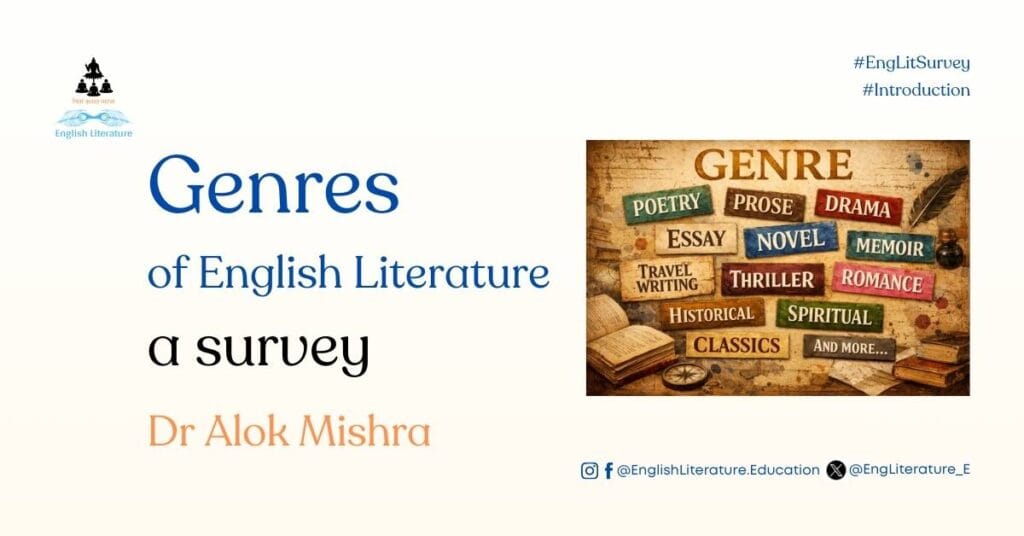
In this detailed article, students of English literature can learn everything about GENRE. What is Genre? What are the genres of English literature? And many other questions will be discussed in this article. If anything else remains untouched or you have a question, please feel free to put it in the comment section, and I will get back to you.
Introduction
Imagine entering a branded cloth showroom and discovering that there are no categories. You encounter everything arranged in layers, one above another. What will you do? Immediately leave the shop and find another that is organised. Won’t you? The message – organisation is crucial for anything to be accessed conveniently, appreciated for its worth and also shared among like-minded consumers.
Likewise, Genres form the backbone of literary study. They organise the vast corpus of texts into recognisable families, provide readers and scholars with expectations about form and matter, and enable writers to situate their work within traditions and markets. A robust understanding of genre is therefore indispensable for anyone who wishes to study English literature with rigour. This article examines what we mean by genre, outlines the principal genres and their salient subgenres, traces the historical moments in which particular forms achieved prominence, considers which genres dominate contemporary readerships, and concludes with a curated reading list for advanced study of the theory and history of genre. The treatment aims to be at once academically rigorous and accessible to readers seeking a reliable, synthetic account.
What is genre in literature? — concepts and theoretical perspectives
At its simplest, “genre” denotes a class or category of texts that share distinctive formal and thematic features: mode of narration, dominant themes, typical structures, and conventional devices. Lexical authorities define genre as a style or type characterised by a particular set of conventions and expectations. Yet this reductive definition conceals important complexities that have exercised literary theory for the last century. Genre is not merely a taxonomic label. It is both a classificatory practice and a cultural technology that produces meanings, mediates relations between author and reader, and organises social value. Within contemporary criticism, it may be considered from at least three interlocking perspectives.
First, the formal perspective treats genre as a set of textual conventions and tropes. Under this view, a sonnet is a sonnet because of its metrical and structural features; a detective story is a detective story because of its investigative plot, the presence of a mystery, and its resolution. Second, the socio-historical perspective emphasises the ways genres emerge, stabilise, mutate, and sometimes disappear in response to changing social needs, markets, patronage structures, and readerships. Third, the theoretical or pragmatic perspective emphasises genre as a social contract between producer and consumer: genres coordinate expectations, making communication efficient and culturally intelligible. Important theorists have expanded and complicated these positions. Mikhail Bakhtin’s account of “speech genres” highlights utterance-level regularities and dialogic contexts; Northrop Frye and later systematic critics offered models that connect genre to mythic and archetypal structures; more recent social theory situates genre within cultural circulation and power relations. In short, genre is simultaneously descriptive, prescriptive, and performative.
Major and popular genres of English literature — categories and subgenres
Scholarly practice typically separates literature into a few principal categories—prose (fiction and nonfiction), poetry, and drama—with a rich array of subgenres nested under each heading. The following overview organises genres by their dominant formal and thematic orientation, together with representative subgenres.
Poetry: From lyric and sonnet to epic and modern free verse, poetry remains a principal literary mode. Subgenres include lyric (sonnet, ode), narrative (ballad, epic), dramatic monologue, and experimental forms such as concrete and sound poetry. Poetry foregrounds condensed language, prosody, and images.
Drama: Drama comprises works intended for performance. Its major historical subgenres are tragedy, comedy, tragicomedy, satire, and the modern realist play; the 20th century saw the rise of the absurdist drama and documentary theatre.
The Novel (Fiction): The novel is the most capacious modern form, absorbing many subgenres: realist novel, Bildungsroman, gothic novel, historical novel, romance, science fiction, fantasy, detective and crime fiction, thriller, psychological novel, and experimental/metafictional forms. The novel’s adaptability accounts for its centrality in modern literary cultures.
Short fiction: Short stories, novellas, and flash fiction exist in relation to, and often independently of, the novel. The short story has its own conventions, marked by an economy of plot and a concentrated effect, and by a canonical modernist and postmodernist history.
Nonfiction: This large category includes essays, memoirs, biographies, historiography, travel writing, literary reportage, and criticism. Nonfiction frequently interpenetrates fictional modes, particularly in hybrid forms such as the autobiographical novel.
Hybrid and emergent forms: Recent decades have seen the proliferation of hybrid forms, such as graphic novels, autofiction, lyric essays, and digital literature, which resist neat classification and highlight genre as a negotiated practice rather than a set of immutable rules.
Historical peaks and timelines — when particular genres flourished
Genres do not have fixed lifespans; they rise, transform, and, at times, decline in cultural centrality. Mapping their “most popular timelines” requires attending to literary production, institutional patronage, readership, and historical circumstance. The following concise chronology highlights key moments in the Anglophone tradition.
Medieval period and early vernacular forms (to c. 1500): Oral and manuscript cultures privileged forms such as the epic and religious drama. The ballad and allegorical romance circulated widely. Chaucer’s Canterbury Tales exemplifies the hybridity of late medieval narrative.
Renaissance and early modernity (c. 1500–1660): Theatre, particularly Elizabethan and Jacobean drama, achieved unprecedented vitality—Shakespeare, Marlowe, and their contemporaries polished tragedy, history play, and comedy. Lyric and pastoral poetry also flourished.
The Augustan and neoclassical period (c. 1660–1798): Formal satire, heroic couplets, the mock-epic, and didactic prose dominated. Periodical essays and epistolary forms developed.
The rise of the novel (from the 18th century to Romanticism): The novel consolidates as a central form in the 18th century, with authors such as Richardson, Fielding, and Sterne, and matures into the realist novel of the 19th century (Austen, Dickens, Gaskell). Gothic and sentimental subgenres also emerge.
Victorian high realism (19th century): The novel becomes the principal cultural vehicle; serial publication and the expansion of reading publics shape novelistic forms. Poetry continues with the romantic legacy and later Victorian innovations.
Modernism (early to mid-20th century): Poetry and the novel experiment radically. Modernist experiments with form, narrative voice, and temporality (Joyce, Woolf, Eliot, Pound) mark an era where genre boundaries are questioned.
Postwar and postmodernity (mid to late 20th century): Genres fragment. The novel accommodates metafiction, historiographic metafiction, and hybrid modes. Drama and poetry continue to innovate. The late 20th century also witnessed the institutionalisation of genre fiction, science fiction, fantasy, and crime as commercially prominent and critically debated.
Contemporary period (late 20th century to present): Globalisation, digital media, and market dynamics encourage hybridity and niche genres. Memoir, autofiction, speculative fiction, and graphic narratives have grown in prominence. This broad chronology is a schematic guide; each field and region will present more nuanced variation.
Which genres are most famous today? — markets, readerships, and cultural prominence
Contemporary prominence is shaped by both cultural prestige and commercial success. Two joint vectors are useful to distinguish: (1) genres that command the greatest sales and market share; and (2) genres that attract sustained critical attention in academic and literary-cultural forums.
Commercial leaders: In global book markets, romance, mystery/crime, thriller, and fantasy repeatedly feature among the highest-selling categories. Genre fiction benefits from avid fan communities, serialisation (series fiction), and cross-media adaptation (film, television, streaming). Recent industry surveys and trade reporting—synthesising bestseller lists and market analytics—identify romance and crime/thriller as among the largest segments of consumer demand. Self-help, business, and popular history also sustain robust markets.
Cultural and critical prominence: Literary fiction, often loosely contrasted with “genre fiction,” continues to hold prestige in prize culture and academic study. Simultaneously, the critical field has expanded to treat genre fiction seriously; crime, fantasy, and science fiction are subjects of sophisticated theoretical work that examines their formal devices, ideological commitments, and cultural functions. Moreover, hybrid forms such as autofiction and the lyric essay command critical attention because they problematise the boundary between fact and fiction. Thus, popularity and prestige no longer map neatly onto separate worlds; cross-fertilisation is a defining feature of the present moment.
Methodological remarks on periodisation and historians’ caution
When we speak of “timelines” and “most popular” epochs, it is important to acknowledge that periodisation is heuristic rather than definitive. Popularity may vary by geography, class, language community, and publishing infrastructure. For example, the novel’s ascendancy in the nineteenth century is evident in Britain, but trajectories differ across other Anglophone geographies. Moreover, subgenres often reappear after an apparent decline. The historical account above, therefore, offers a broad skeleton that must be fleshed out with localised studies and attention to noncanonical traditions.
Recommended books and primary theoretical readings for studying genre in depth
For students and researchers who wish to pursue genre studies with intellectual seriousness, the following list combines classic theoretical statements with seminal historical surveys and accessible introductions. I list each title with a short note on its usefulness.
Mikhail M. Bakhtin: Speech Genres and Other Late Essays. Central for understanding the dialogic and utterance-level approach to genre; useful for scholars interested in how everyday and literary genres interact.
Northrop Frye: Anatomy of Criticism. A grand, systematic attempt to link genres with modes and mythic structures; indispensable for readers who seek a structural-historicist model.
John Frow: Genre (Routledge). A contemporary, theoretically sophisticated introduction that treats genre as social practice and cultural organisation; recommended for graduate-level study.
Erich Auerbach: Mimesis: The Representation of Reality in Western Literature. A wide-ranging historical meditation on how realism and representation have developed; valuable for those tracing genre and realism across epochs.
Terry Eagleton: Literary Theory: An Introduction. Not a book about genre per se, but indispensable for situating genre debates within broader theoretical formations.
Anthologies and handbooks: Collections such as The Cambridge Companion to the Novel and handbooks on drama, poetry, and film genre studies offer reliable overviews and bibliographies for specialised inquiry.
Specialist studies: For specific subgenres, consult dedicated monographs: for detective fiction, see works by Martin Priestman and John Scaggs; for science fiction and fantasy, foundational essays and the Cambridge Companion to Science Fiction; for romance, recent sociological and publishing studies charting the genre’s market dynamics.
These readings provide both the conceptual tools and historical knowledge required to study genre as theory, practice, and institution.
Practical suggestions for scholars and teachers
Use comparative reading: To understand a genre’s conventions, read canonical exemplars alongside marginal or hybrid texts. For instance, pair a classical sonnet sequence with contemporary lyric poems that revise the sonnet form.
Attend to paratexts and markets: Genre is continually shaped by publishers, blurbs, cover design, and marketing. Reading these paratexts clarifies how genres are signalled to readers.
Combine close reading and reception history: Analyse textual features and trace how readers and reviewers received the texts in different historical moments.
Be wary of rigid taxonomies: Genres are fluid: many important works deliberately transgress or hybridise conventions. Understanding tension and crossover is as important as recognition of conventions.
Conclusion
Genre remains a central concern for the study of English literature because it mediates aesthetic practice, social meaning, and commercial circulation. The concept resists a single definitive definition; it is simultaneously a descriptive category, a normative convention, and a historical practice. The historical prominence of particular forms, such as drama in the Renaissance, the novel in the nineteenth century, and genre fiction in contemporary markets, reflects broader social, technological, and institutional transformations. For scholars, the study of genre demands both theoretical literacy and archival subtlety. The reading list suggested above offers reliable entry points into the theoretical debates; subsequent research should integrate these frameworks with attentive readings of primary texts and an awareness of local historical contexts. By treating genre as a dynamic field rather than as a set of fixed boxes, literary study becomes better equipped to account for innovation, hybridity, and the enduring capacity of literature to both reflect and shape cultural life.
Dr Alok Mishra
for the English Literature Education platform