


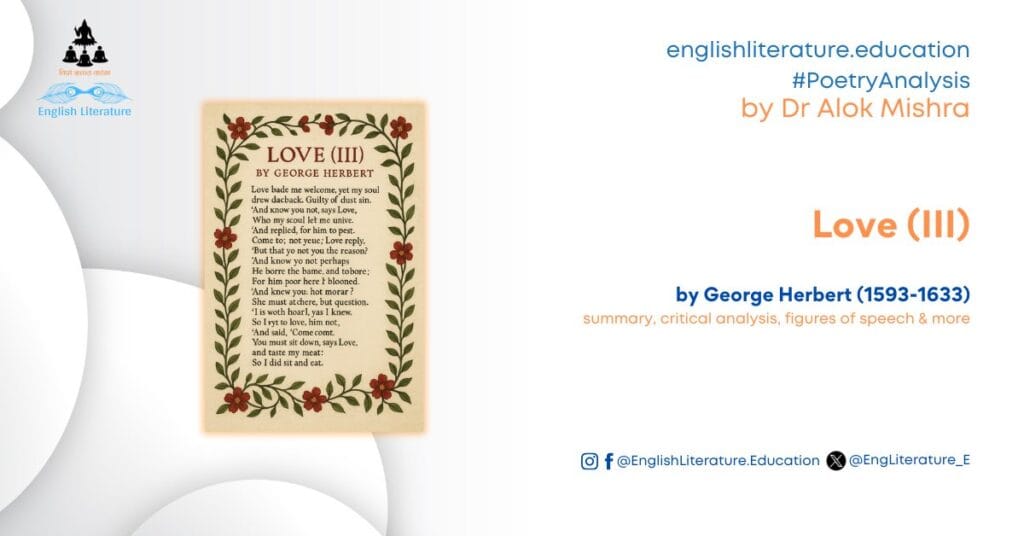
George Herbert’s “Love (III)” is one of the most celebrated poems in “The Temple,” admired for its spiritual intimacy and profound theological resonance. The poem stages a conversation between the speaker and Love, depicted not as an abstract principle but as the incarnate Christ whose gentleness, compassion, and patience overcome the speaker’s sense of unworthiness. With its elegant simplicity and devotional depth, the poem encapsulates Herbert’s exploration of sin, grace, and divine hospitality. Written in Herbert’s characteristic plain style, Love (III) communicates the spiritual drama of the contrite soul being, despite guilt and hesitation, admitted into the transformative embrace of divine love.
George Herbert was a learned poet, well educated and well taught. He is best known for his religious poems exploring spiritual, religious and personal dilemmas, angst and struggles of faith. His reputation rests solidly on the poetry collection published posthumously – The Temple.
This detailed study guide offers everything students of English literature need to study the poem ‘Love’ in their BA or MA syllabuses.
Quick Summary of the Poem Love (III) by George Herbert:
In Love (III), George Herbert presents an intimate, deeply spiritual dialogue between the speaker and Love, personified as a gentle and compassionate host who embodies Christ. The poem begins with Love inviting the hesitant speaker to enter and be welcomed. However, the speaker, overwhelmed by guilt and the awareness of his sinfulness, withdraws in shame, feeling unworthy to stand before such purity. Love, noticing this reluctance, approaches with kindness and asks whether the speaker lacks anything.
The speaker responds that he is not a worthy guest, but Love counters this by declaring that worthiness is bestowed rather than earned. As the dialogue unfolds, the speaker confesses that he has marred the gifts God gave him and believes his shame should banish him. Love reminds him that the burden of sin has already been borne, emphasising the message of divine forgiveness. In the final lines, Love invites the speaker to sit and eat, an image suggesting communion and acceptance. The speaker finally yields, accepting Love’s hospitality and grace.
To sum up, Love (III) is a tender and profound meditation on divine compassion, human guilt, and the transformative power of grace. Through a simple yet emotionally rich dialogue, Herbert illustrates how divine love gently guides the hesitant soul towards acceptance, reconciliation, and spiritual nourishment.
Structure, Rhyme Scheme, and Literary Devices in the Poem Love (III) by George Herbert:
Love (III) is a carefully crafted lyric poem comprising three sestets (three stanzas of six lines each), totalling 18 lines. Each stanza advances the spiritual dialogue between the speaker and Love, moving from hesitation and guilt to acceptance and communion. The structure mirrors the emotional and theological progression: invitation, resistance, reassurance, and finally, surrender. The poem’s rhyme scheme is ABABCC in each stanza, a pattern that lends musicality, balance, and closure to the conversational tone. Herbert’s controlled form and measured rhythm reinforce the calm, persuasive presence of Love and the gradual easing of the speaker’s troubled conscience.
Herbert employs several literary devices to enrich the devotional experience conveyed in the poem. Personification is central: Love is depicted as a courteous, observant, and tender host, allowing complex theological concepts, grace, forgiveness, and redemption to unfold through human interaction. Dialogue forms the core of the poem’s structure, externalising the speaker’s internal struggle. Metaphor is present in the depiction of the meal, symbolising spiritual nourishment and sacramental communion. Rhetorical questions intensify Love’s persuasive voice, gently guiding the speaker to understand divine mercy. Imagery of hospitality, touching, sitting, and eating creates an atmosphere of warmth, reassurance, and intimacy. Herbert also employs contrast, especially between the speaker’s sense of guilt and Love’s unwavering acceptance. The poem’s linguistic simplicity, characteristic of Herbert’s plain style, heightens its emotional clarity and spiritual resonance.
The Refrain-like Movement: From Shame to Acceptance
While Love (III) does not contain a repeated verbal refrain like “must die” in Virtue, it incorporates a refrain-like emotional pattern that shapes the poem’s movement: the speaker repeatedly offers reasons to withdraw—unworthiness, shame, guilt—and Love repeatedly counters these reasons with gentle reassurance. Each new objection from the speaker invites a deeper revelation of divine compassion. This pattern functions like a refrain, emphasising the persistence of divine love in the face of human hesitation.
The poem’s closing gesture, “So I did sit and eat,” operates as an antithetical resolution, parallel to the antithesis in the final line of Virtue. After the speaker’s repeated attempts to pull away, the final action signifies acceptance, peace, and spiritual restoration. The line is understated yet profoundly transformative: human reluctance gives way to divine assurance, and the soul finds its true place at Love’s table.
Stanza 1
“Love bade me welcome. Yet my soul drew back
Guilty of dust and sin.
But quick-eyed Love, observing me grow slack
From my first entrance in,
Drew nearer to me, sweetly questioning,
If I lacked any thing.”
In the opening stanza, the poem begins with a gentle invitation: Love, symbolising Christ, asks the speaker to enter and be welcomed. Despite this gracious greeting, the speaker instinctively withdraws. He feels “guilty of dust and sin,” a phrase that encapsulates both human frailty (“dust”) and moral failing (“sin”). His hesitation is immediately noticed by “quick-eyed Love,” a perceptive and compassionate figure who approaches with kindness rather than reprimand. Love asks, with gentle concern, whether the speaker is lacking anything, creating a tender atmosphere of assurance.
Critically examined, this stanza establishes the spiritual tension that defines the poem as a whole. Herbert masterfully portrays the human condition: the soul is drawn toward divine goodness yet recoils under the weight of its own unworthiness. The contrast between Love’s warmth and the speaker’s shame generates emotional depth and theological nuance. Moreover, Herbert’s personification of Love is central to the poem’s meaning. Love is not abstract but an active, attentive presence who notices, moves, and speaks. This aligns Herbert with the devotional tradition of metaphysical poetry, where spiritual truths are disclosed through intimate encounters. The style recalls John Donne’s religious poems, particularly those depicting the paradox of divine pursuit and human reluctance. Yet Herbert’s tone remains gentler, marked by simplicity and clarity, enhancing the sincerity of the spiritual drama.
Stanza 2
“A guest, I answered, worthy to be here:
Love said, You shall be he.
I the unkind, ungrateful? Ah my dear,
I cannot look on thee.
Love took my hand, and smiling did reply,
Who made the eyes but I?”
The second stanza deepens the conversation. The speaker confesses openly that he is unworthy to be Love’s guest. Love counters this hesitation with an astonishing response: the speaker shall be the guest, because Love chooses to bestow worthiness. The speaker, still overwhelmed by guilt, describes himself as “unkind” and “ungrateful,” unable even to look at Love. In response, Love gently takes his hand and reminds him that the Creator of the eyes can also restore them. This rhetorical question—“Who made the eyes but I?”—asserts divine authority while radiating compassion.
Analytically, this stanza exposes the core tension between human self-accusation and divine mercy. The speaker embodies the psychological struggle of the repentant soul, burdened by memory of past failures. Herbert’s dialogue form allows this inner conflict to unfold naturally, with Love’s replies guiding the soul away from despair. The gesture of taking the speaker’s hand is notable for its intimacy; Herbert uses physical touch to symbolise spiritual healing. The rhetorical question serves both as reassurance and as doctrinal truth, echoing biblical themes of creation and restoration. Comparisons may be drawn with the spiritual dialogues in Dante’s Paradiso, where divine figures counter human inadequacy with grace. Yet, Herbert’s presentation remains more personal and direct, emphasising the immediacy of divine compassion.
Stanza 3
“Truth Lord, but I have marred them: let my shame
Go where it doth deserve.
And know you not, says Love, who bore the blame?
My dear, then I will serve.
You must sit down, says Love, and taste my meat:
So I did sit and eat.”
The final stanza brings the spiritual journey to its resolution. The speaker concedes that although God created him, he has “marred” the eyes—that is, damaged the gifts he was given through sin. He suggests that his shame ought to banish him. Love’s reply is the theological turning point: the blame has already been borne. This alludes unmistakably to Christ’s redemptive sacrifice. Overwhelmed by this realisation, the speaker offers to serve Love, but Love reverses the roles and insists that the speaker must sit and be served. The poem ends with the quiet yet profound acceptance: “So I did sit and eat.”
Critically analysed, this stanza completes Herbert’s profound meditation on grace. The speaker’s final objection—shame—reflects the last barrier between the soul and divine communion. Love dismantles this barrier with the reminder of atonement, emphasising that redemption is not achieved by human merit but granted by divine love. The reversal of roles, where Love serves the speaker, is deeply significant; it mirrors the Christian narrative of Christ washing the disciples’ feet and offering himself in the Eucharist. The invitation to “taste my meat” symbolises sacramental communion and spiritual nourishment. The final line, understated yet decisive, signifies the soul’s surrender to grace and acceptance of divine hospitality. Its simplicity underscores the profound transformation that occurs when guilt yields to love.
The tone and movement of this stanza, and indeed the entire poem, resemble the quiet culmination of spiritual struggles found in Herbert’s own poem “The Collar.” However, Love (III) resolves in peace rather than rebellion. Its theological richness also evokes parallels with St Augustine’s confessional moments, where divine love gently overcomes the restless soul.
Poetic Devices Used in the Poem Love (III) by George Herbert
George Herbert’s Love (III) employs a range of poetic devices that enrich the emotional depth and theological resonance of the poem. These devices work together to portray the intimate encounter between the soul and divine love, creating a lyrical atmosphere characterised by tenderness, humility, and spiritual revelation.
1. Imagery
Herbert uses precise, gentle imagery to evoke the poem’s intimate setting, allowing readers to visualise the interaction between the speaker and Love. Images such as Love’ sweetly questioning,’ “took my hand,” and inviting the speaker to “sit and eat” create a vivid picture of divine hospitality. These sensory details bring warmth and closeness to the relationship, transforming theological concepts, such as sin, grace, and redemption, into lived experience. The imagery invites the reader to witness the soul’s emotional journey from reluctance to acceptance.
2. Personification
Personification is central to the poem, for Love appears as a living, compassionate figure embodying Christ. Love observes, approaches, questions, smiles, and takes the speaker’s hand. This personification transforms divine love from an abstract religious idea into a tangible, relatable presence. By presenting Love as a courteous host, Herbert explores spiritual truths through the dynamics of human interaction. The emotional resonance produced by this device allows readers to feel the softness, patience, and grace that characterise divine nature.
3. Symbolism
Symbolism is woven throughout the poem, deepening its spiritual significance. The “meat” Love offers the speaker symbolises Eucharistic communion, representing nourishment, sacrifice, and unity with the divine. The act of sitting and eating becomes symbolic of spiritual acceptance and the soul’s reconciliation with God. Even the speaker’s references to the eyes he has “marred” symbolise human faculties tarnished by sin, while Love’s reminder—“Who made the eyes but I?”—points to divine power to restore what is damaged. Each symbol contributes to the poem’s overarching message of redemption.
4. Dialogue and Repetition of Structure
While Love (III) does not include a repeated refrain such as “must die,” from the poem Virtue, it employs a repetitive structural pattern in the dialogue. Each time the speaker offers a reason to withdraw—unworthiness, shame, guilt—Love responds with a new reassurance. This repeated movement mirrors the cycle of human hesitation and divine consolation. The rhythm of objection and response creates a refrain-like emotional pattern, reinforcing the poem’s themes of patience, compassion, and spiritual healing.
5. Rhetorical Questions
Herbert uses rhetorical questions to express both divine authority and tenderness. Love’s question, “Who made the eyes but I?” is central to the poem’s argument. It gently reminds the speaker of God’s role as Creator and Redeemer while addressing the speaker’s inner turmoil. The rhetorical questions invite introspection, prompting the soul to reconsider its feelings of inadequacy in light of divine love.
6. Metaphor
Several metaphors enrich the poem. The speaker’s “dust and sin” metaphorically represent human frailty and moral imperfection, capturing the existential distance between the human and the divine. The entire banquet scenario with a gracious host is metaphorical, representing an invitation to divine communion. Through these metaphors, Herbert conveys abstract theological ideas in concrete and emotionally accessible terms.
7. Tone and Plain Style
Herbert’s use of the metaphysical plain style is itself a poetic device. The language is simple, conversational, and unadorned, yet the simplicity belies the complexity of the spiritual drama unfolding within the poem. The tone remains gentle, contemplative, and reverent throughout. This plain style evokes sincerity and humility, reinforcing the speaker’s vulnerability and Love’s compassion.
8. Contrast
Herbert repeatedly employs contrast to highlight the poem’s central conflict. The speaker’s guilt is set against Love’s tenderness; his reluctance contrasts with Love’s persistence; human shame contrasts with divine grace. These oppositions heighten the emotional tension of the poem and make the final reconciliation more powerful. The contrast between the speaker’s desire to “serve” and Love’s insistence that he must instead be “served” underscores the radical generosity of divine love.
List of All Poetic Embellishments Used in the Poem Love (III) by George Herbert
1. Metaphors
Herbert employs several metaphors that deepen the spiritual meaning of the poem:
• “Guilty of dust and sin” – A metaphor for human frailty and moral imperfection.
• Love as a host – The entire scenario of Love inviting the speaker to dine functions as an extended metaphor for divine grace and Eucharistic communion.
• “Taste my meat” – Symbolises spiritual nourishment and Christ’s sacrificial love.
• “Marred eyes” – A metaphor for the corrupted faculties of the soul affected by sin.
2. Irony
Herbert uses subtle theological irony to highlight reversals:
• The speaker offers to serve Love, yet Love insists on serving him – a reversal of expected roles (spiritual irony reflecting divine humility).
• The sinner imagines he should flee, yet Love approaches him even more gently – an ironic contrast between human fear and divine compassion.
3. Allusions
The poem contains indirect allusions to Christian theology:
• Atonement – “Who bore the blame?” alludes to the crucifixion and Christ’s redemptive sacrifice.
• Eucharist – “Taste my meat” evokes the sacrament of Holy Communion.
• Biblical Creation – “Who made the eyes but I?” recalls Genesis imagery of God forming humanity.
Although these allusions are gentle and subtle, they enrich the poem’s devotional tone.
4. Comparisons
While explicit comparisons (using “as” or “like”) are not dominant, implied comparisons shape the poem:
• The dynamic between host and guest evokes a comparison to biblical hospitality.
• The speaker’s unworthiness is implicitly compared to Love’s perfection, creating moral and emotional contrast.
No direct similes are used, which maintains the poem’s plain, intimate tone.
5. Similes
There are no explicit similes in the poem. Herbert intentionally avoids ornate comparisons to preserve simplicity and spiritual immediacy.
6. Other Poetic Devices
Personification
Personification is the poem’s central device. Love is depicted as a living figure with human actions and emotions:
• Love “bade me welcome.”
• Love is “quick-eyed,” observing the speaker’s hesitation.
• Love “drew nearer,” “smiling did reply,” and “took my hand.”
• Love “sweetly questioning” reinforces the tone of divine tenderness.
This personification transforms an abstract virtue into an intimate divine presence.
Symbolism
The poem is rich in Christian symbolism:
• Love represents Christ and divine grace.
• The meal symbolises the Eucharist and spiritual nourishment.
• The act of sitting and eating symbolises acceptance, communion, and reconciliation.
Symbolism enhances the poem’s devotional quality.
Dialogue
The entire poem unfolds as a dramatic dialogue:
• The soul voices self-doubt and shame.
• Love counters with reassurance, compassion, and theological truth.
The conversational form externalises the soul’s inner conflict, making the poem’s spiritual journey vivid and personal.
Rhetorical Questions
Herbert uses rhetorical questions to convey divine authority and provoke reflection:
• “Who made the eyes but I?” directs the speaker’s attention to divine creation and restoration.
• “And know you not… who bore the blame?” emphasises Christ’s redemptive sacrifice.
Each question gently dismantles the speaker’s arguments against himself.
Imagery
Herbert uses imagery that evokes intimacy, warmth, and spiritual closeness:
• Love “took my hand.”
• Love “drew nearer.”
• The speaker is invited to “sit down” and “taste my meat.”
These sensory details allow theological concepts to be felt emotionally.
Contrast
Herbert employs contrast to illuminate theological truths:
• Human guilt vs. divine mercy
• Unworthiness vs. worthiness bestowed
• Shame vs. acceptance
• The sinner wanting to serve vs. Love insisting on serving
These contrasts culminate in the poem’s peaceful resolution.
Overall Effect
“Love (III)” showcases Herbert’s mastery of poetic simplicity combined with profound theological insight. Through metaphors, personification, dialogue, symbolism, and rhetorical questions, Herbert reveals the transformative power of divine love. The poem’s intimate voice and gentle movements invite readers to experience the journey from guilt to grace, making it one of the most enduring devotional lyrics in English literature.
Comprehensive Critical Commentary on Herbert’s poem Love (III)
George Herbert’s “Love (III)” stands as one of the most profound devotional lyrics in English metaphysical poetry. Composed as the final poem in The Temple (1633), it presents a dramatic dialogue between the human soul and divine Love, encapsulating Herbert’s theology of grace, humility, and spiritual acceptance. Through a deceptively simple structure and diction, Herbert constructs an intricate psychological and theological meditation on the tension between divine invitation and human unworthiness.
The poem opens with Love personified as a host who welcomes the speaker: “Love bade me welcome, yet my soul drew back, / Guilty of dust and sin.” Immediately, Herbert situates the drama within the soul’s inner conflict. The courteous invitation contrasts with the speaker’s instinctive recoil, revealing the deep-seated anxiety of sin and the sense of moral inadequacy before divine perfection. The phrase “Guilty of dust and sin” recalls the biblical fall and the doctrine of original sin, suggesting that guilt is not merely personal but existential. Herbert’s diction is plain yet charged with theological resonance; each word bears both emotional and doctrinal weight.
As the dialogue progresses, Love’s gentle persistence embodies divine grace. The line “And know you not, says Love, who bore the blame?” crystallises the central Christian paradox of redemption: Love, who represents Christ, bears the cost of sin that the sinner might be reconciled. The tone of the exchange shifts from self-reproach to tender reassurance. Herbert’s artistry lies in the restraint of his language; he eschews ornate conceits in favour of intimacy and immediacy. The dialogue unfolds as a sequence of invitations and refusals, culminating in acceptance. This movement from resistance to communion mirrors the spiritual journey of the believer who must relinquish self-condemnation to embrace divine mercy.
Formally, the poem’s structure of three six-line stanzas mirrors a Trinitarian pattern, subtly reinforcing the theological dimension of divine completeness and perfection. The iambic rhythm and unobtrusive rhyme scheme create a tone of quiet conversation rather than exalted address. Herbert’s deliberate simplicity serves his purpose: the poem enacts the process of spiritual purification, where human complexity yields to divine clarity. The repetition of “Love” at the beginning of each stanza centres the poem around the constancy of divine compassion, emphasising that salvation is not achieved but received.
The closing lines—“So I did sit and eat”—constitute the culmination of the poem’s dramatic and theological arc. The act of sitting and eating evokes the Eucharist, symbolising communion with God. The brevity of the final clause reflects spiritual peace after inner turmoil; speech gives way to silence, and resistance yields to acceptance. Herbert’s choice to end not with a declaration but with an action signifies the inward transformation that true grace effects. The human soul, once hesitant and ashamed, now participates in divine hospitality.
Ultimately, “Love (III)” captures Herbert’s central conviction that divine grace overcomes human frailty not by denying sin, but by transforming it through love. The poem’s enduring power lies in its delicate balance between theology and emotion, intellect and devotion. It is both confession and consolation, a serene dialogue where divine mercy answers human humility.
Critical Observations: George Herbert’s Poetic Style, Comparison of Love (III) with Other Poems by Herbert and Contrast with Other Metaphysical Poets
George Herbert’s “Love (III)” occupies a singular position within both his own poetic corpus and the broader landscape of seventeenth-century metaphysical poetry. It distils the devotional essence that pervades The Temple (1633), while exemplifying Herbert’s distinct theological sensibility and stylistic restraint. When compared with his other notable poems, such as “The Collar,” “The Pulley,” and “Easter Wings,” “Love (III)” reveals Herbert’s gradual movement from spiritual turbulence toward serenity. When further contrasted with the works of his contemporary John Donne and other metaphysical poets like Henry Vaughan and Andrew Marvell, Herbert’s distinction becomes clear: he is the poet not of intellectual defiance, but of spiritual surrender.
In “The Collar,” Herbert dramatises rebellion against divine authority through the voice of a restless speaker who rails against the constraints of religious obedience. The poem’s volatile rhythm and disordered syntax convey inner agitation: “I struck the board, and cried, ‘No more; / I will abroad!’” The speaker’s energy oscillates between defiance and frustration until the poem resolves in divine gentleness—“Methought I heard one calling, Child! / And I replied, My Lord.” This resolution parallels the structure of “Love (III),” where the soul’s resistance gives way to submission. Yet the tone of “Love (III)” differs markedly: there is no outburst, only a soft yielding to grace. The turmoil of “The Collar” dramatises the journey of conversion, whereas “Love (III)” represents its culmination—tranquillity after conflict.
Similarly, “The Pulley” complements “Love (III)” by presenting Herbert’s theological vision of human restlessness. In “The Pulley,” God withholds “Rest” from man so that “if goodness lead him not, yet weariness / May toss him to my breast.” The withheld blessing ensures that man’s exhaustion becomes the means of his return to God. The same logic operates in “Love (III),” where the soul’s awareness of unworthiness becomes the condition for grace. Both poems explore the dialectic of distance and return, but “Love (III)” internalises the drama into pure dialogue. The metaphysical wit of “The Pulley”—its intellectual conceit—is transformed in “Love (III)” into a dramatic simplicity that conveys the immediacy of divine encounter.
“Easter Wings” offers another dimension of comparison. Its emblematic shape, resembling wings, visualises the spiritual ascent from sin to redemption. The poem’s structure and imagery embody Herbert’s belief that “affliction shall advance the flight in me.” “Love (III)” achieves the same ascent not through visual form but through emotional rhythm. The movement from guilt to acceptance mirrors the vertical motion of “Easter Wings.” Both poems enact the theology of spiritual elevation through humility, though “Love (III)” expresses it with greater emotional intimacy and less formal artifice. The absence of elaborate conceit enhances its sincerity and inwardness.
When Herbert is set beside John Donne, the distinctions between their spiritual temperaments become striking. Donne’s religious verse, as in “Batter my heart, three-person’d God” or “A Hymn to God the Father,” is characterised by intellectual intensity and passionate struggle. Donne approaches God through paradox and dialectic, often arguing or wrestling with the divine. His metaphors—violent, sensual, and surprising—reflect a mind seeking assurance through reasoning. Herbert, by contrast, expresses faith through obedience and submission. His dialogue with God is intimate rather than disputatious. Where Donne’s soul demands to be “ravished” into faith, Herbert’s soul is gently persuaded. Donne’s metaphysical style thrives on wit and conceit; Herbert tempers wit with devotion, transforming metaphysical ingenuity into theological clarity.
Among other metaphysical poets, Henry Vaughan most closely resembles Herbert in tone and spirituality. Vaughan’s “The World” and “The Retreat” share Herbert’s contemplative serenity and focus on divine illumination. Yet Vaughan’s mysticism tends toward the visionary and cosmic, whereas Herbert remains grounded in the immediate and personal. Herbert’s divine Love is a domestic figure—a host offering food and welcome—whereas Vaughan’s divinity often manifests as transcendent light. Andrew Marvell, on the other hand, employs metaphysical techniques for political or erotic reflection, as in “To His Coy Mistress.” His irony and scepticism contrast sharply with Herbert’s faith. Where Marvell questions permanence, Herbert affirms it through divine constancy.
The central distinction that marks Herbert’s individuality among metaphysical poets is his fusion of simplicity and depth. The esoteric school is known for intellectual ingenuity, paradox, and elaborate conceits, but Herbert transforms these qualities into vehicles of devotion rather than display. His metaphors—such as God as a host, pulley, or collar—are concrete yet transparent, designed to clarify faith rather than complicate it. His linguistic modesty matches this clarity. Herbert’s plain diction and controlled rhythm make his poetry accessible while retaining profound spiritual resonance. Donne’s intensity provokes the mind; Herbert’s gentleness moves the soul.
Furthermore, Herbert’s theological orientation differs from that of his contemporaries. His Anglican piety, shaped by the discipline of priestly life, emphasises inward obedience and sacramental grace. In “Love (III),” the Eucharistic symbolism of eating at Love’s table encapsulates this sacramental vision. Donne’s poetry often dramatises conversion through torment; Herbert’s dramatises acceptance through humility. Both engage in a dialogue between faith and doubt, but Herbert’s resolution is always anchored in divine benevolence.
In sum, “Love (III)” represents the spiritual and artistic summit of Herbert’s work. It refines the conflicts of earlier poems, such as “The Collar” and “The Pulley”, into a serene acceptance. When set against Donne’s intellectual fervour or Marvell’s ironic detachment, Herbert’s poetry emerges as the still point of metaphysical devotion—a poetry of equilibrium, grace, and inward peace. His distinction lies in transforming metaphysical wit into spiritual wisdom, and in embodying the paradox that proper exaltation is found in humility before divine Love.
If you have any queries, comments, or observations, please feel free to write them in the comments section.
Dr Alok Mishra
for English Literature Education