


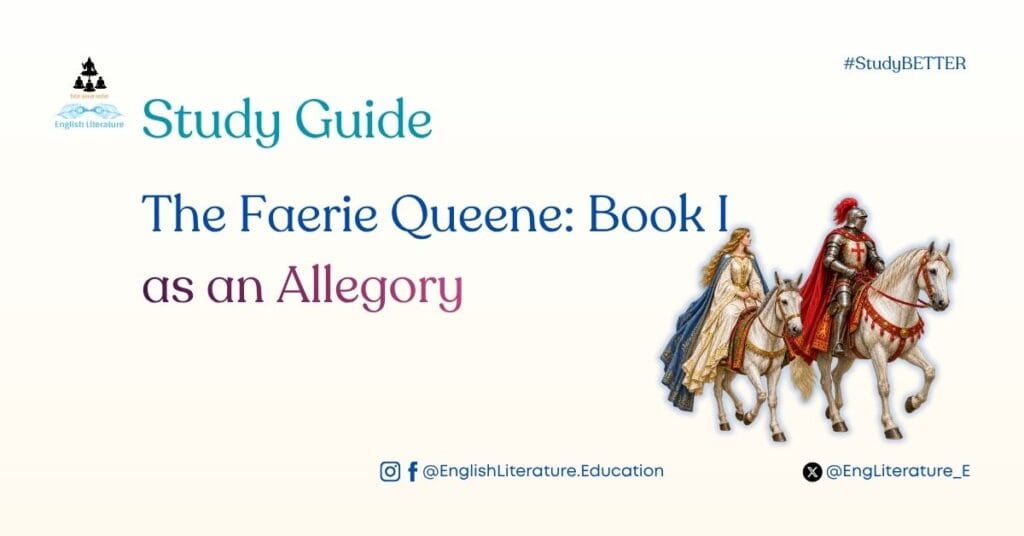
In his letter to Sir Walter Raleigh, Edmund Spenser famously defines The Faerie Queene as a “continued Allegory, or darke conceit” designed “to fashion a gentleman or noble person in vertuous and gentle discipline”. Approaching Book 1 (“The Legend of the Knight of the Red Crosse, or Of Holinesse”) requires recognising that Spenserian allegory does not function as a rigid, static one-to-one cypher. Instead, Spenser constructs a dynamic, multi-tiered narrative architecture in which literal romance adventures continuously intersect with moral, theological, historical, and meta-poetic levels of meaning. In other words, multiple encryptions work simultaneously to ensure the text functions not only as an interesting epic but also as moral, religious, and political propaganda. Since the story is grand, Spenser enjoys an edge in presenting his allegory effectively.
Book 1 presents the Protestant “paradigm of salvation” mapped onto a chivalric quest. Edmund Spenser integrates personification, biblical typology, Tudor politics, and hermeneutic reflection within the quest. Once these elements are clear, we can see why The Faerie Queene: Book 1 stands as a masterpiece of Renaissance allegory.
The Moral and Psychological Level: Psychomachia and Human Frailty
At its fundamental ethical layer, Book 1 operates as a psychomachia, illustrating the internal struggle between virtue and vice within the human soul.
Redcrosse Knight: Rather than a flawless hero, Redcrosse represents the Christian Everyman or the elect believer undergoing spiritual and ethical development. His name Georgos (meaning “man of earth” or ploughman) underscores his earthly frailty and fallen nature before his spiritual transformation.
Una vs. Duessa: The moral opposition between the two primary female figures structures the entire book. Una embodies oneness, singular Truth, and moral integrity. She travels with a milk-white lamb on a humble ass, veiled in black to signify her displaced state in a fallen world. Conversely, Duessa signifies twoness, duplicity, and deceptive surfaces. Clad in opulent scarlet and gold, Duessa seduces Redcrosse not merely through carnal lust, but through intellectual and spiritual deception.
Archimago: Meaning “arch-magician” or “arch-imager”, Archimago personifies Hypocrisy. He manipulates sensory perceptions by summoning false dreams and deceptive spirits from Morpheus to sever Redcrosse from Una.
Allegorical Landscapes and Monsters:
The Monster Errour: Encased in the dark Wandering Wood, Errour is a hybrid serpent-woman whose serpentine folds mirror the digressive, winding nature of spiritual and intellectual error. Her spewing of books, papers, and blind frogs represents heretical propaganda and poisonous doctrine.
The House of Pride vs. The House of Holiness: The House of Pride (Lucifera’s court) is a gaudy, flimsy structure built on sand with paper-thin walls covered in gold foil, symbolising worldly vanity and self-aggrandisement. In contrast, the House of Holiness (governed by Caelia and her daughters Fidelia, Speranza, and Charissa) features a narrow, humble entrance guarded by Humiltà, emphasising spiritual discipline and inner transformation.
Orgoglio and Despaire: Orgoglio (meaning carnality and bloated pride) is born of earth and wind, capturing Redcrosse when he lays aside his spiritual armour. Despaire personifies spiritual melancholy and the loss of faith, using legalistic arguments of unworthiness to drive the guilt-ridden knight toward suicide.
The Theological Level: The Protestant Salvation Drama
To early modern readers, the deepest current of Book 1 was its soteriological allegory, rooted in Reformed theology, Saint Paul’s Epistles, and the Book of Revelation. Spenser signals this theological framework immediately through Redcrosse’s equipment: his shield and armour represent “the armour of a Christian man specified by Saint Paul v. Ephes[ians]” (Ephesians 6:13-17). However, Redcrosse initially relies on his own raw physical courage rather than spiritual understanding, leaving him vulnerable to fall.
The narrative traces the classic Protestant sequence of salvation:
The Fall and Bondage: Deceived by Archimago’s optical tricks, Redcrosse abandons Una (Truth). His self-righteousness leads him to defeat Sansfoy (Faithlessness) and claim Sansfoy’s shield as a proud trophy, bringing him into league with Duessa. Exhausted and disarmed by a fountain, Redcrosse is captured by the giant Orgoglio and cast into a dark dungeon, representing the sinner’s absolute helplessness in the “gulf of perdition”.
Divine Grace (Prince Arthur): Redcrosse cannot rescue himself. Salvation comes only when Una brings Prince Arthur, whose uncovered diamond shield casts heavenly light that blindfolds Orgoglio and shatters his illusion. Arthur functions here as the incarnation of heavenly Grace and Magnificence.
Justification vs. Damnation (Despaire): Although freed from Orgoglio’s dungeon, Redcrosse falls into deep spiritual melancholy. In Canto IX, Despaire rigorously lists Redcrosse’s sins, arguing that divine justice demands his death. Despaire’s trap lies in presenting God’s law without God’s mercy. Just as Redcrosse holds the dagger to his throat, Una snatches the weapon away, reminding him: “Where justice growes, there growes eke greater grace”.
Sanctification (The House of Holiness): In Canto x, Redcrosse undergoes systematic spiritual cleansing. Fidelia instructs him in sacred scripture, Speranza comforts him, and Charissa introduces him to the seven Beadsmen who perform works of mercy. Ascending the hill of Heavenly Contemplation, he receives a vision of the New Jerusalem and learns his true identity as St. George, patron saint of England.
Glorification (The Battle with the Dragon): In Canto xi, Redcrosse fights the great Dragon of Sin for three days in Eden. On the first two days, when beaten back, he is revived by the Well of Life and the Tree of Life, clear sacramental emblems of Baptism and the Eucharist. On the third day, he slays the monster, liberating Una’s royal parents.
The Historical and Political Level: Tudor Ecclesiastical Allegory
Spenserian allegory seamlessly weaves private moral virtue into public national history. In the historical-ecclesiastical dimension of Book 1, Spenser reflects Tudor England’s conflict with Catholic Europe.
Una as the True Reformed Church: Una represents the ancient, uncorrupted Primitive Church, whose parents ruled over East and West before being displaced by the dragon of papal tyranny. Her restoration under Redcrosse shadows Queen Elizabeth I’s re-establishment of the Protestant Church of England.
Duessa as Roman Catholicism: Duessa’s attire (scarlet robes, gold, pearls, and a Persian mitre/triple crown) directly mirrors the Whore of Babylon from Revelation 17, interpreted by Elizabethan Protestants as the Papacy. Her allegiance with the Saracen brothers Sansfoy, Sansloy, and Sansjoy underscores the Protestant equation of Catholicism with spiritual lawlessness and infidelity.
Archimago and Heretical Propaganda: Archimago’s friar robes, bead-counting, and “Aue-Maries” link him to Roman Catholic monasticism and hypocrisy. When the monster Errour vomits books, papers, and frogs, Spenser directly draws on Revelation 16:13 and the contemporary Geneva Bible glosses, which identified frogs issuing from the dragon’s mouth as papal ambassadors and Catholic polemics.
Redcrosse as St. George and England: By revealing Redcrosse as St. George, patron saint of England and patron of the Order of the Garter, Spenser turns his theological quest into an English national epic. England’s national identity is thus defined as intrinsically bound up with defending God’s true faith against antichristian forces.
The Meta-Poetic Level: Allegory as an Hermeneutic Process
Finally, Book 1 functions as an allegory of reading and interpretation. Spenser’s text, its interpretations and scholarly consensus constantly alert readers that understanding allegory requires active cognitive discernment rather than passive reception.
In the very first canto, Redcrosse, Una, and the Dwarf enter the Wood of Errour. While Redcrosse wants to charge impetuously into Errour’s cave, asserting that “vertue giues her selfe light, through darkenesse for to wade”, Una counsels caution. As scholarly commentary points out, both “errour” (from Latin errare, to wander) and “retrate” (from Latin tractum, writing) are terms intimately tied to textuality and interpretation. Redcrosse’s error lies in trusting his fallen physical senses. When Archimago presents him with the ocular “proof” of false Una in bed with a squire, Redcrosse fails because he trusts his eyes without questioning the illusion.
Spenser teaches his readers not to make Redcrosse’s mistake. By alternating diachronic narrative movement (knights riding on quests) with synchronic emblematic tableaux (the House of Pride, the Cave of Despair, the House of Holiness), Spenser, in a way, forces the reader to “read on” and synthesise surface details with deeper spiritual truths. Therefore, the allegory in Book 1 of The Faerie Queene is an active allegory that demands a continued engagement with the text on multiple levels.
Dr Alok Mishra
for English Literature Education