


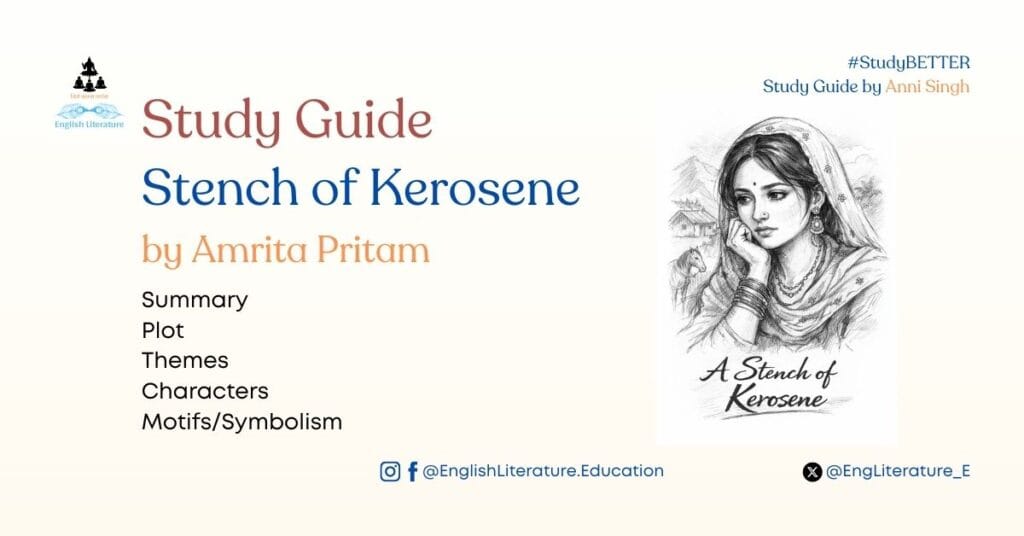
Comprehensive Study Guide
A Stench of Kerosene by Amrita Pritam
Translated from Punjabi by Khushwant Singh
Introduction to the Author and the Story
Amrita Pritam holds a significant place in the reputation of Punjabi writers in Indian Literature. Her fictional compositions depict the emotional, psychological, and moral struggles of women within the deeply rooted Indian patriarchal society. Although a major portion of her writings has made her a renowned author in the canon of partition literature, it is also her post–independence short stories that powerfully portray her artistic creativity as she exposes domestic oppression, gendered injustice, and emotional violence. A Stench of Kerosene is one among her sharp short stories, known for its profound impact, symbolic density, and devastating emotional climax.
The story is set in a rural North Indian milieu, likely in the hill regions around Chamba, and focuses on the marital life of Guleri and Manak. Without dramatic excess or overt moral commentary, the narrative gradually reveals how social customs, silence, and obedience conspire to destroy a woman whose only fault is her inability to produce a child. The story culminates in an unforgettable final image in which personal tragedy becomes a haunting symbol of collective guilt.
Summary of the Story
The story begins with Guleri’s joyful reaction after recognising the mare sent by her parents. She immediately comes out to pet the mare as the arrival of this mare indicates her visit to Chamba, which is a once-in-a-year meetup with her parents, friends and an opportunity to revisit the place where she grew up. Her exciting & childlike behaviour reflects a strong emotional attachment to her maternal home.
Contrary to Guleri’s excitement, her husband, Manak, appears hesitant and upset about her departure. Although he does not forbid her to visit her native place, his continuous insistences suggest that he wants her to stay back this time, as he pleads: “Guleri, do not go away. I ask you again, do not go this time.” Guleri, completely unaware of the fact, believes that Manak is merely being overemotional and thus convinces him that she will not stay for long. Manak accompanies her halfway, and during their walk together, he recalls his courtship days with Guleri – especially the time when he was worried about the bride-price Guleri’s father would ask for. Their mutual and genuine love, and Guleri’s father’s prudence, led to the refusal of the customary bride-price. However, the emotional intimacy of the past stands in painful contrast to the present silence between them. Manak’s flute, once a symbol of love and harmony, now produces an anguished sound, foreshadowing impending tragedy.
After Guleri leaves, the narrative shifts to Manak’s home, where the truth is revealed. His mother, determined to secure an heir, has arranged his second marriage during Guleri’s absence. The inability of Guleri to bear a child even after seven years of wedlock appears to be the reason behind Manak’s second marriage. Manak reluctantly agrees to this decision out of obedience and social pressure, though his emotional life remains empty and paralysed.
Manak continues spending his days not less than a living -dead man until one day he learns from his friend Bhavani that Guleri, upon hearing of the second marriage, set herself on fire by soaking her clothes in kerosene. The story’s climax is not sensationalised and is conveyed with chilling simplicity. The ending intensifies the tragedy when Manak’s second wife gives birth to a baby boy, and Manak’s mother hands him the heirloom, assuming that this joyful event will bring back life to her son as well. Manak reacts with horror upon holding his newborn son, screaming that the child “stinks of kerosene,” depicting that Guleri’s death has permanently withered his conscience and psyche.
Major Themes
Patriarchy and the Politics of Reproduction
The central thematic axis of the story is the oppressive logic of patriarchy, particularly the expectation that a woman’s primary social function is to bear children. Guleri’s seven years of childless marriage place her in a position of silent vulnerability. Although no one openly accuses or abuses her, the decision to arrange Manak’s second marriage is taken without her knowledge or consent. This absence of confrontation is itself a form of violence. The mother’s internal resolution, “I will not let it go beyond the eighth year,” reduces marriage to a reproductive contract and strips Guleri of emotional legitimacy as a wife.
Silence as Emotional Violence
Silence functions as a destructive force throughout the narrative. Manak’s repeated refusal to articulate the truth to Guleri exemplifies how emotional cowardice contributes to tragedy. His constant pleas, “Just this time,” remain unexplained for an extended period, leaving Guleri confused rather than prepared. Similarly, Guleri’s inability to understand Manak’s anguish underscores how silence fractures intimacy. Even after his second marriage, Manak’s silence conveys a loud message to readers about the suffering he endures. The tragedy emerges not from a single act but from accumulated unspoken decisions.
Tradition versus Individual Humanity
The story critiques tradition not through explicit authorial condemnation but through its consequences. Polygamy is socially sanctioned in the absence of children, and Manak’s mother acts within accepted norms. Nevertheless, Amrita Pritam exposes how tradition, when prioritised over empathy, annihilates individual dignity. Manak’s obedience illustrates how social conformity can coexist with moral collapse.
Love, Guilt, and Psychological Disintegration
Manak’s love for Guleri does not protect her; instead, it condemns him to lifelong guilt. After her death, he continues to live mechanically, “like a man dead,” performing social roles without emotional presence. His final breakdown reveals that guilt, once internalised, becomes more corrosive than punishment imposed from outside.
Character Analysis
Guleri
Guleri emerges as one of Amrita Pritam’s most sensitively drawn female characters, marked by emotional warmth, dignity, and a quiet but unmistakable sense of selfhood. From the opening paragraph, her inner life is foregrounded through action rather than exposition. Her immediate recognition of the mare from her parents’ village and the gesture of resting her head against its neck “as if it were the door of her father’s house” is deeply symbolic. This moment establishes her emotional rootedness in her natal home and reveals that, for her, marriage has not erased earlier bonds of affection and belonging. The mare becomes a living extension of her childhood world, suggesting that Guleri’s identity is not confined to her role as a wife.
Her anticipation of the annual harvest visit further reveals her humanity and emotional vitality. The narrative lingers on seemingly small details such as new dresses, dyed and starched dupattas sprinkled with mica, glass bangles, and silver earrings. These details are not ornamental; they underline Guleri’s desire for beauty, celebration, and shared female companionship. Her joy in meeting friends who are similarly married away from Chamba reflects a collective female experience of displacement and reunion, reinforcing the normalcy and legitimacy of her longing.
Crucially, Guleri is not passive or submissive. Her insistence on visiting her parents despite Manak’s vague resistance shows decisiveness. When he pleads, “Just this time,” she challenges him directly and even childishly, demanding reasons rather than yielding unquestioningly. Her teasing during the journey, her playful insistence that Manak play the flute, and her light irony about the “blue-bell wood” that makes people deaf all indicate emotional confidence and agency. Even her farewell is marked by generosity rather than resentment, as she gently urges Manak to return home and rest.
Guleri’s suicide must therefore be understood not as weakness or despair born of dependency, but as the catastrophic result of profound emotional erasure. The discovery of Manak’s second marriage nullifies her existence as a wife and beloved partner. Her act of self-immolation, conveyed with stark simplicity, becomes a tragic assertion of pain in a world that has rendered her voiceless. In this sense, Guleri embodies not fragility but the unbearable cost of betrayal within a rigid social structure.
Manak
Manak is portrayed with exceptional psychological nuance, making him one of the most conflicted male figures in Pritam’s short fiction. He is neither overtly cruel nor morally courageous. His tragedy lies in his paralysis. From the outset, his discomfort is evident in his evasiveness, his silence, and his inability to meet Guleri’s gaze. When she speaks excitedly of the fair and pleads with him to visit Chamba, he responds not with honesty but with withdrawal, smoking his hookah and closing his eyes, as though trying to escape a truth he cannot articulate.
The flute episode is central to understanding Manak’s inner turmoil. The flute, a relic of their courtship and shared past, once symbolised love and harmony. When Manak finally plays it on the road to Chamba, the sound is described as “a strange anguished wail.” This is not music but a cry of pain, externalising emotions he lacks the courage to express verbally. His repeated plea, “Guleri, do not go away,” remains tragically incomplete, as he still withholds the truth that might allow her to choose differently.
Manak’s submission to his mother’s will marks his moral failure. He does not arrange the second marriage out of desire, but he does not resist it either. His compliance reflects the destructive power of social conditioning, where obedience is prioritised over emotional responsibility. After Guleri’s death, his existence becomes mechanical. He eats, works, and moves through life “like a man dead,” signalling the complete collapse of his inner world.
The final scene, in which Manak recoils from his newborn son, screaming that the child “stinks of kerosene,” represents the culmination of his psychological disintegration. The smell is not real but symbolic, a manifestation of guilt that contaminates even the socially sanctioned success of fatherhood. Manak’s survival is thus purely physical; spiritually and emotionally, he is irreparably destroyed.
Manak’s Mother
Manak’s mother functions less as an individual character and more as the embodiment of institutionalised patriarchy. Her actions are governed entirely by custom, lineage, and reproductive anxiety. The chilling resolve, “I will not let it go beyond the eighth year,” reduces Guleri’s life to a mere biological deadline and marriage to a mere contract against an inversely ticking clock. This decision is made unilaterally, without consultation, underscoring the absolute authority she wields within the household.
Her satisfaction at the second wife’s pregnancy further reveals her value system. Emotional compatibility, love, and loss are irrelevant to her; what matters is the continuation of the family line. Significantly, the narrative records no moment of grief or remorse on her part after Guleri’s death. Even the horror of suicide does not disturb her belief in the righteousness of her actions. In this way, she symbolises a social order that perpetuates cruelty not through overt malice, but through unquestioned tradition.
Bhavani
Bhavani plays a subtle yet crucial role as a moral and narrative counterpoint. His presence connects Manak’s past and present, reminding both the protagonist and the reader of a time when love and joy were possible. His reference to the fair seven years earlier, when Manak first met Guleri, intensifies the sense of loss by juxtaposing youthful hope with present devastation.
Bhavani’s flute, protruding from his bundle, visually echoes Manak’s abandoned instrument, reinforcing the contrast between remembered harmony and current silence. His announcement of Guleri’s death is delivered in a flat, understated tone, which paradoxically heightens its emotional impact. By refusing melodrama, Bhavani becomes the bearer of unadorned truth, forcing Manak to confront the irreversible consequences of his inaction.
Through Bhavani, the narrative introduces a witness who neither judges nor consoles, but simply states what has happened. This restraint underscores the story’s moral gravity and amplifies its tragic resonance.
Symbols and Motifs
Kerosene
Kerosene is the story’s most potent symbol. Ordinarily associated with domestic survival, it becomes an instrument of self-annihilation. The “stench” persists beyond death, invading Manak’s consciousness and contaminating even the birth of his son. It symbolises how domestic oppression can turn lethal and how guilt can permanently scar the psyche.
The Flute
The flute symbolises harmony, courtship, and shared memory. Its transformation from an object of love to a source of anguished sound parallels the deterioration of Manak and Guleri’s relationship. After Guleri’s death, the flute effectively disappears from Manak’s life, marking the end of emotional expression.
The Journey and the Road
The descending road to Chamba symbolises Guleri’s movement towards emotional hope, while Manak’s return signifies retreat into moral darkness. The physical separation mirrors the emotional chasm that ultimately becomes irreversible.
The Mare
The mare embodies connection, belonging, and freedom. Guleri resting her head against its neck “as if it were the door of her father’s house” illustrates her yearning for emotional refuge.
Narrative Technique and Style
Amrita Pritam employs an understated realist narrative style marked by emotional restraint. The third-person narration allows balanced insight into both Guleri’s innocence and Manak’s guilt without overt moral commentary. Dialogue is economical but layered with implication. Descriptive passages are sparse yet evocative, allowing symbolism to emerge organically. The shift in narrative focus after Guleri’s departure subtly prepares readers for the story’s tragic turn.
Title and Its Significance
The title A Stench of Kerosene operates on both literal and metaphorical levels. Literally, it refers to Guleri’s method of suicide. Metaphorically, it represents the lingering moral decay produced by patriarchal cruelty. The final line transforms the title into an ethical indictment. The stench is not confined to Guleri’s body but permeates Manak’s conscience and, by extension, the social order that enabled her destruction.
Conclusion
A Stench of Kerosene is a devastating exploration of how ordinary lives are destroyed by extraordinary indifference. Amrita Pritam does not dramatise suffering; she allows it to unfold quietly, making the impact more profound. The story refuses to offer redemption, instead offering a haunting image of unresolved guilt. As a work of short fiction, it exemplifies narrative economy, symbolic precision, and moral urgency.
For students and readers of Indian literature, the story remains deeply relevant, inviting reflection on gender justice, emotional responsibility, and the unseen costs of tradition. Its power lies not in spectacle but in the quiet persistence of its final image, which continues to burn in the reader’s consciousness long after the story ends.
By Anni Singh
(Assistant Professor in the Department of English
Nava Nalanda Mahavihara)
Thanks for reading this study guide! If you have any questions or concerns, please share your thoughts in the comments.