


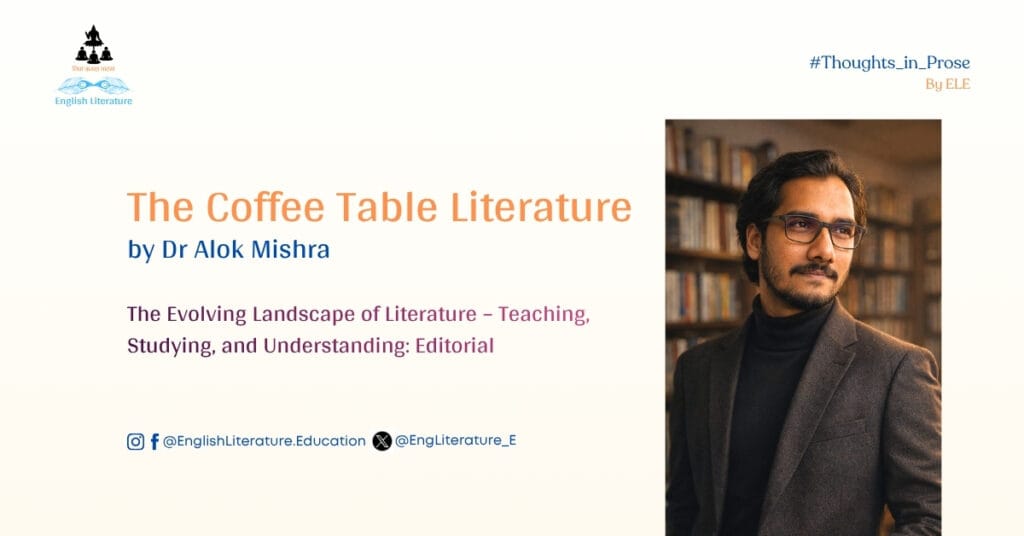
Systematic unfolding, or rather unwinding of literature, or, in even better a phrase, divulging the core secrets of creativity and the art of literature to the new inductees of this world of words, intentions and vision is a task that might appear convenient at the outset; however, executing the same without impediments and many a second thought appearing at the scene of transaction is certainly difficult, if not impossible. As a student, independent instructor and later as a professor of English literature, I have felt this firsthand. I have been on both sides of this table – receiving the secrets and telling them to some. There is a great lacuna, a perception bias, and a problematic space that is created at the exact moment of such literary transactions – are they equipped with the prerequisite?
This question, though simple in its formulation, carries within it layers of pedagogical anxiety that most instructors quietly endure. The classroom, which ideally should function as a shared intellectual space, often turns into an uneven ground where expectations and preparedness fail to meet. The teacher arrives armed with texts, theories, contexts, and a long lineage of interpretations. In contrast, the student, more often than not, arrives with fragmented exposure, partial familiarity, and a vague sense of obligation rather than curiosity. The mismatch is not merely academic; it is experiential. Literature demands receptivity, patience, and a willingness to dwell in ambiguity. These are not qualities that can be assumed as given. They have to be cultivated, nurtured, and sustained.
Over the years, one cannot help but observe a gradual shift in the temperament of students engaging with literature. Thanks to the increasing penetration of technology, the internet, and most recently, AI, the classroom landscape is rapidly evolving. There is an increasing tendency to seek immediacy, clarity, and direct relevance. The slow unfolding of a narrative, the layered complexity of poetic expression, or the philosophical digressions in prose often appear taxing to minds conditioned by the rapid consumption of information. The modern student is not necessarily less intelligent or less capable. The difference lies in the habits of engagement. Attention spans are shorter, patience is thinner, and the desire for instant comprehension often overrides the willingness to struggle with a text. Literature, however, resists such demands. It unfolds in its own time and expects the reader to accompany it with equal commitment.
This creates a peculiar tension in the classroom. The teacher, aware of the richness of the text, attempts to open its layers, while the student, unsure of where to begin, often retreats into passive listening or mechanical note-taking. The act of teaching then risks becoming a performance rather than a dialogue. Concepts are introduced, explained, and elaborated upon, yet their resonance remains uncertain. One begins to wonder whether the transmission is truly taking place or merely being simulated. The problem is not that students are incapable of understanding literature; it is that they are rarely initiated into its rhythms in a manner that aligns with their current cognitive and emotional frameworks.
At this juncture, it becomes imperative to revisit the notion of a prerequisite. Addressing the fundamental question – what does it mean for a student to be prepared for literature? Must one possess an extensive vocabulary, familiarity with canonical texts, or a prior understanding of literary theory? While these certainly aid comprehension, they are not foundational. The true prerequisite is a cultivated sensitivity to language and an openness to experience. A student must learn to listen to words, not merely read them. The cadence of a sentence, the pause within a line of poetry, the silence between two dialogues – these are the entry points into literature. Without this sensitivity, even the most detailed explanations remain external to the learner. The bigger question is, how can students achieve it? Can they do it on their own? Perhaps not!
The responsibility, therefore, shifts significantly onto the teacher. It is not enough to present literature as an object of study; it must be introduced as an experience. The classroom must become a space where literature is encountered rather than explained away. This requires a recalibration of pedagogical methods. Instead of beginning with theoretical frameworks or historical contexts, one might begin with the text itself, allowing students to respond, question, and even misinterpret. These initial responses, though imperfect, serve as bridges between the unfamiliar and the known. Once the student feels a sense of ownership over the text, deeper explorations can follow with greater effectiveness.
Another challenge that persists in the teaching of English literature is the tendency to overwhelm students with obscure concepts at an early stage. Terms such as deconstruction, postcoloniality, intertextuality, and narrative fragmentation, though essential to advanced study, often create barriers when introduced without adequate grounding. The student, instead of engaging with the text, becomes preoccupied with mastering terminology. Literature then appears as a coded discipline, accessible only to those fluent in its jargon. This perception alienates many learners who might otherwise have developed a genuine interest in reading and interpretation.
The solution does not lie in abandoning theory but in sequencing it judiciously. Concepts must emerge organically from the text rather than being imposed upon it. When a student encounters irony in a narrative and recognises its effect, the introduction of the term ‘irony’ becomes meaningful rather than burdensome. Similarly, when a poem evokes multiple interpretations, the idea of ambiguity can be discussed as a lived experience rather than an abstract concept. This method preserves the integrity of literary study while ensuring accessibility.
Equally important is the role of context. Students often struggle with literature because they find it distant from their lived realities. A Victorian novel, an Elizabethan play, or a modernist poem may appear detached from contemporary concerns. It is the teacher’s task to bridge this distance, not by oversimplifying the text but by drawing connections that illuminate its relevance. Themes of love, loss, ambition, conflict, identity, and moral dilemma transcend temporal boundaries. When students recognise these continuities, literature ceases to be an antiquated subject and becomes a mirror reflecting enduring human experiences.
The question of language also demands attention. English literature, particularly in non-native contexts, is often approached through a lens of linguistic inadequacy. Students hesitate to express their thoughts for fear of grammatical errors or limited vocabulary. This hesitation inhibits participation and reinforces passivity. A more encouraging environment, where expression is valued over perfection, can significantly alter this dynamic. Once students begin to articulate their responses, however tentative, their confidence grows, and with it, their engagement with the text deepens.
It is also necessary to acknowledge that teaching literature is not a one-way process. The teacher, too, learns continuously through interaction with students. Their questions, confusions, and unexpected interpretations often reveal dimensions of the text that might otherwise remain unnoticed. This reciprocal relationship transforms the classroom into a collaborative space. The teacher is no longer the sole authority but a facilitator guiding a collective exploration. Such an approach reduces the hierarchical distance that often inhibits genuine dialogue.
Assessment practices further complicate the teaching of literature. Examinations, by their very nature, demand clarity, structure, and precision. While these are valuable skills, they often encourage formulaic responses. Students learn to reproduce standard interpretations rather than develop independent insights. Over time, this pattern reinforces the belief that literature has fixed meanings that must be memorised and reproduced. To counter this, assessments must allow room for interpretation, encouraging students to justify their perspectives rather than conform to predetermined answers.
The broader cultural environment also influences students’ receptivity to literature. In a world increasingly oriented towards utility and measurable outcomes, literature is often perceived as a peripheral discipline. Its value is questioned in terms of employability and practical application. This utilitarian mindset shapes students’ attitudes, leading them to approach literature with reluctance rather than curiosity. Addressing this requires a sustained effort to articulate the relevance of literature beyond immediate gains. Literature refines perception, enhances empathy, and cultivates critical thinking. These are not secondary skills; they are essential to navigating complex human realities.
One must also consider the impact of digital media on reading habits. The shift from long-form reading to fragmented consumption has altered the way students interact with texts. Skimming replaces deep reading, and summaries replace engagement with original works. While technology offers unprecedented access to information, it also demands new strategies for teaching literature. Incorporating digital tools thoughtfully, without compromising the depth of reading, can help bridge this gap. Audio readings, visual adaptations, and interactive discussions can complement traditional methods, making literature more accessible without diluting its complexity.
Ultimately, the challenge of teaching English literature lies not in the subject itself but in the manner of its transmission. Literature, by its very nature, is engaging, provocative, and transformative. The difficulty arises when it is presented in a manner that obscures these qualities. The teacher’s role is to reveal rather than conceal, to invite rather than impose, and to guide rather than dictate. This requires patience, adaptability, and a genuine commitment to the learner’s experience.
If one were to envision an ideal literary classroom, it would not be one where students possess a complete understanding, but one where they are willing to engage, question, and explore. Joy in learning literature does not arise from immediate comprehension but from the gradual realisation that meaning can be pursued, discovered, and even contested. Acceptance follows when students recognise that confusion is not a failure but a stage in understanding.
Before I stop pressing keys on my keyboard, I have one more thought to share. The problem of students becoming unreceptive to literature is not insurmountable. It demands a rethinking of pedagogical practices, a sensitivity to changing learner profiles, and a commitment to making literature accessible without simplifying it beyond recognition. The classroom must evolve from a site of information delivery to a space of intellectual and emotional engagement. When literature is taught with attention to both its aesthetic richness and the learner’s readiness, it regains its place as a subject that not only informs but transforms. Therefore, professors and teachers, please let literature remain literature. Let us not hard-mutate it into science where Hydrogen and Oxygen must mingle to make water. Let literature remain a fertile ground for inquiry, introspection and dialogue!
Dr Alok Mishra
Author, Poet & Literary Critic
Teaching English Literature at Nava Nalanda Mahavihara