


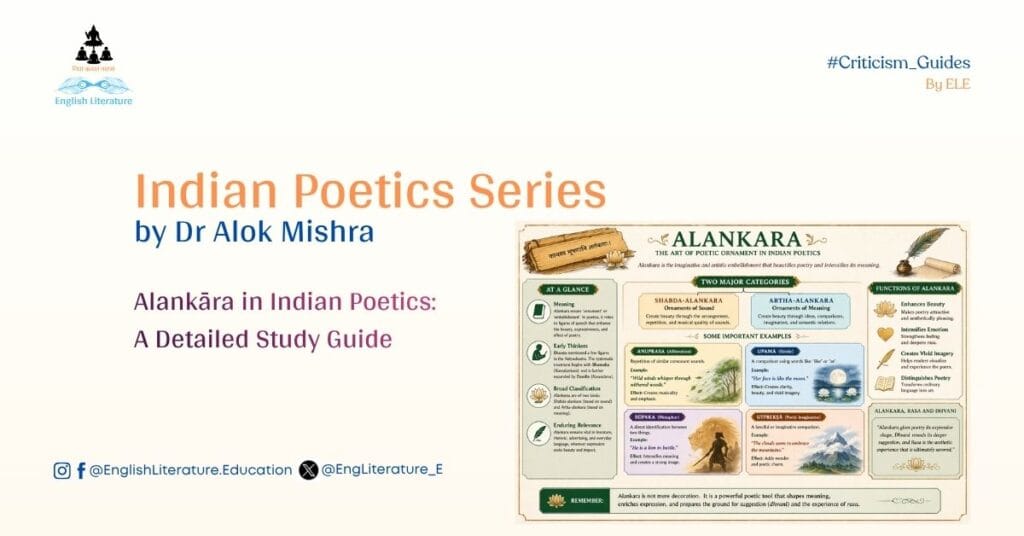
The concept of alankāra occupies a central and formative position in the tradition of Indian poetics. For any beginner entering the field, it serves as one of the most accessible entry points into understanding how Sanskrit literary theory evolved and how poetry was appreciated, analysed, and created. At its simplest, alankāra means “ornament” or “embellishment,” and in the context of literature, it refers to those devices that enhance the beauty, expressiveness, and impact of poetic language.
However, this apparently simple definition opens into a rich and complex intellectual tradition. Alankāra is not merely decorative. It is deeply connected to how meaning is shaped, how emotion is intensified, and how poetry distinguishes itself from ordinary language.
When we attempt to situate alankāra within the broader framework of Indian poetics, particularly in relation to rasa and dhvani, it becomes evident that its role is both foundational and transitional. In the early stages of Sanskrit literary theory, alankāra occupies a position of prominence, offering a systematic way to understand how poetic language distinguishes itself through craft, pattern, and embellishment. It reflects an initial intellectual impulse to locate poetic beauty in the visible and analysable features of expression, in the interplay of śabda and artha. However, as the tradition matures, especially with the emergence of dhvani in Ānandavardhana and its philosophical consolidation in Abhinavagupta, the emphasis gradually shifts from ornamentation to suggestion, and from structure to experience. In this evolving hierarchy, alankāra does not disappear, nor is it dismissed; rather, it is reabsorbed into a more expansive aesthetic vision. It becomes a माध्यम, a conduit or a means through which the deeper currents of meaning and emotion are articulated. Without alankāra, poetry may lose its expressive sharpness, its capacity to shape and nuance language; yet without rasa and dhvani, it risks remaining confined to surface brilliance. Thus, alankāra may be seen as the visible architecture of poetry, while dhvani is its resonance and rasa its lived experience. Together, they form a continuum rather than a hierarchy of exclusion, where each element participates in the unfolding of aesthetic meaning. In this sense, alankāra is not merely an ornamental addition but an essential preparatory ground, enabling poetry to move from articulation to suggestion, and from suggestion to aesthetic realisation.
1. What is Alankāra? Understanding the Core Idea
The word alankāra comes from the Sanskrit root alam, meaning “to adorn” or “to make sufficient.” In literary terms, it refers to figures of speech that beautify language and make it aesthetically appealing.
A useful way to understand this is through a traditional analogy often used by classical theorists. Just as ornaments such as jewellery enhance the beauty of a person, alankāras enhance the beauty of poetry. Without ornaments, a person may still exist, but their appearance may lack charm. Similarly, without alankāra, poetry may still convey meaning, but it may not achieve aesthetic excellence.
At the same time, later critics remind us that alankāra is not just superficial decoration. It plays an important role in bridging literal meaning and deeper emotional or imaginative experience, thereby contributing to the overall poetic effect.
2. Historical Development of Alankāra Theory
The theory of alankāra is one of the earliest systematic approaches in Indian poetics. In fact, many scholars consider it the starting point of Sanskrit literary theory.
Bharata and the Early Stage
The earliest references to alankāra can be traced to Bharata’s Nāṭyaśāstra, where a few figures such as upamā (simile), rūpaka (metaphor), dīpaka, and yamaka are mentioned.
At this stage, alankāra is not yet a full-fledged theory but an important component of dramatic and poetic expression.
Bhāmaha and the Alankāra School
The first major systematic treatment comes with Bhāmaha (7th century), whose work Kāvyālaṅkāra gives the theory its name. Bhāmaha places great emphasis on figures of speech and considers them essential to poetic beauty.
For him, poetry is primarily composed of śabda (word) and artha (meaning), and alankāra enhances their expressive power.
Daṇḍin and Expansion
Daṇḍin, another major theorist, expands the scope of alankāra in his Kāvyādarśa. He identifies numerous figures and argues that poetic beauty arises from their effective use.
Both Bhāmaha and Daṇḍin agree that figurative expression is central to poetry, even though they differ in classification and emphasis.
3. Types of Alankāra
Alankāras are broadly classified into two major categories:
1. Śabda-alankāra (Sound-based figures)
These focus on the phonetic and auditory beauty of language.
2. Artha-alankāra (Meaning-based figures)
These focus on the conceptual and semantic richness of poetry.
This classification highlights an important insight of Indian poetics. Poetry is not only about what is said but also about how it sounds and how it is structured.
Śabda-Alankāra: The Beauty of Sound
Śabda-alankāras create aesthetic pleasure through sound patterns such as repetition, rhythm, and musicality.
Example 1: Anuprāsa (Alliteration)
This involves repetition of consonant sounds.
Example:
“Wild winds whisper softly”
The repetition of the “w” sound creates a musical effect.
Example 2: Yamaka (Repetition)
This involves repetition of the same word or sound with different meanings.
Example (Sanskrit style):
A word repeated in the same form but conveying different senses.
These devices make poetry pleasing to the ear, enhancing its memorability and emotional resonance.
Artha-Alankāra: The Beauty of Meaning
Artha-alankāras operate at the level of meaning and imagination. They are often more intellectually engaging.
Example 1: Upamā (Simile)
A comparison using words like “like” or “as.”
Example:
“Her face shines like the moon.”
This creates clarity and vivid imagery.
Example 2: Rūpaka (Metaphor)
A direct identification between two things.
Example:
“He is a lion in battle.”
The comparison is implicit and stronger than a simile.
Example 3: Utprekṣā (Imaginative Comparison)
A hypothetical or imaginative suggestion.
Example:
“The clouds seem to embrace the mountains.”
This adds a poetic, almost dream-like quality.
Example 4: Atiśayokti (Hyperbole)
Exaggeration for effect.
Example:
“I have told you a thousand times.”
This intensifies emotional expression.
4. Function of Alankāra in Poetry
Alankāra serves several important functions:
- Enhancing Beauty: It makes language more attractive and aesthetically pleasing.
- Intensifying Emotion: It strengthens emotional expression and contributes to rasa.
- Creating Imagery: It helps readers visualise scenes and ideas more vividly.
- Distinguishing Poetry from Prose: Ordinary language becomes poetic through alankāra.
In this sense, alankāra transforms simple statements into artistic expressions.
5. Alankāra and Rasa: A Crucial Relationship
Although early theorists focused heavily on alankāra, later critics like Ānandavardhana and Abhinavagupta shifted attention toward rasa and dhvani.
However, alankāra did not lose its importance. Instead, it was reinterpreted as:
A supporting element
A means to enhance rasa
As later theorists suggest, alankāra contributes to the intensity and clarity of aesthetic experience, even if it is not the ultimate goal.
6. Criticism of the Alankāra School
While the alankāra school made foundational contributions, it also faced criticism.
Main Criticism: Overemphasis on Form
Critics argued that focusing too much on figures of speech neglects:
- Emotional depth
- Suggestion
- Aesthetic experience
Later schools, especially the Dhvani school, argued that:
- Alankāra is secondary
- The real essence of poetry lies in suggestion and rasa
Despite this, alankāra remains indispensable as a tool of poetic expression.
7. Alankāra in Practice: A Simple Illustration
Let us compare two sentences:
Ordinary sentence:
“The king is brave.”
With alankāra:
“The king is a lion on the battlefield.”
The second sentence:
- Uses metaphor (rūpaka)
- Creates imagery
- Intensifies meaning
This simple example shows how alankāra elevates language from informative to evocative.
8. Relevance of Alankāra Today
Even today, alankāra remains highly relevant:
In poetry and literature
In speeches and rhetoric
In advertising and media
Whenever language is made more powerful, expressive, or memorable, alankāra is at work.
Conclusion: Things at a Glance
The concept of alankāra represents one of the earliest and most influential attempts to understand the nature of poetic beauty in Indian poetics. While it begins as a theory of ornamentation, it gradually reveals a deeper insight into how language can be shaped to evoke pleasure, emotion, and imagination.
Although later theories, such as dhvani and rasa, shift the focus toward experience and suggestion, alankāra continues to play a vital role. It provides the tools through which poetry becomes expressive and aesthetically rich. In this sense, alankāra is not merely decoration. It is a creative force that transforms language into art.
For a student of Indian poetics, understanding alankāra is essential, not only because of its historical importance but also because it helps one appreciate how poetry works at both the level of sound and meaning. It shows that beauty in literature is not accidental. It is carefully crafted through the thoughtful use of language, imagination, and expression.
Dr Alok Mishra
Professor of English Literature
(Nava Nalanda Mahavihara, Nalanda)
..