The short story, as a literary form, occupies a distinctive position within the broader landscape of narrative traditions. It demands precision, economy of language, and a finely balanced structure that can deliver thematic depth within a limited space. Since its modern emergence in the nineteenth century through writers such as Edgar Allan Poe, Nathaniel Hawthorne, and Anton Chekhov, the short story has evolved into a refined artistic expression capable of presenting complex human experiences with clarity and emotional intensity. For beginners in English literature, understanding the fundamental elements of short fiction is essential for literary analysis. For advanced learners, a deeper exploration of these elements encourages an appreciation of the artistry and interpretive possibilities embedded in this narrative form. The following discussion presents a detailed and comprehensive account of the significant aspects that shape a short story.
(Please note that these elements are listed irrespective of any supposed order or importance.)
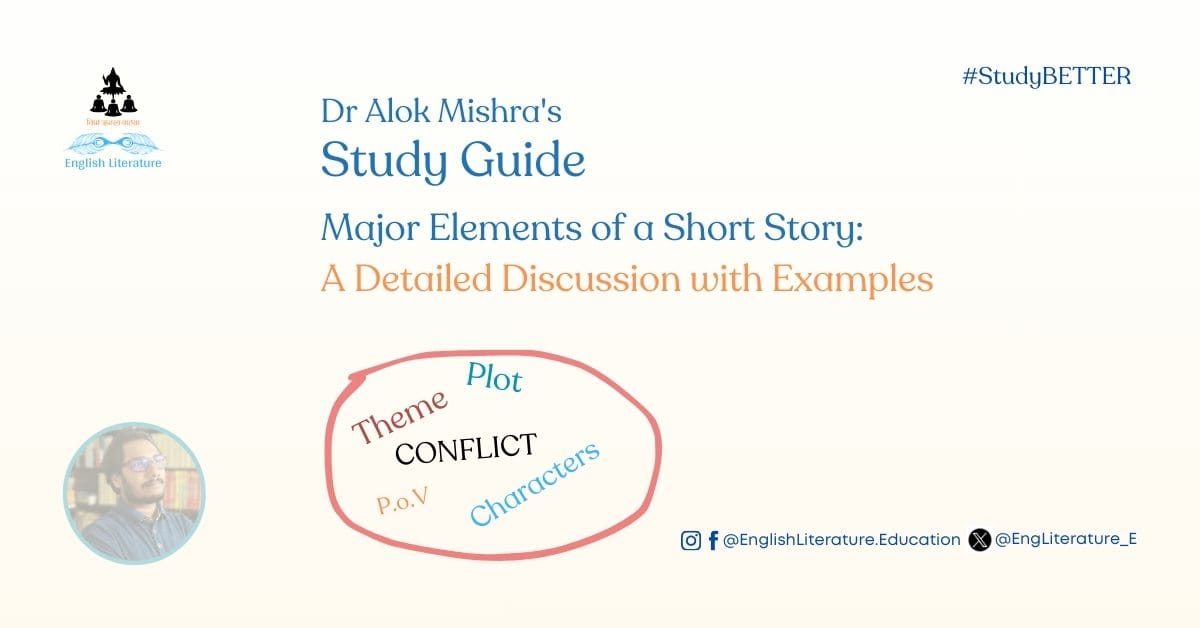
Plot
Plot refers to the organised sequence of events that structure the story. It is not merely the chronological arrangement of happenings but the pattern through which narrative logic, causality, and tension are shaped. A well-designed plot guides the reader through a progression of actions that culminate in a significant outcome.
Many short stories employ a linear plot structure that moves smoothly from exposition to rising action, climax, falling action, and resolution. Edgar Allan Poe’s “The Tell-Tale Heart” provides a classic example of this pattern. The narrator describes his initial obsession with the old man’s eye, the growing tension of his nightly spying, the violent climax of the murder, and the subsequent unravelling of the narrator’s sanity as he hears the imagined beating of the dead man’s heart. The compactness of the plot creates an intense psychological effect, a quality Poe famously advocated in his theory of the single emotional impression.
Some stories depart from linearity to experiment with fractured time or circular patterns. Jhumpa Lahiri’s “A Temporary Matter” uses a gradual revelation of both past and present to highlight the emotional distance between a couple after the death of their infant. The plot unfolds through five evenings of power outages, each night bringing partial disclosures that build towards the painful climax. This structural technique demonstrates how plot can serve both narrative movement and thematic resonance.
A strong plot, particularly in short fiction, depends on the careful selection of moments that reveal character and heighten the central conflict. Since the form offers no space for digressions, the plot must be purposeful, cohesive, and aligned with the story’s thematic goals.
Setting
Setting refers to the temporal and spatial environment in which the narrative unfolds. It encompasses not only the physical location but also social, historical, and cultural contexts that influence character behaviour and thematic development. In short fiction, the setting often functions with remarkable density and symbolic value because every descriptive element must justify its presence.
In Kate Chopin’s “The Story of an Hour,” the domestic interior in which Mrs Mallard receives news of her husband’s death becomes a symbolic space that mirrors her internal awakening. The open window, the vibrant spring scene outside, and the quiet room together create a powerful contrast between confinement and a sudden expansion of emotional possibility. The setting plays an active role in the story’s meaning, guiding the reader to an understanding of Mrs Mallard’s transformation.
Conversely, the setting in Shirley Jackson’s “The Lottery” illustrates how a seemingly ordinary village can harbour unsettling rituals. The clear summer morning, the familiarity of the townspeople, and the tranquil atmosphere heighten the impact of the violent conclusion. The setting functions as a tool of irony, challenging assumptions about safety and communal traditions.
For advanced learners, it is essential to recognise that setting can operate symbolically, psychologically, and politically. It can reflect social hierarchies, expose cultural tensions, and shape the narrative’s emotional climate. In short stories, setting is rarely neutral. It often shapes the reader’s interpretive path.
Characters
Characters provide the narrative’s human dimension. They may be fully developed individuals with complex motivations or more limited figures designed to serve a particular narrative purpose. Short stories frequently concentrate on one or two central characters to maintain focus and intensity. These two may typically be the protagonist and antagonist – the two pillars that help the narrative remain coherent until the plot reaches its resolution and subsequent conclusion.
Round characters exhibit psychological depth, internal conflict, and the capacity for change. In James Joyce’s “Eveline,” the protagonist is portrayed as a young woman torn between her familial duties and the desire for personal freedom. Joyce develops her character through interior monologue, memory, and sensory detail, revealing her emotional paralysis. Although the story is brief, the characterisation demonstrates profound insight into human indecision and the weight of social expectations.
Flat characters, by contrast, may have limited development but contribute to the overall structure or theme. In Saki’s “The Open Window,” the self-possessed Vera catalyses the story’s humour and irony through her imaginative fabrications. While she does not transform, her presence is essential for the narrative’s clever twist.
Dynamic and static distinctions are also important—a dynamic character changes, whereas a static character remains stable throughout. The choice between these modes depends on the story’s thematic aims. In short fiction, change may be subtle yet significant, often occurring through a moment of insight that shapes the outcome.
Point of View
Point of view governs the angle from which the story is told, shaping the reader’s access to information and emotional intimacy. Choosing the appropriate perspective is crucial because it determines the narrative’s authority, reliability, and interpretive possibilities.
First-person narration offers direct insight into the narrator’s thoughts and emotions. However, it may also introduce reliability issues. In Poe’s “The Cask of Amontillado,” Montresor’s first-person perspective allows the reader to witness his calculated revenge. Yet, it also raises questions about his mental state and the accuracy of his account. The power of the story lies in the tension between what Montresor believes and what the reader suspects.
Third-person limited narration focuses on the experiences of a single character while maintaining an external perspective. Jhumpa Lahiri often employs this mode to evoke emotional intimacy without collapsing entirely into subjective narration. In “Interpreter of Maladies,” the story follows Mr Kapasi’s reflections and misunderstandings, revealing the cultural and emotional gaps between him and Mrs Das.
Third-person omniscient narration provides a broader perspective, although it is less common in short fiction because of the form’s inherent need for focus. Still, some writers use it effectively to explore multiple viewpoints within a brief space.
Conflict
Conflict provides the central tension that drives the plot. It may arise between characters, between a character and society, between a character and nature, or within the character’s own mind. This tension is the engine of the narrative and shapes the development of both plot and theme.
Man versus self conflicts are particularly suited to short stories because they can be explored with subtlety and emotional concentration. In Ambrose Bierce’s “An Occurrence at Owl Creek Bridge,” the protagonist’s psychological struggle during the final moments of his life produces a powerful blend of illusion and reality. The internal conflict magnifies the story’s emotional force.
Man versus society conflicts appear in stories that critique norms or highlight social pressures. In Saadat Hasan Manto’s “Toba Tek Singh,” the partition of India becomes the backdrop for a tragicomic depiction of individuals caught in political upheaval. The conflict arises not through physical action but through the absurdity of bureaucratic decisions that fail to recognise human identity.
Man versus nature conflicts often foreground survival or vulnerability. Jack London’s “To Build a Fire” provides an iconic representation of this tension. The protagonist’s battle against the harsh environment illustrates human arrogance, vulnerability, and the unforgiving power of nature.
Conflict determines the narrative’s momentum and emotional texture. It provides urgency and directs the reader toward the thematic core.
Theme
Theme refers to the deeper ideas explored in the narrative. A theme is not a moral instruction but a conceptual insight that emerges from the interaction of plot, character, setting, and conflict. Themes in short stories often centre on universal human experiences, such as love, fear, alienation, identity, and mortality.
For example, O Henry’s “The Gift of the Magi” explores themes of sacrifice and love. The narrative presents a simple plot and ordinary characters, yet it reveals profound insight into human generosity and the paradoxical nature of giving. The story’s emotional impact arises from the thematic interplay between selflessness and value.
In contrast, Franz Kafka’s “The Hunger Artist” explores themes of alienation and artistic suffering. The protagonist’s isolation and obsession highlight tensions between individual desire and social incomprehension. The theme emerges gradually as the narrative reveals the complexities of creative identity.
Themes may be presented implicitly, leaving space for readers’ interpretation. Advanced learners should note that themes often work through patterns, symbols, and recurring motifs, rather than through explicit statements.
Symbolism and Imagery
Symbolism and imagery enrich the narrative by associating physical objects, settings, or actions with broader conceptual meanings. Short stories rely heavily on these devices because they allow writers to convey complex ideas within limited space.
For instance, the black box in Shirley Jackson’s “The Lottery” symbolises blind adherence to tradition. Its shabby condition and the villagers’ reluctance to replace it reveal the tension between custom and conscience. The symbol enhances the story’s critique of normative violence.
Similarly, in Ernest Hemingway’s “Hills Like White Elephants,” the landscape itself symbolises the emotional distance between the characters. The barren hills and contrasting fertile valley hint at the underlying conflict regarding the woman’s possible pregnancy. Hemingway’s use of imagery reinforces the unspoken tension between choice and consequence.
Symbolism must be interpreted within the larger context of the story. A symbol does not stand apart from the narrative. It acquires meaning through repeated associations and thematic relevance.
Tone and Style
Tone refers to the author’s attitude towards the subject, while style encompasses the linguistic choices that shape the narrative voice. Together, they influence how readers engage with the story on both emotional and intellectual levels.
Raymond Carver’s minimalist style, for example, creates a tone of quiet contemplation and understated realism. In “Cathedral,” the simplicity of language reflects the protagonist’s limited understanding of human connection, and the shift in tone mirrors his gradual emotional awakening.
By contrast, the tone in Hawthorne’s “Young Goodman Brown” is dark, moralistic, and allegorical. The elaborate prose style and solemn atmosphere contribute to the story’s exploration of sin, guilt, and doubt.
Tone and style not only reflect authorial preference but also serve the story’s thematic and emotional goals. For advanced learners, analysing diction, rhythm, narrative pace, and figurative language is essential for understanding how writers construct meaning beyond the literal level.
Structure and Compression
Short stories often depend on structural discipline and narrative compression. The limited length requires a careful balance among exposition and action, description and dialogue, and what is revealed and what remains unsaid. This economy of expression is often described as the defining craft of short fiction.
The opening of a short story frequently performs multiple tasks at once. It introduces the setting, hints at character, and establishes the central conflict. In Gabriel García Márquez’s “A Very Old Man with Enormous Wings,” the opening paragraph presents the unusual figure of the fallen angel and the mundane domestic setting, setting the stage for a narrative that blends the ordinary with the fantastical.
Compression does not mean oversimplification. Instead, it involves the careful distillation of narrative elements so that every sentence contributes to the overall effect. Chekhov famously advised writers to remove anything that does not serve the story’s purpose. His own stories demonstrate this principle. In “The Lady with the Dog,” each interaction between the characters advances the subtle development of their emotional entanglement.
Understanding structural economy helps readers appreciate the craftsmanship that distinguishes short fiction as an art form.
Dialogue
Dialogue provides insight into character psychology and social dynamics. It also advances the plot and builds tension. In short stories, dialogue often carries significant weight because it can reveal conflicts and relationships with immediate clarity.
In Flannery O’Connor’s “Good Country People,” the conversations between Hulga and Manley Pointer expose the clash between intellectual pride and deceptive innocence. The dialogue, precisely crafted, reveals the power imbalance that leads to the story’s unsettling conclusion.
Dialogue must be purposeful, concise, and authentic. It creates rhythm and supports thematic development. For learners, analysing dialogue involves examining both what is said and what is implied through silence, hesitation, or fragmented speech.
Conclusion
The short story, although brief, is a richly layered literary form that demands close attention to its structural and thematic elements. Plot, setting, character, point of view, conflict, and theme form the narrative foundation, while symbolism, tone, style, dialogue, and structure deepen the interpretive possibilities. For beginners, understanding these elements provides a framework for engaging with short fiction. For advanced learners, each element offers a pathway to more nuanced analysis that considers cultural, psychological, and philosophical dimensions.
Short stories remain an enduring mode of literary expression precisely because they can distil human experiences into concentrated moments of clarity. They invite readers to examine the complexity of life through brief yet powerful encounters with narrative art. A careful study of their elements not only enhances literary interpretation but also fosters a deeper appreciation for the craft and imagination that define this vital genre.
Dr Alok Mishra for the English Literature Education platform
You may share your comments, suggestions, queries, or anything else in the comments section. I will try to get back to as many as possible, ASAP.
Thanks for reading!
__