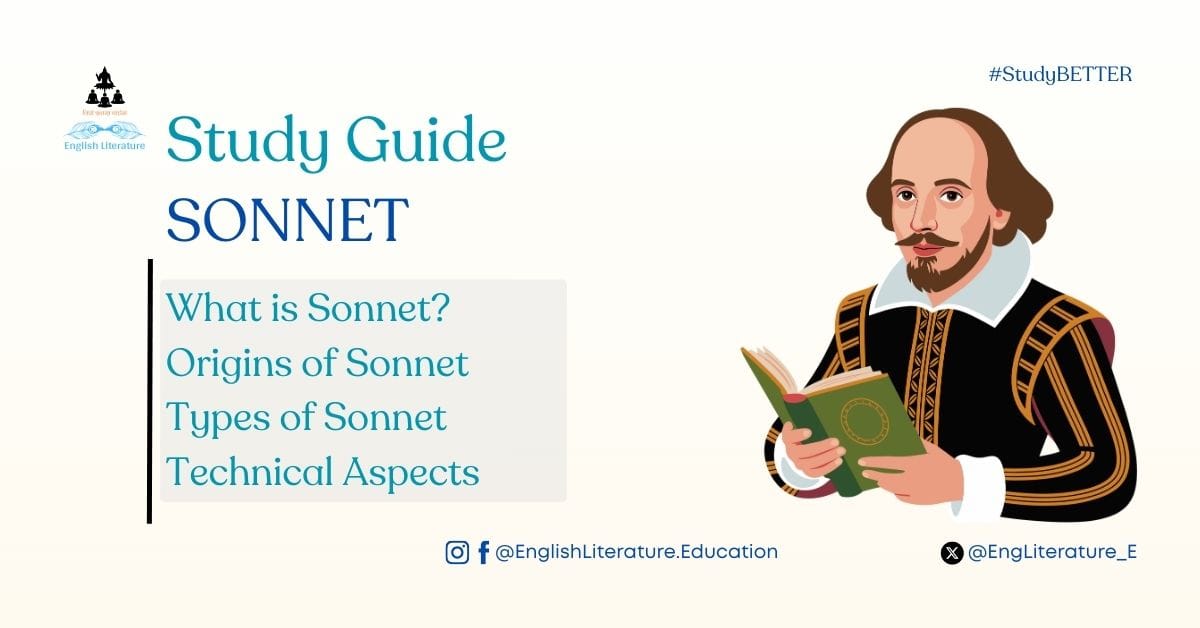
The sonnet is one of the most enduring poetic forms in world literature. Its history spans more than seven centuries, and its influence extends across linguistic, cultural, and artistic boundaries. For students and scholars of English literature, the sonnet offers a rich field of inquiry because it combines structural discipline with expressive openness. Within its fourteen lines, the sonnet demonstrates how poetic limitation can generate remarkable creative freedom. It has been adapted, modified, contested, and revitalised by poets from the Renaissance to the present day. This comprehensive study aims to introduce beginners to the essentials of the form while offering advanced learners a deeper critical exploration of its variations and ongoing relevance.
Origins and Early Development of the Sonnet
The sonnet originated in medieval Italy and is most decisively attributed to Giacomo da Lentini, a poet associated with the Sicilian School in the thirteenth century. Although this early lineage is intellectually significant, the form gained wider recognition and refinement through the works of Francesco Petrarca (Petrarch). His Canzoniere, a collection devoted largely to his idealised love for Laura, established the sonnet as a dominant mode of Italian lyric expression. The Petrarchan sonnet became a vehicle for introspection, emotional conflict, and philosophical reflection. Its themes often revolved around unfulfilled desire, the tension between earthly love and spiritual aspiration, and the transience of beauty.
The structure of the Petrarchan sonnet contributed to its expressive power. The bipartite organisation into an octave and a sestet allowed poets to explore a problem, question, or emotional dilemma in the opening stanza, followed by a reflective turn in the sestet that offered either a resolution or a redefinition of the thematic focus. The division between the two parts created space for a shift in perspective known as the volta. This conceptual hinge became the hallmark of the sonnet form and continues to shape its evolution.
The sonnet travelled from Italy to France and then to England, where it flourished remarkably during the sixteenth century. Sir Thomas Wyatt and Henry Howard, Earl of Surrey, were instrumental in adapting the Italian structure to English. Their efforts led to the creation of a distinct English version that maintained the thematic integrity of the Petrarchan tradition while accommodating the rhythmic patterns of English speech.
There are two major types of sonnets popular in English literature – Petrarchan Sonnet and Shakespearean Sonnet.
The Petrarchan Sonnet
The Petrarchan sonnet remains one of the most widely studied forms because of its elegant structure and enduring influence. Its fourteen lines are arranged as an octave, typically following an abbaabba rhyme scheme, and a sestet, which may vary with cdecde or cdcdcd patterns. The unity of thought within the octave and the reflective shift in the sestet create a dynamic relationship between tension and resolution.
For beginners, understanding the structural relation between the two stanzas is crucial. The octave establishes an emotional or intellectual condition, often depicting conflict or contemplation. The sestet does not merely answer the octave but deepens the reflection by expanding, complicating, or reframing the subject.
Petrarch’s Sonnet 90, for example, presents Laura as a figure of radiant beauty whose image continues to haunt the poet long after the intensity of his passion has faded. The octave describes Laura’s appearance, while the sestet shifts to a more reflective tone in which the poet acknowledges the enduring memory that surpasses the original emotional wound. The interplay between idealisation and personal reflection exemplifies the Petrarchan method.
The Petrarchan sonnet entered English literature through Wyatt and Surrey, and it became a favoured form for poets such as Sir Philip Sidney, Edmund Spenser, and later, John Milton. Sidney’s Astrophil and Stella demonstrates the form’s adaptability to English expressive rhythms. Milton’s sonnets illustrate a further development, shifting the Petrarchan model toward moral and political concerns. His sonnet “On His Blindness” exemplifies the meditative quality of the form, with the octave expressing frustration and doubt, and the sestet offering a theological reinterpretation of labour and service.
The Shakespearean Sonnet
The evolution of the sonnet in England led to the emergence of a distinct structure now known as the Shakespearean sonnet. The English rhyme scheme, ababcdcdefefgg, reflects the phonetic and lexical properties of the English language, which provide fewer rhyming opportunities than Italian. The need for a flexible and sustainable rhyme structure encouraged the development of the three-quatrain and final-couplet model.
The Shakespearean form offers several interpretive advantages. The three quatrains allow poets to develop themes in progressive stages, while the closing couplet provides a conclusive or surprising insight. The couplet often functions as an epigrammatic statement that intensifies the thematic direction of the poem.
William Shakespeare’s sonnet sequence demonstrates the expressive richness of this form. Sonnet 18, for instance, follows a logical and emotional progression through the quatrains, comparing the beloved to a summer’s day, analysing the shortcomings of earthly beauty, and asserting the permanence of poetic preservation. The final couplet elevates the poem’s subject by claiming immortality through verse. The couplet not only summarises the theme but also reshapes the poem by placing creative power at its centre.
Other sonnets in the sequence illustrate how the Shakespearean structure lends itself to argumentation, irony, and emotional complexity. Sonnet 130 reverses conventional Petrarchan ideals by presenting the speaker’s mistress in realistic terms rather than idealised beauty. The quatrains dismantle romantic hyperbole, and the couplet reaffirms authentic affection. The Shakespearean sonnet, therefore, demonstrates how form can support thematic innovation.
The Spenserian Sonnet (another type which Edmund Spenser used)
The Spenserian sonnet, derived from Edmund Spenser’s work, constitutes a third significant variation within the English tradition. Its interlocking rhyme scheme, abab bcbc cdcd ee, creates continuity between stanzas and emphasises thematic linkage. The structure encourages a flowing progression of thought because each quatrain is connected to the next through shared rhymes.
Spenser’s Amoretti sequence exemplifies this form. Unlike the melancholic tone familiar in Petrarchan tradition, Amoretti presents a more optimistic view of love, celebrating courtship and eventual union. The interwoven rhyme scheme supports this thematic unity by creating a sense of sustained continuity. The closing couplet often provides a reflective moment that affirms the poem’s emotional and philosophical stance.
For learners, the Spenserian sonnet demonstrates how innovation in rhyme can shape a poem’s emotional rhythm. The overlapping rhymes encourage fluidity, in contrast to the more segmented structure of the Shakespearean form.
Technical Aspects of a Sonnet
The Volta and Its Interpretive Significance
Across all primary sonnet forms, the volta occupies a central position. It may appear between the octave and sestet in the Petrarchan model or between the final quatrain and the couplet in the Shakespearean model. The volta introduces a shift in tone, perspective, argument, or emotional intensity. Its placement indicates thematic emphasis.
In Shakespeare’s Sonnet 29, the volta appears at the beginning of the third quatrain. The poet moves from despair to a transformative recollection of love that renews his sense of worth. The structural position of this turn demonstrates the poet’s control over emotional dynamics. In Milton’s “On His Blindness,” the volta marks the moment when the speaker transitions from self-questioning to a theological insight into divine service. The volta, therefore, functions as a moment of revelation, whether intellectual, emotional, or spiritual.
Advanced learners should study how subtle or overt the volta may be. A poet may signal the turn through transitional expressions or through shifts in imagery, rhythm, or tone. Understanding the volta helps readers grasp the deeper architecture of the sonnet.
Variations and Experiments in the Sonnet Tradition
Although the sonnet is known for its structural discipline, poets have continuously experimented with its boundaries. Such experimentation keeps the form vibrant and adaptable.
One significant variation is the Miltonic sonnet, which expands the Petrarchan model by reducing the pause between octave and sestet. Milton’s enjambed lines create a feeling of continuous movement, reflecting his preference for meditative unity over rhetorical segmentation. Modern poets often draw inspiration from this approach to produce more fluid sonnets.
Gerard Manley Hopkins introduced the curtal sonnet, a shortened form that compresses the sonnet into ten and a half lines. His poem “Pied Beauty” exemplifies the compressed intensity of this style. The curtal sonnet illustrates how poetic innovation can arise from altering even the length of the traditional form while maintaining thematic resonance.
Contemporary poets have also experimented with metrical modifications. The traditional iambic pentameter remains dominant in English sonnets, but many poets vary the meter to reflect natural speech or experimental rhythms. These variations demonstrate that the sonnet is not a static form but a flexible framework capable of new expression.
The Sonnet Across Cultures and Languages
While the sonnet has European origins, its adoption into diverse linguistic traditions reveals its global versatility. English poets adapted the form to new phonetic environments. German, French, Spanish, and Portuguese poets infused it with their own literary sensibilities. In India, poets writing in English, such as Aurobindo Ghose, have used the sonnet to express philosophical and cultural themes. Aurobindo’s sonnets often explore spiritual introspection and nationalist sentiment, demonstrating the adaptability of the form to non-European contexts.
In African and Caribbean literatures, the sonnet has been used to challenge colonial narratives or to articulate identity and resistance. Claude McKay’s “If We Must Die,” for example, demonstrates how the Shakespearean sonnet can support political urgency. McKay retains the form’s structural precision while infusing it with defiant resolve in response to racial violence. The poem’s disciplined structure and rhetorical energy demonstrate how traditional forms can convey modern struggles.
These cross-cultural innovations reveal that the sonnet is not limited to romantic or introspective themes. It can express political dissent, philosophical reflection, cultural identity, and spiritual contemplation.
The Sonnet in the Modern and Contemporary Literary Landscape
The twentieth century witnessed significant transformations in poetic practices, including the rise of free verse and the decline of traditional metrical forms. In this context, one might expect the sonnet to diminish in relevance. However, the opposite is true. The sonnet has remained an active and widely explored form in contemporary poetry.
Poets such as W. H. Auden, Robert Lowell, Seamus Heaney, Elizabeth Bishop, and Eavan Boland have employed the sonnet to navigate modern experience. They have explored themes ranging from psychological trauma and historical memory to personal identity and social change. Boland’s poems, for example, critique patriarchal structures while exploring motherhood, national identity, and the complexities of female subjectivity. Her work demonstrates how the sonnet can become a vehicle for feminist expression.
Many modern poets have also adapted the form to everyday language, employing conversational tones rather than elevated diction. This linguistic shift reflects broader trends in contemporary poetry and proves that the sonnet can accommodate informal speech without losing structural coherence.
In today’s digital age, the sonnet continues to find new audiences. Online poetry communities often challenge writers to compose sonnets as creative exercises, thereby demonstrating the form’s accessibility and enduring appeal. The sonnet’s brevity and recognisable structure make it particularly suitable for contemporary reading habits that favour concise yet meaningful expressions.
Why the Sonnet Endures
The enduring appeal of the sonnet can be attributed to several qualities. First, the structural discipline provides a framework within which creativity can flourish. Poets often find that constraints encourage innovation. The fourteen-line limit requires economy of language, while the rhyme scheme and meter impose a rhythmic order that supports expressive depth.
Second, the sonnet’s bipartite or tripartite pattern encourages argumentation. A sonnet often presents a proposition, explores its implications, and arrives at a reflective or conclusive insight. This logical progression aligns the form with philosophical reasoning, emotional introspection, and ethical reflection.
Third, the sonnet’s capacity for transformation ensures its relevance. It can express romantic longing, political outrage, spiritual contemplation, or modern fragmentation. Its adaptability across cultures, themes, and historical contexts provides continuous opportunities for renewal.
Finally, the sonnet remains a symbol of poetic craftsmanship. Mastery of the form requires attention to meter, rhyme, diction, and imagery. For learners, the sonnet provides an excellent foundation for understanding poetic technique. For advanced readers, it offers a field for nuanced interpretation and appreciation of artistic refinement.
The Present State of the Sonnet: Challenges and Opportunities
Diverse poetic forms, hybrid genres, and cross-media experimentation characterise the contemporary literary landscape. While free verse predominates in many circles, the sonnet continues to serve as a respected and widely practised form. Its current state can be understood through several key observations.
First, the sonnet has become a space for cultural and political expression. Modern poets use the form to address issues such as migration, identity, environmental crisis, gender politics, and social inequality. These themes reveal the form’s capacity to engage with contemporary realities.
Second, the sonnet has expanded beyond traditional print culture. Digital platforms have enabled broader engagement, especially among younger writers. Many poets use the sonnet as a vehicle for creative experimentation or as a means of achieving expressive clarity within a compact form.
Third, while some contemporary poets maintain traditional rhyme and meter, others use slant rhymes, varied line lengths, or mixed meters. Such innovations demonstrate that the sonnet is not limited by its origins. Instead, it has evolved into a flexible structure that accommodates both rigour and experimentation.
Fourth, academic interest in the sonnet remains strong. Scholars continue to examine its historical development, thematic variations, and linguistic adaptations. The sonnet is frequently included in syllabi for literary studies, illustrating its pedagogical value as a form that synthesises literary theory, historical analysis, and close reading.
Fifth, the sonnet’s endurance raises questions about the nature of poetic tradition. In an era when many rigid forms have fallen out of everyday use, the continued presence of the sonnet suggests that poetic structure retains meaning for writers and readers. The form’s longevity demonstrates that artistic traditions can remain vital when they adapt to changing cultural conditions.
Conclusion
The sonnet stands as one of the most influential and resilient forms in the history of poetry. Its evolution from medieval Italy to contemporary global literature illustrates the dynamic relationship between structure and expression. The Petrarchan, Shakespearean, and Spenserian forms each provide distinct pathways for poetic argument and emotional articulation, while the volta remains a defining feature that shapes the poem’s movement and insight.
The sonnet’s adaptability ensures its continuing relevance. It has absorbed cultural transformations, linguistic differences, and intellectual shifts without losing its characteristic integrity. Today, the sonnet thrives not as a relic of tradition but as a form capable of addressing modern concerns through disciplined yet flexible artistry.
For beginners in literature, studying the sonnet provides an entry point into the principles of poetic structure, argument, and figurative expression. For advanced learners, the form offers a rich field of interpretive and comparative study, connecting historical innovation with contemporary practice. The sonnet endures because it combines precision with possibility, constraint with creativity, and tradition with continual renewal. Through these qualities, it remains a cornerstone of poetic expression and a testament to the enduring power of human imagination.
You can share your thoughts, queries and opinions in the comments section.
Dr Alok Mishra for the English Literature Education platform
Thanks for reading!
__