On this page, you will find everything that you need to study and comprehensively understand the poem “To His Coy Mistress” by Andrew Marvell. The guide begins with a general introduction to the poet and his poem. After the introduction, the guide dives into the historical background and context of the poem’s publication, offering details you need to assess the poem critically, intellectually, and contextually. The sections that follow these two are a stanza-by-stanza paraphrasing, critical analysis, a comprehensive study of the poetic devices used in the poem, an extensive critical commentary on the poem, an assessment of Marvell’s poetic style, and a comparison of Andrew Marvell and other metaphysical poets. If you want anything else or have any questions or doubts, please feel free to post them in the comments, and I will get back to you.
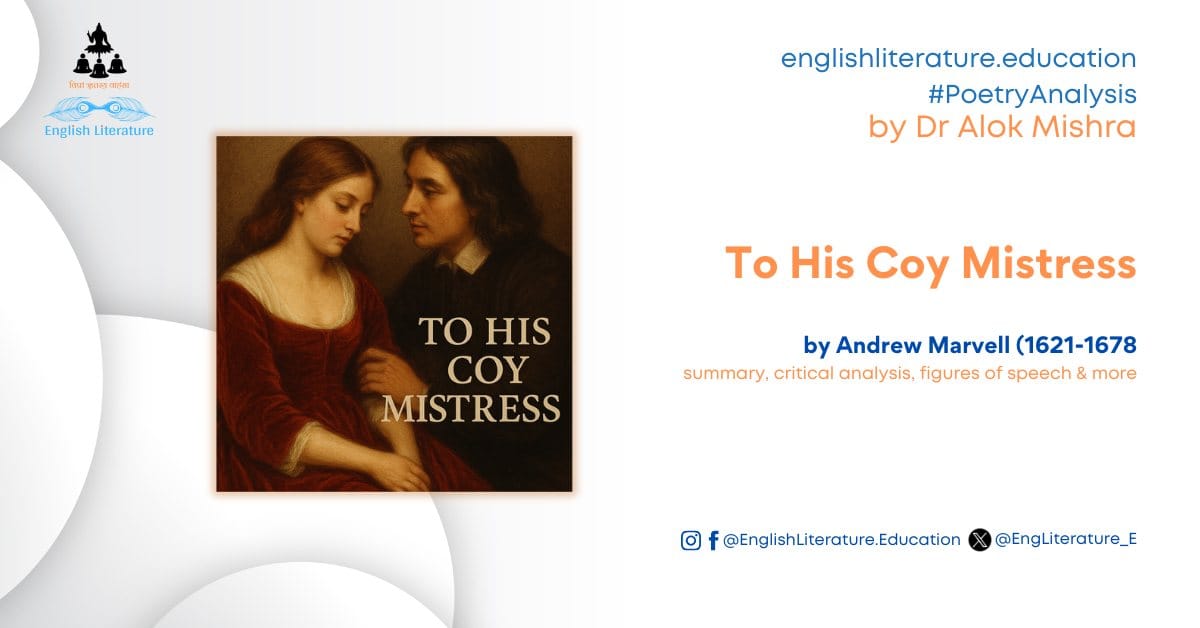
Andrew Marvell’s “To His Coy Mistress” is one of the most compelling examples of metaphysical poetry, blending intellectual wit, sensual passion, and philosophical urgency. The poem unfolds as a dramatic monologue in which the speaker addresses a hesitant lover, urging her to seize the fleeting pleasures of youth before time and death extinguish them. Its argument, rooted in the classical carpe diem tradition, transforms a seduction poem into a meditation on mortality, desire, and the human condition. Through its intricate balance of logic and emotion, the poem embodies the metaphysical poets’ fascination with paradox and the tension between body and soul.
Structurally, Marvell divides the poem into three persuasive movements. The first section imagines an ideal world of infinite time and space in which the speaker and his beloved could indulge in prolonged courtship. The tone here is tender and expansive, full of hyperbolic imagery that elevates love to cosmic proportions. This hypothetical paradise—where love grows “vaster than empires and more slow”—evokes both genuine admiration and ironic excess, suggesting the futility of such idealism. The second section abruptly interrupts this fantasy with the famous line, “But at my back I always hear / Time’s wingèd chariot hurrying near.” The mood shifts to urgency and foreboding as the speaker confronts mortality and decay. The imagery of worms, dust, and “marble vaults” brings the reality of death into stark relief, dispelling illusions of eternal youth. Finally, the third section turns to passionate exhortation. The speaker advocates action and consummation, urging the lovers to “devour” time rather than succumb to it. Here, sensual energy becomes a defiant assertion of life against the inevitable approach of death.
Marvell’s poetic craft lies in his fusion of intellectual argument and emotional appeal. The poem’s precise structure, rhythmic control, and vivid imagery create a persuasive unity of thought and feeling. It is both a love poem and a metaphysical reflection on temporality, where desire becomes a form of resistance to mortality. The poem’s enduring power stems from this tension: the lover’s plea is at once an act of seduction and a profound acknowledgement of the limits imposed by time and death.
Introduction to the Poet: Andrew Marvell
Andrew Marvell (1621–1678) occupies a unique position among seventeenth-century English poets. He stands at the intersection of the metaphysical tradition established by John Donne and the political and philosophical concerns of the Restoration period. Educated at Trinity College, Cambridge, Marvell combined the intellectual rigour of a scholar with the sensibility of a lyric poet. His work reveals a mind equally attuned to moral reflection, political irony, and delicate lyricism. Though he lived during one of England’s most turbulent eras, Marvell’s poetry exhibits an extraordinary balance between passion and intellect, idealism and realism.
Marvell’s career was as varied as his poetry. He served as a tutor, a parliamentarian, and a political writer, closely associated with figures such as Oliver Cromwell and John Milton. His prose writings defend political liberty and religious tolerance, while his poems often reflect personal introspection and philosophical speculation. His poetic style unites the precision of classical thought with the emotional intensity of metaphysical poetry. Unlike Donne, whose metaphors are often audacious and contorted, Marvell’s wit tends toward irony and controlled elegance. He uses argument not merely to astonish but to persuade, transforming complex ideas into graceful poetic form.
In “To His Coy Mistress,” Marvell’s synthesis of sensuality and intellect reaches its height. The poem’s rhetorical clarity and measured reasoning reflect his classical education, while its urgency and emotional depth reveal his metaphysical inheritance. Beyond this famous poem, works such as “The Garden” and “An Horatian Ode upon Cromwell’s Return from Ireland” demonstrate his range, moving from contemplation to politics, from serene meditation to civic engagement. Marvell’s poetry thus stands as a bridge between private contemplation and public life, uniting spiritual introspection with worldly awareness. His disciplined intelligence and subtle irony ensure his lasting reputation as one of the most refined and versatile voices of the metaphysical tradition.
Historical & Contextual Background of the Publication of the Poem
“To His Coy Mistress” was written in the mid-seventeenth century, a time of immense political, intellectual, and cultural change in England. Although Andrew Marvell likely composed the poem during the 1650s, it was not published until after he died in 1681, in a collection titled Miscellaneous Poems. This delay was not unusual; many of Marvell’s poems circulated privately in manuscript form rather than appearing in print during his lifetime. The reasons for this are both personal and political. Marvell lived through the English Civil War, the execution of Charles I, the rise of Oliver Cromwell’s Commonwealth, and the eventual Restoration of the monarchy under Charles II. The volatile atmosphere made writers cautious about what they chose to publish, especially works that might be seen as morally or politically provocative.
The poem reflects the intellectual climate of the seventeenth century, shaped by scientific discovery, philosophical inquiry, and religious uncertainty. The influence of contemporary thinkers such as Francis Bacon and the new scientific emphasis on time, motion, and the physical world can be felt in Marvell’s imagery, especially in the reference to “Time’s wingèd chariot.” At the same time, the poem belongs to the carpe diem, or “seize the day,” tradition, inherited from classical Latin poets like Horace and Ovid and developed in English by writers such as Robert Herrick. Within this tradition, love and desire become metaphors for the brevity of life and the urgency of experience.
While “To His Coy Mistress” may at first seem like a witty seduction poem, its intellectual depth and tension between passion and mortality reflect the metaphysical poets’ fascination with paradox and reasoning. In its historical moment, the poem captures the spirit of an age torn between religious piety, scientific rationalism, and the human yearning for pleasure and permanence.
The Authoritative Text: To His Coy Mistress by A Marvell
Had we but world enough and time,
This coyness, lady, were no crime.
We would sit down, and think which way
To walk, and pass our long love’s day.
Thou by the Indian Ganges’ side
Shouldst rubies find; I by the tide
Of Humber would complain. I would
Love you ten years before the flood,
And you should, if you please, refuse
Till the conversion of the Jews.
My vegetable love should grow
Vaster than empires and more slow;
An hundred years should go to praise
Thine eyes, and on thy forehead gaze;
Two hundred to adore each breast,
But thirty thousand to the rest;
An age at least to every part,
And the last age should show your heart.
For, lady, you deserve this state,
Nor would I love at lower rate.
But at my back I always hear
Time’s wingèd chariot hurrying near;
And yonder all before us lie
Deserts of vast eternity.
Thy beauty shall no more be found;
Nor, in thy marble vault, shall sound
My echoing song; then worms shall try
That long-preserved virginity,
And your quaint honour turn to dust,
And into ashes all my lust;
The grave’s a fine and private place,
But none, I think, do there embrace.
Now therefore, while the youthful hue
Sits on thy skin like morning dew,
And while thy willing soul transpires
At every pore with instant fires,
Now let us sport us while we may,
And now, like amorous birds of prey,
Rather at once our time devour
Than languish in his slow-chapped power.
Let us roll all our strength and all
Our sweetness up into one ball,
And tear our pleasures with rough strife
Through the iron gates of life:
Thus, though we cannot make our sun
Stand still, yet we will make him run.
Simplistic Paraphrasing of the poem (section-by-section)
Section I: (Lines 1–20)
If time were endless and the world were wide enough for us to love without hurry, your shyness would not be a problem at all. We could sit together and calmly decide how to spend our long days of love. You could wander by the beautiful Ganges River in India, searching for precious rubies, while I stayed by the River Humber in England, singing of my love and waiting for you patiently.
I would begin loving you long before the biblical Flood, and you could refuse me until the end of time itself—say, until “the conversion of the Jews,” a phrase that means something that will never happen. My love would grow slowly and steadily, like a plant that expands with time, becoming “vaster than empires.” I would spend a hundred years admiring your eyes and forehead, two hundred praising your breasts, and thirty thousand years devoted to the rest of your beauty. Every part of you would receive its due admiration, and in the final age of eternity, I would worship your heart. You deserve this grand, patient devotion, and I would not love you any less than you deserve.
In this first section, the speaker imagines an ideal world where time never runs out. His tone is tender, even romantic, but the exaggerated time spans, thousands of years of praise, hint at the impossibility of such love. The speaker’s imagination stretches toward eternity, only to reveal that such perfection belongs to fantasy.
Section II: (Lines 21–32)
However, reality intrudes. Behind me, I can always hear the sound of Time’s winged chariot racing closer. Before us lies a vast, empty eternity, a desert where everything living will vanish. Your beauty will fade; in the grave, your body will lie cold and silent. My songs of love will no longer echo in your tomb. Then worms will invade that long-protected virginity, and the “quaint honour” you preserved will crumble into dust, just as my passion will turn to ashes.
The grave may be a “fine and private place,” he says with irony, but nobody makes love there.
In this second section, the tone shifts sharply from dreamy imagination to grim realism. The speaker confronts the fact of mortality. Death and decay destroy both beauty and desire, leaving no room for love. His imagery—worms, marble vaults, dust—forces his beloved to face the futility of delaying pleasure. The tenderness of the first section gives way to urgency and warning.
Section III: (Lines 33–46)
Now, then, while you are still young and full of life, while your skin glows as the fresh morning dew and your soul burns with warmth and energy, let us enjoy our love to the fullest. Like fierce birds of prey, let us devour time rather than let it eat us (in other words, end human life). Instead of wasting away slowly under time’s control, let us gather all our strength, passion, and sweetness into one shared experience.
Let us roll all that we are into one great, shining ball of love and energy, and push through life’s “iron gates” together. We cannot stop the sun or make time stand still, but through the intensity of our love, we can make time seem to move faster—we can live more fully in the moments we have.
The final section transforms the fear of death into passionate action. The speaker calls for a physical and emotional union to resist time’s power. Love becomes an act of defiance, a way to claim meaning and vitality before everything fades.
Summary of the poem – in brief
Across the poem, Marvell’s speaker moves from fantasy to fear to fierce urgency. The first section dreams of eternal love, the second acknowledges that time destroys all things, and the third insists that love must be lived now, while there is still youth and desire. Beneath the surface of seduction lies a deeper philosophical question: how can human beings find value and joy in a world where time and death are certain?
Critical Analysis of the Poem – Stanza by Stanza
Stanza I: The Vision of Infinite Love (Lines 1–20)
The opening stanza of “To His Coy Mistress” begins not as a plea for passion but as a philosophical hypothesis: “Had we but world enough and time, / This coyness, lady, were no crime.” From the outset, Marvell situates the poem within the conditional realm of imagination. The phrase “Had we but” establishes an unreal scenario, one in which the lovers possess infinite time and space. The tone is measured and reflective, suggesting not impulsive lust but rational persuasion. The speaker imagines a universe in which patience and restraint are virtuous because eternity allows endless courtship. This hypothetical beginning is essential to the poem’s structure; it contrasts sharply with the later intrusion of mortality, creating a dialectic between possibility and limitation.
Marvell’s language in this stanza embodies both tenderness and wit. The lover’s tone is at once courteous and ironic. He presents himself as a poet-philosopher capable of constructing a vision of ideal love governed by timeless admiration. The image of the lady sitting by “the Indian Ganges’ side” while he lingers by “the tide / Of Humber” is geographically extravagant yet emotionally intimate. These rivers are not random choices. The Ganges evokes exotic beauty, spirituality, and sensual richness, while the Humber, a modest English river, reflects the poet’s own local reality. By pairing these two rivers, Marvell unites the foreign and the familiar, suggesting that true love transcends boundaries of geography and culture. The contrast also heightens the lovers’ sense of distance, both literal and emotional, that time must eventually bridge.
The stanza’s hyperbolic imagery, such as loving her “ten years before the flood” and waiting “till the conversion of the Jews,” signals the poem’s metaphysical wit. These are expressions of temporal impossibility. The biblical references situate human love within the cosmic scale of creation and redemption, implying that the lover’s devotion, if time allowed, would match divine patience. However, the very exaggeration betrays irony; Marvell invites the reader to sense the absurdity of such endless waiting. In doing so, he exposes the gap between romantic idealism and human limitation.
The central metaphor of “vegetable love” is particularly intriguing. At first glance, it might seem odd or even humorous, but it carries profound resonance. The word “vegetable” in the seventeenth century suggested organic growth, slow and steady development, and natural expansion. The metaphor thus describes love as something living and fertile, growing “vaster than empires and more slow.” The pairing of “vast” and “slow” is deliberate: it captures the tension between the infinite and the temporal, the ideal and the real. Love, in this imagined world, could expand indefinitely, encompassing both sensual and spiritual admiration.
The stanza’s concluding lines—“For, lady, you deserve this state, / Nor would I love at lower rate”—anchor the fantasy in flattery. The speaker ends his vision by affirming the lady’s worthiness, transforming hyperbole into homage. Yet beneath the charm lies persuasion: by constructing an image of perfect, timeless love, he prepares the ground for his later argument that such love is impossible within human limits. The careful symmetry, balanced rhythms, and logical progression of this stanza mirror a tone of controlled reason. The speaker presents himself as courteous, intelligent, and capable of patient devotion. But his courtesy is strategic. By beginning with a tone of calm idealism, he creates contrast for the urgency that follows.
Critically, this stanza exemplifies the metaphysical method: argument clothed in imagination. The lover’s reasoning proceeds like a syllogism—if time were infinite, coyness would be acceptable; but time is not infinite, therefore coyness is futile. The poem’s intellectual power derives from this logical construction, even as its emotional appeal arises from the beauty of its imagery. Marvell’s wit is neither cruel nor mocking; it is contemplative. He offers his reader, and his mistress, a seductive vision of eternal courtship, only to withdraw it in the next breath. The first stanza thus establishes both the intellectual framework and the emotional contrast that sustain the poem’s argument: love’s grandeur depends on the brevity of life.
Stanza II: The Awareness of Mortality (Lines 21–32)
The second stanza marks a dramatic shift in tone and imagery. The speaker, who previously imagined timeless love, now confronts the relentless passage of time: “But at my back I always hear / Time’s wingèd chariot hurrying near.” The conjunction “But” cancels the fantasy of eternity and ushers in a new mood of urgency. The measured rhythm of the first stanza gives way to acceleration. The metaphor of the winged chariot, drawn from classical mythology, evokes both Apollo’s sun chariot and the biblical vision of divine judgment. Time becomes a pursuing force, a reminder that human life is bounded by decay. This single image condenses centuries of philosophical meditation into a few syllables: time is not static; it is always advancing toward death.
The stanza’s imagery of “deserts of vast eternity” intensifies the bleakness. The once-lush world of love and rivers has turned into a barren landscape of nothingness. Marvell’s diction deliberately contrasts abundance and emptiness, movement and stillness. Eternity, which in religious thought is often celebrated as salvation, appears here as an endless void. The poet’s perspective is secular, even existential. He does not imagine heavenly reward but silence and decay. The lady’s beauty, so idealised in the previous stanza, is now envisioned as perishable flesh, soon to be consumed by worms. The bluntness of “then worms shall try / That long-preserved virginity” shocks the reader into awareness of mortality. It is a moment of physical realism that punctures the decorum of poetic courtship.
This stanza also reveals the poem’s argument’s gendered dimension. The lady’s “quaint honour” is treated with a touch of irony. Her chastity, preserved through delay, will ultimately be rendered meaningless by death. Marvell does not ridicule her virtue outright, but he exposes its fragility over time. The phrase “the grave’s a fine and private place” drips with sardonic wit. Privacy, so valued in modesty, becomes the stillness of death where no love is possible. The speaker’s tone balances between humour and horror, acknowledging the futility of both beauty and desire when separated by hesitation.
Philosophically, this stanza reflects the influence of seventeenth-century materialism and the growing awareness of human mortality in a world undergoing scientific transformation. Marvell’s contemporary readers would have recognised echoes of the memento mori tradition, which reminded individuals of death’s certainty. Yet Marvell transforms this medieval warning into a modern argument: awareness of death should not lead to despair but to action. The language of decay is both a threat and a stimulus, preparing the ground for the passionate resolution that follows.
Stylistically, the stanza’s rhythm mirrors its theme. The verse quickens as the chariot approaches, then slows into a grim stillness, with the imagery of the tomb. Marvell controls syntax and cadence to embody the compression of time itself. The repeated sound patterns—“found,” “sound,” “round”—create a muffled echo that suggests both finality and continuity. The poem’s voice grows darker, more reflective, yet retains its intellectual clarity.
In sum, the second stanza dismantles the illusions constructed in the first. It is the poem’s pivot from dream to reality, from timeless love to temporal limitation. Its imagery of pursuit, decay, and silence transforms the lover’s argument from fantasy into existential urgency. Time, not passion, becomes the dominant force. Yet by exposing mortality so vividly, Marvell paradoxically heightens the value of life and desire. The stanza’s dark vision prepares the reader for the carnal defiance that concludes the poem.
Stanza III: The Defiance of Time (Lines 33–46)
The final stanza offers resolution through passionate assertion. Having imagined eternal courtship and confronted inevitable death, the speaker now demands action: “Now therefore, while the youthful hue / Sits on thy skin like morning dew.” The repeated “now” signals immediacy. Time, once an enemy, becomes the spur to love. The imagery of “morning dew” captures both freshness and transience, suggesting that beauty, like dawn, exists only for a brief moment. The lover’s rhetoric here is persuasive and exhilarating, blending sensual appeal with philosophical conviction.
The comparison of the lovers to “amorous birds of prey” introduces an extraordinary metaphor. Unlike gentle doves or traditional symbols of love, birds of prey connote intensity, hunger, and vitality. Their union is not passive or sentimental but fierce and consuming. Marvell’s choice of imagery overturns the conventions of romantic poetry. Love is not portrayed as soft affection but as a violent energy that can resist time’s dominion. The lovers are urged to “devour” time, reversing the natural order in which time devours them. This inversion encapsulates the poem’s metaphysical daring: through passion, humans can challenge cosmic inevitability.
The lines “Let us roll all our strength and all / Our sweetness up into one ball” express the metaphysical ideal of unity. Love becomes a concentrated force, both physical and spiritual. The circular image of the “ball” suggests completeness, echoing Renaissance notions of harmony and totality. The lovers’ merging of strength and sweetness fuses masculine and feminine qualities, body and soul, desire and tenderness. Marvell’s language achieves a rare balance of sensual imagery and moral seriousness. Love is not merely indulgence; it is an act of existential courage.
The closing couplet—“Thus, though we cannot make our sun / Stand still, yet we will make him run”—is among the most memorable in English poetry. It concludes the poem with a paradoxical triumph. Human beings cannot halt the passage of time, but through passionate intensity, they can make time seem to accelerate, transforming passive endurance into active engagement. The lovers cannot achieve immortality, but they can experience a form of transcendence through their union. Marvell’s tone here is neither cynical nor despairing. It is exhilarated, even heroic. Love becomes an act of resistance against entropy, a momentary victory over decay.
Critically, this stanza resolves the poem’s dialectic between thought and emotion, intellect and passion. The logical argument of the earlier stanzas culminates in a sensual imperative. Yet this final movement is not merely erotic persuasion. It expresses a profoundly human desire to affirm life in the face of death. Marvell’s fusion of metaphysical wit with physical imagery anticipates modern existential thought. The poem suggests that meaning arises not from eternity but from intensity. The human condition, bound by time, can still achieve grandeur through awareness and action.
Stylistically, the stanza achieves closure through rhythm and balance. The alternation of monosyllables and polysyllables mirrors the heartbeat’s pulse. The syntax tightens, the imagery burns brighter, and the tone grows increasingly urgent. Marvell’s use of paradox—motion as defiance of stillness, destruction as fulfilment—epitomises metaphysical artistry. Each image, from dew to birds to iron gates, contributes to the argument’s emotional crescendo.
In essence, the third stanza transforms mortality into momentum. The poem that began with hypothetical love and passed through death ends with passionate vitality. Marvell reconciles the opposites that define human experience: time and eternity, body and soul, reason and desire. His speaker’s final appeal is not merely to his mistress but to all humanity—to live fully within the boundaries of time, to make meaning out of transience. In this closing vision, Marvell achieves what few poets manage: the union of intellectual clarity, emotional urgency, and philosophical depth.
Poetic Devices and Their Function in “To His Coy Mistress”
Andrew Marvell’s “To His Coy Mistress” stands as one of the most intricately constructed examples of metaphysical poetry, where form, rhythm, and imagery combine to shape argument and emotion. The poem’s power lies not only in its persuasive logic but also in its technical mastery. Through imagery, metaphor, hyperbole, irony, paradox, rhythm, and structure, Marvell creates a work that transcends mere seduction, becoming instead a meditation on time, mortality, and the meaning of human passion.
One of the most striking features of the poem is its use of imagery. In the first stanza, Marvell constructs a landscape of idealised love through expansive, geographically and temporally extravagant images. The lady is imagined “by the Indian Ganges’ side,” surrounded by exotic beauty, while the speaker lingers by “the tide / Of Humber.” This juxtaposition of the distant and the familiar reflects both the grandeur and the absurdity of the speaker’s vision. The imagery evokes vastness—of space, of time, of devotion—emphasising the fantasy’s conditional nature. Similarly, the “vegetable love” that “should grow / Vaster than empires and more slow” embodies organic imagery, connecting human affection to natural growth and fertility. The phrase, though humorous to modern ears, was in Marvell’s time deeply suggestive of life’s slow, unfolding vitality. This imagery of expansion and duration conveys the magnitude of feeling that infinite time would allow.
In the second stanza, imagery turns from fertility to decay. The tone shifts dramatically from abundance to emptiness, and the poem’s sensual landscape becomes a vision of mortality. The “wingèd chariot” of time, drawn from classical and biblical symbolism, introduces a note of terror. The phrase suggests relentless pursuit and the inevitable approach of death. Marvell’s subsequent images—“deserts of vast eternity,” “worms,” and “marble vaults”—replace warmth and light with cold stillness. These contrasts of imagery between the first and second stanzas reflect the duality of human experience: desire exists within the shadow of mortality. The transformation from rivers and gardens to deserts and tombs illustrates the temporal fragility of beauty and pleasure.
Metaphor and conceit, hallmarks of metaphysical poetry, operate at the heart of Marvell’s art. The “vegetable love” metaphor captures the metaphysical poets’ characteristic blending of the concrete and the abstract, linking bodily desire with natural process and spiritual endurance. Similarly, the poem’s final image—“Let us roll all our strength and all / Our sweetness up into one ball”—embodies the metaphysical conceit in its most potent form. The ball, a symbol of completeness and unity, represents the lovers’ fusion of body and soul, energy and tenderness. Marvell’s conceits are not ornamental; they are vehicles of thought. Each metaphor advances the poem’s central argument that love’s intensity, not its duration, defines its value.
Hyperbole functions as another key device in the poem. The speaker’s extravagant claims—spending “an hundred years” to praise her eyes and “thirty thousand to the rest”—are obviously exaggerated. Yet this exaggeration serves more than flattery; it dramatises the impossibility of infinite love within finite time. Hyperbole becomes a rhetorical strategy that heightens the sense of urgency. By imagining what could be, Marvell underscores what is not possible. His hyperbole, therefore, carries philosophical weight, exposing the limits of human existence even as it celebrates imagination’s freedom.
Irony runs through every stage of the poem. The opening declaration that the lady’s coyness “were no crime” if time were endless is both courteous and ironic, for the speaker immediately reveals that time is far from infinite. His tone oscillates between sincerity and wit, creating a tension that engages both intellect and emotion. The line “The grave’s a fine and private place” exemplifies Marvell’s irony at its sharpest. The statement mimics the tone of modest praise but conceals bitter humour; privacy in the grave is meaningless, for passion and life no longer exist. This interplay of irony and seriousness prevents the poem from slipping into sentimentality, keeping the reader alert to the underlying argument.
Marvell’s frequent use of paradox reinforces this complexity. The poem itself is built upon a paradoxical structure: the desire for timeless love within the boundaries of mortal existence. Each stanza transforms one side of the paradox into its opposite. Love grows through awareness of death; time’s passage, though destructive, gives meaning to passion. The closing couplet—“Thus, though we cannot make our sun / Stand still, yet we will make him run”—encapsulates this paradox beautifully. The lovers cannot stop time, yet through love’s intensity, they can accelerate its experience, creating a symbolic victory over mortality.
The poem’s rhythm and form also contribute significantly to its persuasive power. Written in rhyming iambic tetrameter couplets, the poem maintains a brisk, conversational pace. The couplets resemble logical propositions—each thought is complete yet leads to the next. This tight structure mirrors the speaker’s controlled reasoning, while the consistent rhyme provides musical continuity. At moments of emotional intensity, Marvell manipulates rhythm for effect: the pause in “But at my back I always hear / Time’s wingèd chariot” slows the pace, mimicking the suspense of approaching death, while the rapid succession of monosyllables in “Now let us sport us while we may” propels the verse forward with urgency. The balance between measured argument and emotional quickening is essential to the poem’s effect.
Finally, Marvell’s tone—at once rational, sensual, and philosophical—acts as a unifying device. His voice moves fluidly between flattery and reflection, humour and seriousness, creating a persuasive intimacy. The tone never collapses into crude desire; instead, it elevates passion through the intellect. This fusion of the cerebral and the emotional is the signature of metaphysical poetry and the reason for Marvell’s enduring influence.
In sum, “To His Coy Mistress” is a masterclass in the interplay of poetic devices. Imagery, metaphor, hyperbole, irony, paradox, and rhythm work together to dramatise the tension between time and desire. Through these techniques, Marvell transforms the ancient carpe diem theme into a metaphysical argument of remarkable sophistication. His poem endures because it speaks to a universal truth: that love, however transient, remains humanity’s most eloquent answer to the tyranny of time.
Comprehensive Critical Commentary on “To His Coy Mistress”
Andrew Marvell’s “To His Coy Mistress” remains one of the most finely wrought expressions of human desire confronted by the inexorable passage of time. On its surface, it reads as a persuasive love poem, a witty and eloquent plea for physical union. Yet beneath this seductive rhetoric lies a profound meditation on the human condition. Marvell’s speaker does not simply urge his mistress to yield; he articulates the tension between ideal love and mortal limitation, between the infinite longing of the spirit and the finite boundaries of flesh and time. The poem’s enduring brilliance rests on its ability to balance passion with intellect, sensuality with philosophy, and urgency with precision.
At the heart of Marvell’s poem is the classical carpe diem motif, the exhortation to “seize the day.” Yet Marvell’s treatment of this theme surpasses mere sensual persuasion. His argument is not an appeal to reckless pleasure but an acknowledgement of the tragic brevity of life. The speaker’s reasoning unfolds with the clarity of a syllogism: if there were endless time, coyness would be justified; but since time is limited, delay is futile; therefore, the lovers must act now. What might seem a simple argument becomes a metaphysical reflection on temporality itself. The poem dramatises the paradox that only by recognising mortality can one fully appreciate life’s intensity.
Marvell’s control of tone is central to his success. The speaker begins with tenderness and humour, painting an idyllic fantasy of eternal courtship. His hyperboles, spending centuries admiring each part of his beloved, seem at once charming and excessive, establishing a playful intimacy. Yet this imaginative indulgence is undercut by irony. The reader senses from the start that such devotion is impossible. When the second stanza introduces the winged chariot of time, the fantasy collapses. The lover’s gentle voice turns urgent, and the imagery darkens into decay and silence. The abruptness of this shift gives the poem its dramatic power. Marvell transforms the conventions of love poetry into existential argument, using irony not to mock affection but to expose its fragility.
The final stanza restores vitality by transmuting fear into action. The speaker’s call to “sport us while we may” is not a descent into hedonism but a redefinition of passion as resistance. Love, for Marvell, becomes a form of defiance against the tyranny of time. The lovers cannot escape mortality, but through their intensity, they can “make the sun run.” This metaphor of movement encapsulates the poem’s central paradox: one cannot halt time, but through passionate consciousness, one can alter its experience. Time, once the enemy, becomes the very substance through which love achieves meaning.
The poem’s unity lies in its movement from hypothetical eternity to actual mortality and finally to transcendent vitality. Each stage of the argument corresponds to a distinct emotional state: idealism, fear, and courage, and together they form a complete vision of human experience. Marvell’s speaker is neither a mere seducer nor a moral philosopher; he is a profoundly human voice grappling with the limits of existence. His plea to his mistress thus becomes an allegory for all human striving against decay. The poem’s persuasive power rests on its ability to make physical desire a metaphor for the life force itself.
What makes “To His Coy Mistress” extraordinary is its balance between intellect and emotion. The poem’s logic is flawless, yet it never feels mechanical. Marvell’s verse moves with the rhythm of thought and feeling combined. The rhymed couplets give the argument precision, while the supple meter allows for expressive variation. His diction remains natural and direct, unencumbered by ornament. Every word carries both rhetorical and emotional weight.
Critically, the poem exemplifies the metaphysical poets’ central aim: to unite the realms of reason and passion, the abstract and the concrete. Marvell’s speaker thinks with his heart and feels with his mind. The poem’s persuasion is as much intellectual as sensual. It asks not merely for love but for an affirmation of life within the awareness of death. Its concluding image of the lovers making the sun “run” embodies the triumph of vitality over despair.
Ultimately, “To His Coy Mistress” endures because it speaks to a universal truth. Time is fleeting, death is inevitable, yet through imagination and love, human beings can transcend these limits, if only momentarily. Marvell’s poem is not a moral sermon but an invitation to live fully and consciously. It is both a love poem and a philosophical reflection, both sensual and spiritual, both witty and profound. In this fusion lies its lasting greatness.
Marvell’s Poetic Style and Comparison with Other Metaphysical Poets
Andrew Marvell’s poetic style occupies a distinctive position within the tradition of seventeenth-century metaphysical poetry. Like John Donne, George Herbert, and Henry Vaughan, he combines intellectual subtlety with emotional intensity, but his tone and method are uniquely balanced. Marvell’s verse is characterised by precision, restraint, and ironic wit, qualities that lend his work a clarity often lacking in the more turbulent energies of Donne or the devotional fervour of Herbert. His poetry demonstrates an equilibrium between body and spirit, passion and intellect, which makes him one of the most harmoniously poised figures of the metaphysical school.
Marvell’s craftsmanship lies in his ability to merge logical reasoning with lyrical grace. His arguments unfold with the structure of philosophical discourse but are illuminated by poetic imagery. In “To His Coy Mistress,” for example, the syllogistic pattern mirrors a scholar’s reasoning, while the metaphors—“vegetable love,” “Time’s wingèd chariot,” “birds of prey”—animate abstraction with vivid immediacy. Marvell’s language is disciplined, his syntax controlled, and his rhythm deliberate. Each couplet functions as both an intellectual unit and a rhythmic pulse. Unlike Donne, whose verse often reflects the turbulence of inner conflict, Marvell’s poetry achieves balance through composure and proportion.
Another hallmark of Marvell’s style is his use of irony and ambiguity. His tone is rarely single-minded; he often holds multiple meanings in tension. In “To His Coy Mistress,” the speaker’s plea can be read as sincere passion, playful wit, or philosophical reflection. This tonal complexity is a signature of Marvell’s artistry. Whereas Donne’s metaphysical conceits shock the reader into awareness, Marvell’s subtle ironies invite contemplation. He does not force revelation; he allows it to emerge through suggestion.
Compared with George Herbert, Marvell’s treatment of spirituality appears more secular and intellectual. Herbert’s The Temple explores the soul’s struggle for grace through devotional sincerity. Marvell, though capable of religious reflection, is more concerned with human perception and the philosophical implications of time and mortality. His spirituality is filtered through reason rather than prayer. In contrast, Henry Vaughan’s visionary mysticism and Thomas Traherne’s childlike wonder represent a more ecstatic engagement with the divine than Marvell ever attempts. Marvell’s focus remains grounded in the temporal world, where intellect seeks harmony rather than transcendence.
Stylistically, Marvell’s clarity and symmetry anticipate the classical balance of the later Augustan poets, particularly Alexander Pope. Yet he never abandons the metaphysical concern with paradox and intensity. His imagery, though controlled, retains metaphysical daring; his conceits, though ingenious, are never obscure. The refinement of his diction and the lucidity of his structure make his poetry intellectually satisfying and emotionally resonant.
In sum, Marvell bridges two worlds: the metaphysical and the neoclassical. From the former, he inherits wit, paradox, and philosophical depth; from the latter, he anticipates balance, polish, and proportion. His art transforms intellectual speculation into lyrical persuasion. In “To His Coy Mistress,” these qualities converge perfectly. The poem unites passion and thought, mortality and vitality, in a form both elegant and exact. Among the metaphysical poets, Marvell stands apart for his mastery of restraint, his union of wit and harmony, and his profound ability to render the complexity of human experience in clear, resonant verse.
…
Thanks for reading!
If you have anything to add, ask, or submit, please feel free to write it in the comments.
Dr Alok Mishra
…
..
.