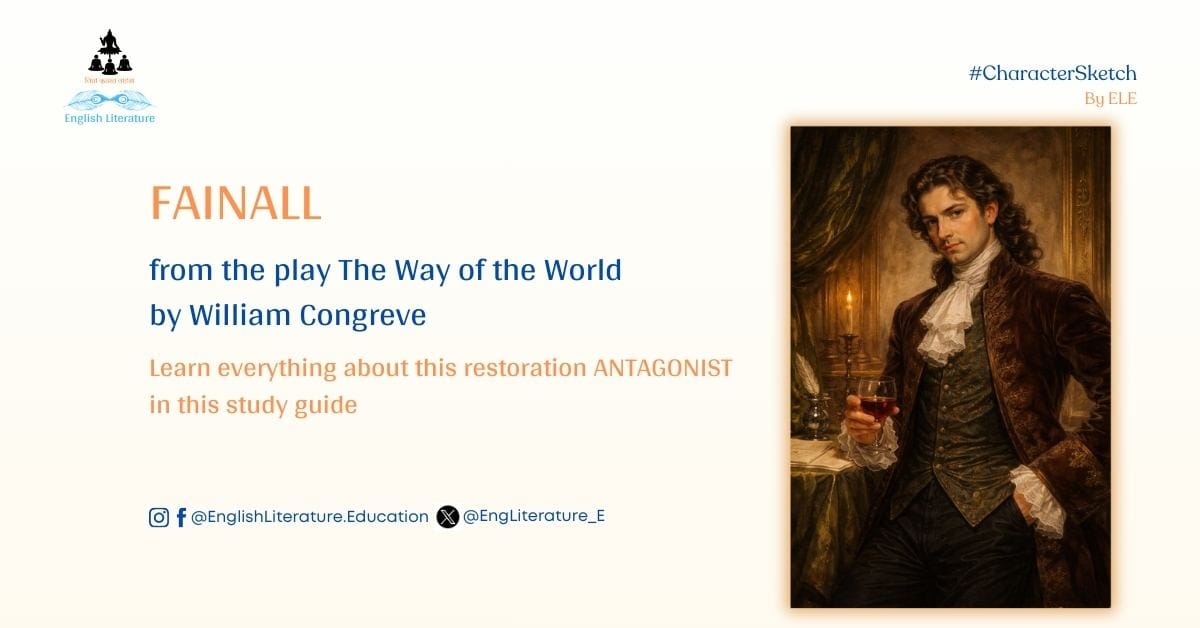
Fainall is examined as the moral and ideological antithesis of Mirabell in William Congreve’s The Way of the World. For Mirabell to shine and stand out, Congreve’s brilliant analytical poetic mind conjured a character like Fainall to warn the Restoration audience of the excessive manipulation and its consequences. In this article, as a part of the complete study guide to The Way of the World, you will understand the character of Fainall and different aspects of this dramatic persona, who serves as another wheel driving the plot forward, along with Mirabell.
Fainall: Worldliness Without Decency
Fainall is the most overtly antagonistic figure in The Way of the World and one of Congreve’s most penetrating studies of intelligence divorced from moral responsibility. Unlike Witwoud or Petulant, Fainall is not ridiculous; unlike Sir Wilfull, he is not naïve. He is a man of sense, capable of sustained reasoning, strategic foresight, and polished conversation. Yet it is precisely this competence, untempered by good nature, that renders him dangerous. In the moral architecture of the play, Fainall represents worldliness in its purest and most corrosive form.
Congreve does not construct Fainall as a melodramatic villain. Instead, he is disturbingly plausible. He understands the mechanisms of marriage, law, inheritance, and reputation, and he uses them instrumentally, without ethical hesitation. His presence exposes the dark potential inherent in Restoration social systems when intelligence is guided solely by self-interest.
A “Man of Sense” Turned Predatory
Critically, Fainall belongs to the same intellectual category as Mirabell. Both are sharp observers of social behaviour, fluent speakers, and strategic thinkers. However, where Mirabell balances intelligence with restraint, Fainall embraces cynicism as a governing principle.
This distinction becomes evident in his attitude toward marriage. Fainall speaks with chilling candour about his motives:
“I married to make lawful prize of a rich widow’s wealth.”
This line crystallises his character. Marriage, for Fainall, is not a social bond or moral contract but a legal mechanism for appropriation. The adjective “lawful” is crucial. Fainall does not reject social institutions; he exploits them. His villainy operates within the letter of the law, exposing the moral emptiness that can exist beneath respectable forms.
Unlike Mirabell, who anticipates harm and seeks to limit it, Fainall calculates harm as a means to profit. His intelligence is thus extractive rather than preservative.
Marriage as Tyranny: Fainall and Mrs. Fainall
Fainall’s relationship with his wife is the bleakest marriage in the play and serves as a moral counterpoint to the negotiated union of Mirabell and Millamant. Mrs. Fainall enters marriage as a strategy of concealment; Fainall enters it as a strategy of domination. The asymmetry is devastating.
Once Fainall believes he possesses legal control, his language toward his wife becomes overtly coercive. In Act V, he threatens to reduce her to social and economic ruin:
“I will turn you off, and rob you of all you have.”
The brutality of this declaration strips away any remaining veneer of civility. Marriage, in Fainall’s hands, becomes a weaponised institution, enabling cruelty under the guise of legitimacy.
Congreve underscores this moral failure by contrasting Fainall’s behaviour with Mirabell’s earlier protection of Mrs. Fainall’s estate. Where Mirabell uses law to safeguard vulnerability, Fainall seeks to use law to legalise injustice.
The Affair with Mrs. Marwood: Passion Without Tenderness
Fainall’s relationship with Mrs. Marwood introduces the most emotionally volatile element in the play. Their scenes are marked by jealousy, bitterness, and mutual suspicion, so intense that critics often note they “skirt the borders of tragedy.”
Unlike Mirabell and Millamant’s measured verbal duel, Fainall and Marwood engage in emotional brinkmanship. When Fainall accuses Marwood of loving Mirabell, her reaction betrays both anger and wounded pride. Their exchanges lack playfulness; they are raw, accusatory, and destabilising.
Fainall’s emotional posture in this relationship is telling. He does not offer loyalty or affection; instead, he demands complicity. Love becomes another transaction, sustained only so long as it serves his interests. This is evident in his readiness to abandon Mrs. Marwood once his scheme fails.
Thus, even passion is subordinated to power. Fainall’s emotional life mirrors his economic life: acquisitive, conditional, and ultimately disposable.
Cynicism as Worldview
Fainall repeatedly invokes “the way of the world” to justify his conduct. When his schemes are exposed, he shrugs off moral outrage with characteristic detachment:
“If it must all come out, why let ’em know it; ’tis but the way of the world.”
This line reveals the philosophical core of his character. For Fainall, moral norms are illusions sustained by convenience. Exposure does not shame him; it merely alters tactics. He assumes that corruption is universal and that anyone claiming otherwise is either foolish or hypocritical.
Congreve presents this cynicism not as sophistication but as moral exhaustion. Fainall’s refusal to acknowledge any value beyond self-interest isolates him from the social harmony achieved at the play’s conclusion. He is not defeated intellectually but disqualified ethically.
Fainall vs. Mirabell: A Moral Antithesis
The contrast between Fainall and Mirabell is one of the play’s most carefully structured oppositions. Both characters:
- Are men of sense
- Understand the law
- Engage in strategic planning
- Speak with polish and authority
Yet their ends differ radically.
Mirabell schemes to secure consent, protect reputation, and preserve autonomy. Fainall schemes to seize wealth, silence opposition, and assert control. Where Mirabell plans with foresight, Fainall plans with appetite. Where Mirabell stops short of irreversible harm, Fainall pushes relentlessly toward total domination.
This difference becomes decisive in Act V, when Mirabell produces the deed of trust that nullifies Fainall’s power. The moment is not merely a plot resolution; it is a moral judgment enacted through law. Fainall’s reliance on legal authority collapses when confronted with an earlier, more ethical legal act.
Language and Tone
Fainall’s language reflects his character with remarkable precision. His speech lacks the flamboyance of Witwoud and the grotesque excess of Lady Wishfort. Instead, it is controlled, assertive, and edged with threat. This linguistic restraint enhances his menace. He does not rant; he calculates aloud.
Congreve thus avoids caricature. Fainall’s villainy is credible precisely because it is quiet, logical, and socially fluent.
Moral and Structural Function
In the moral economy of The Way of the World, Fainall exists to test the limits of social elegance. He proves that polish without principle is insufficient. His downfall does not result in repentance or transformation; instead, he exits the play exposed, thwarted, and morally diminished.
Unlike the fools, he does not invite laughter; unlike Lady Wishfort, he does not invite sympathy. He invites judgment.
Conclusion: Fainall as the Play’s Ethical Warning
Fainall embodies the darkest possibility of Restoration society: that intelligence, law, and social refinement can coexist with cruelty when severed from decency. He is not an outsider to the world of the play but its logical extreme. His defeat affirms Congreve’s central moral claim: that to survive the “way of the world,” one must master its rules—but to deserve success within it, one must also retain humanity.
If Mirabell represents ethical intelligence, Fainall represents intelligent immorality. The play’s resolution decisively rejects the latter.
Read more character sketches from The Way of the World – Mirabell | Millamant | Fainall (currently reading) | Lady Wishfort
Read Detailed Summary of the Play – The Way of the World by William Congreve Summary
Read the comprehensive study guide – The Way of the World Study Guide
Dr Alok Mishra for the English Literature Education platform
Thanks for reading!