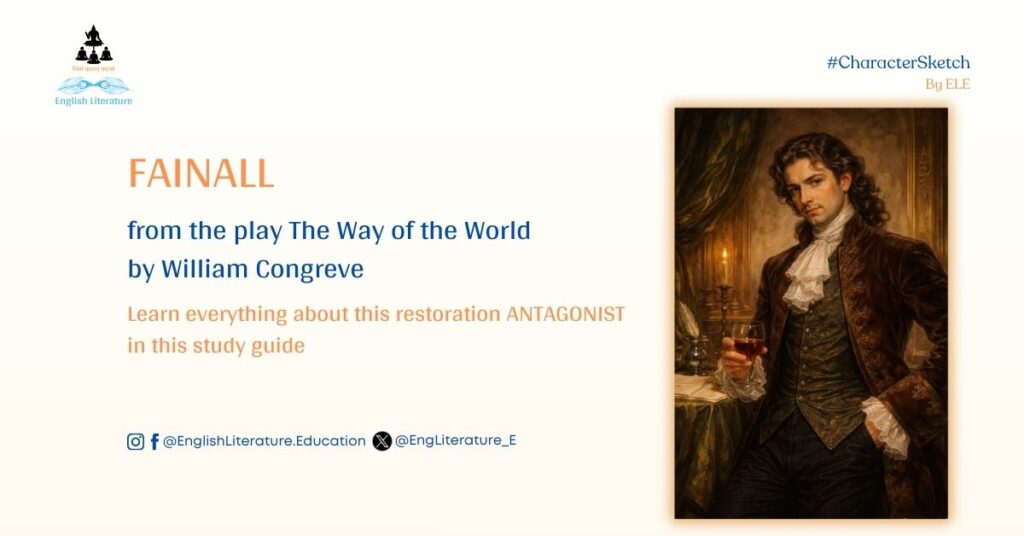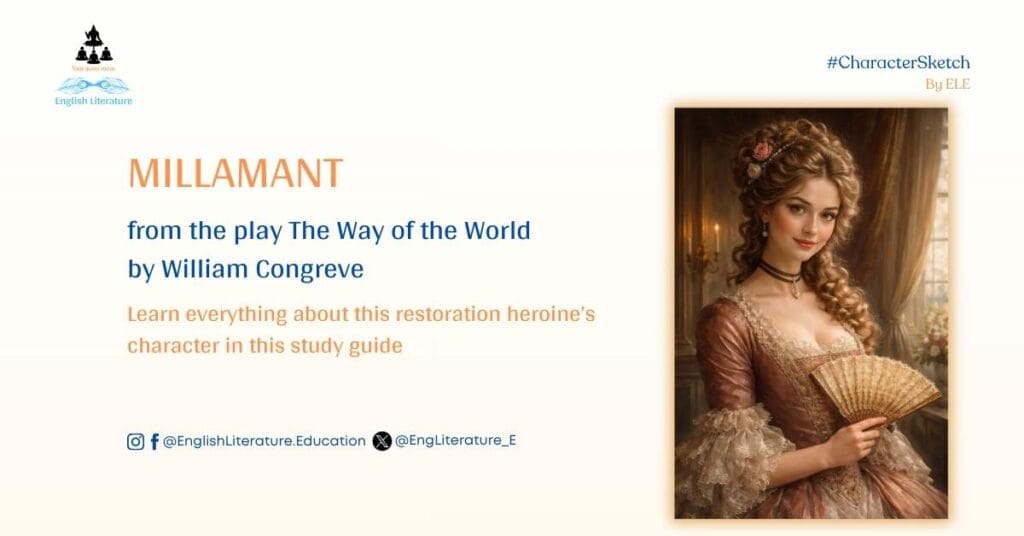

One of the most iconic female characters on the Restoration stage, Lady Wishfort from The Way of the World, is like a labyrinth of perspectives… unending and perplexing – the more you read, the more you surprise yourself. Lady Wishfort is examined not merely as a comic figure but as a structurally indispensable and morally complex presence in William Congreve’s The Way of the World. Read this academic article to understand various facets of Lady Wishfort’s complex character in Congreve’s famous drama.
Lady Wishfort: Vanity, Power, and the Pathos of Social Decorum
Lady Wishfort is one of the most vividly drawn characters in The Way of the World and among the most memorable comic creations of Restoration drama. At first glance, she appears to belong to the tradition of grotesque comic figures: an ageing woman absurdly obsessed with youth, cosmetics, and remarriage. However, Congreve’s treatment of Lady Wishfort goes far beyond ridicule. She is not merely an object of laughter but a crucial structural agent, an economic authority, and a moral test case within the play’s larger inquiry into worldliness and decency.
Lady Wishfort embodies a paradox. She is simultaneously powerful and vulnerable, authoritative and ridiculous, sharp-tongued and fundamentally good-natured. Congreve uses her character to explore the human cost of social conventions, particularly those governing age, gender, and reputation. Unlike Fainall, whose villainy is deliberate, Lady Wishfort’s folly arises from fear, insecurity, and misplaced adherence to decorum.
Economic Authority and Structural Centrality
Despite her comic excesses, Lady Wishfort is arguably the most powerful character in the play from a material standpoint. She controls the “purse strings,” specifically the moiety of Millamant’s £6000 fortune. This financial authority places her at the centre of the plot’s amatory and economic conflicts.
Congreve is careful to ensure that Lady Wishfort’s importance is not merely symbolic. Without her consent, Mirabell cannot marry Millamant without forfeiting half her fortune. Without her humiliation, Mirabell’s elaborate scheme cannot succeed. In this sense, Lady Wishfort functions as the principal obstacle to the play’s resolution.
Her power, however, is exercised without insight. She does not understand the mechanisms of the world she inhabits, making her authority brittle and easily manipulated. This contrast between economic dominance and intellectual vulnerability is central to her character and to the play’s moral design.
Vanity as Social Survival
Lady Wishfort’s obsession with youth and appearance is often treated as farce, yet Congreve subtly invites a more sympathetic reading. In a society that defines female value almost exclusively through desirability, Lady Wishfort’s terror of ageing is not irrational but socially induced.
Her famous reliance on cosmetics is described with merciless wit. She is likened to an “old peeled wall” that must be “repaired” before it can receive a suitor. Yet beneath this satire lies a critique of a culture that offers women no dignified mode of ageing.
Her own language betrays her anxiety:
“I look like an old peeled wall, when the rain has washed off the plaster.”
This moment of self-awareness is rare and fleeting, but it exposes the emotional cost of her vanity. Lady Wishfort’s desperation to remarry is not driven by lust alone, but by a profound fear of social erasure.
The Tyranny of Decorum
One of Lady Wishfort’s defining traits is her obsessive concern with decorum. Ironically, this obsession repeatedly undermines her dignity. She fears impropriety more than deception, which makes her the perfect victim of Mirabell’s scheme.
Her terror of “breaking forms” is repeatedly expressed, even in moments of emotional urgency. When she contemplates marriage with “Sir Rowland,” she worries less about authenticity than about pace and propriety. Her complaint is revealing:
“I have a mortal terror at the apprehension of offending against decorums.”
Congreve exposes decorum here as a mechanical substitute for judgment. Lady Wishfort follows social rules not because they protect virtue, but because they offer the illusion of control. This blind obedience renders her incapable of distinguishing sincerity from performance.
In contrast to Millamant, who negotiates convention intelligently, Lady Wishfort submits to it slavishly. Her tragedy lies in confusing form with substance, mistaking ritual for protection.
Language: Boudoir Billingsgate
Lady Wishfort’s linguistic style is among the most distinctive in the play. Critics have famously described her speech as a “flow of boudoir billingsgate,” a mixture of aristocratic setting and coarse invective. Her language oscillates between exaggerated refinement and startling brutality.
She showers insults on her servants with theatrical ferocity, calling Foible a “viper,” a “changeling,” and threatening her with physical punishment. These outbursts are comic, but they also reveal Lady Wishfort’s loss of emotional regulation. Her power expresses itself not through rational command but through verbal excess.
Unlike Mirabell’s measured eloquence or Millamant’s controlled brilliance, Lady Wishfort’s speech exposes her inner chaos. For her, language becomes a release valve, not a tool of mastery.
Relationship with Mirabell: Wounded Vanity and Lasting Grudge
Lady Wishfort’s hostility toward Mirabell originates in wounded pride. His earlier “sham addresses” flattered her vanity, and the discovery that these were merely a cover for courting Millamant transforms admiration into hatred.
Her reaction is disproportionate, but psychologically credible. She feels not merely deceived but publicly diminished. Mirabell’s betrayal strikes at the core of her self-image as a still-desirable woman.
She refers to him with unrelenting bitterness, calling him a “false and a designing lover.” Yet her anger also reveals her vulnerability. She does not hate Mirabell because he is immoral, but because he exposes her self-deception.
Congreve ensures that this hostility fuels the plot without rendering Lady Wishfort malicious. She seeks revenge, but her schemes lack the cruelty and calculation of Fainall’s designs.
Lady Wishfort and the Moral Spectrum
In the play’s moral taxonomy, Lady Wishfort belongs to the category of “people of good will.” This distinction is crucial. Unlike Fainall and Mrs Marwood, she does not deliberately seek to harm others. Her follies are self-regarding, not predatory.
She wishes to protect her daughter, Mrs. Fainall, from further humiliation and expresses genuine maternal concern. Her desire to marry Sir Wilfull to Millamant, though misguided, is motivated by familial control rather than greed.
Congreve ultimately excludes Lady Wishfort from the conventional comic resolution. She is reconciled, but not transformed; forgiven, but not triumphant. This outcome reflects the play’s ethical nuance. Decency without discernment, Congreve suggests, is insufficient for success in a sophisticated social order.
Victim of the World She Upholds
Perhaps the most ironic aspect of Lady Wishfort’s character is that she becomes the victim of the very social system she defends. Her reverence for rank, title, and decorum blinds her to the possibility of deception. She believes in appearances because she has invested her identity in them.
The “Sir Rowland” episode humiliates her not because she is foolish, but because she is faithful to social illusions. In this sense, Lady Wishfort is less a comic monster than a cautionary figure, illustrating how rigid adherence to convention can invite exploitation.
Conclusion: Lady Wishfort as Comic Pathos
Lady Wishfort is one of Congreve’s most humane creations. She provokes laughter, but she also invites discomfort. Her vanity is absurd, yet understandable; her anger is excessive, yet wounded; her authority is absolute, yet precarious.
Through Lady Wishfort, Congreve critiques a society that equates worth with youth, obedience with virtue, and decorum with wisdom. She stands as a reminder that good intentions, untempered by insight, can lead to ridicule and loss.
If Mirabell represents ethical intelligence and Fainall represents intelligent immorality, Lady Wishfort represents misdirected decency. Her fate underscores the play’s central moral lesson: navigating the way of the world requires not only good will, but judgment.
Read more character sketches from The Way of the World – Mirabell | Millamant | Fainall | Lady Wishfort (currently reading)
Read Detailed Summary of the Play – The Way of the World by William Congreve Summary
Read the comprehensive study guide – The Way of the World Study Guide
Dr Alok Mishra for the English Literature Education platform
Thanks for reading!