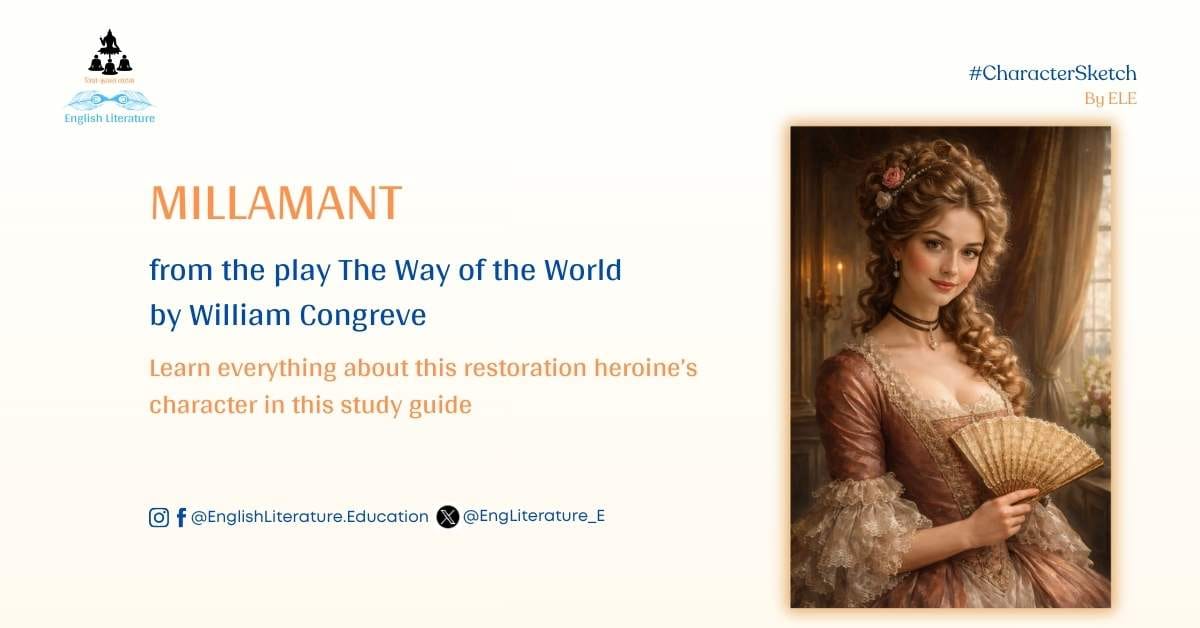
One of the most dynamic, self-aware and fitting-to-the-time ladies of the English stage, Millamant in The Way of the World lights up the scenes she is attributed with the playwright Congreve. Despite the romantic and comic nature of the drama, Millamant is treated not merely as a romantic heroine but as a central intellectual force in The Way of the World by William Congreve. This academic article evaluates the character of Millamant in the broader contexts of the play.
Millamant: Wit, Autonomy, and the Ethics of Selfhood
Millamant stands as one of the most complex and enduring female characters in Restoration comedy. While Mirabell is the motivating intelligence of The Way of the World, Millamant is its emotional and ideological prize. Congreve constructs her not as a passive object of desire but as a figure who actively interrogates the conditions under which love, marriage, and identity can coexist. She represents the highest refinement of social elegance, yet simultaneously exposes the fragility beneath that refinement. Her character embodies the play’s central intellectual struggle: the tension between individual liberty and social convention.
Critically, Millamant is not defined by action in the conventional sense. She does not scheme, deceive, or manipulate the plot. Instead, her importance lies in her capacity for resistance. She resists emotional exposure, patriarchal absorption, sentimental cliché, and social reduction. In doing so, she becomes Congreve’s most sustained meditation on female autonomy within a rigid social order.
Millamant as the Social Ideal of the Beau Monde
Within the play’s social hierarchy, Millamant occupies the highest symbolic position. All the male characters admire her: Mirabell loves her genuinely; Witwoud and Petulant follow her as fashionable appendages; Sir Wilfull is willing to marry her to fulfil familial obligation. This universal admiration establishes her as the social apex of the town, the figure around whom taste, wit, and desire converge.
Yet Congreve is careful to show that Millamant’s power is not economic. Despite her social authority, she remains financially vulnerable. Half of her £6000 fortune is controlled by Lady Wishfort, which places Millamant in a precarious position. This imbalance between social power and economic dependence is central to her character. Unlike Lady Wishfort, who wields money without discernment, Millamant wields charm and wit while lacking material control.
Her casual remark captures this paradox:
“I’ll lie abed in a morning as long as I please, and dine in my dressing-gown when I have a mind to’t.”
The tone is playful, but the implication is profound: Millamant clings to symbolic freedoms precisely because larger freedoms remain inaccessible.
Wit as Defence, Not Display
Millamant’s wit is frequently mistaken by other characters as cruelty or affectation. However, a critical reading reveals that her wit functions primarily as defensive armour. In a society that scrutinises women relentlessly, emotional transparency becomes a liability. Millamant, therefore, cultivates a verbal brilliance that allows her to control the terms of interaction.
Her celebrated “cruelty” is self-consciously articulated:
“One’s cruelty is one’s power.”
This line has often been misread as evidence of coquetry or emotional coldness. In context, it reflects a hard-earned understanding of gendered vulnerability. Millamant recognises that affection, once displayed, becomes exploitable. Cruelty, in her lexicon, does not mean malice but emotional restraint.
Congreve reinforces this interpretation through contrast. Millamant’s private confession to Mrs. Fainall reveals the depth of feeling concealed beneath her wit:
“If Mirabell should not make a good husband, I am a lost thing, for I find I love him violently.”
The adverb “violently” is striking. It disrupts the image of Millamant as merely playful or detached. Her emotional life is intense, but deliberately hidden. This duality—surface brilliance masking inner vulnerability—makes Millamant psychologically richer than most Restoration heroines.
The Proviso Scene: Millamant as Moral Legislator
Millamant’s most significant contribution to the play occurs in the Proviso Scene (Act IV), where she articulates a radical vision of marriage. This scene is not merely a romantic negotiation; it is a philosophical argument staged through dialogue.
Millamant’s fear is not of Mirabell, but of the institution of marriage itself. She expresses this fear memorably:
“I’ll never marry, unless I am first made sure of my will and pleasure.”
Her language insists on a precondition, not a concession. She refuses to enter marriage as a gradual erasure of self, famously declaring her refusal to “dwindle into a wife.” The metaphor of diminution captures her anxiety about losing social presence, intellectual vitality, and personal autonomy.
Her demands are precise and revealing:
- Freedom to receive and pay visits
- Independence in correspondence
- Sovereignty over her tea-table
These may appear trivial, but within Restoration society they symbolise control over social space and identity. Millamant is not rejecting marriage; she is redefining it.
Equally important is her rejection of sentimental exhibitionism:
“Let us be very strange and well-bred.”
Here, restraint becomes a moral principle. Millamant understands that public excess of affection trivialises intimacy and subjects it to social ridicule. Her ideal marriage preserves distance as a matter of dignity.
Millamant and Mirabell: Equality Without Illusion
Millamant’s relationship with Mirabell is remarkable for its intellectual symmetry. She does not idealise him, nor does she submit to his authority. Instead, she meets him as an equal negotiator. This equality distinguishes their relationship from every other pairing in the play.
Mirabell’s acceptance of her conditions is crucial. He does not interpret her demands as threats or eccentricities. Instead, he responds within the same legalistic framework, revealing that he recognises the legitimacy of her concerns. The scene thus stages a mutual preservation of identity rather than a contest of dominance.
Millamant’s earlier mockery of marriage is therefore not cynicism but caution. She has observed marriages like that of the Fainalls, where legal authority enables cruelty. Her insistence on safeguards is a rational response to social evidence.
Affectation and Authenticity
Millamant is often associated with affectation, particularly through the commentary of her maid, Mincing. Mincing’s malapropisms and exaggerated delicacy mirror her mistress’s style in comic miniature. When Mincing remarks that Millamant curls her hair with poetry because prose “won’t make the hair sit pleasant,” Congreve playfully satirises fashionable excess.
Yet the satire is gentle. Millamant’s affectation differs fundamentally from that of Witwoud or Petulant. Their wit is false, an attempt to simulate intelligence they do not possess. Millamant’s affectation, by contrast, is an artful performance masking genuine intelligence and feeling. It is a conscious role, not a delusion.
Millamant in the Moral Structure of the Play
In the play’s ethical geometry, Millamant represents refined decency. She is neither naïve like Sir Wilfull nor corrupt like Mrs. Marwood. Unlike Lady Wishfort, she is not blinded by vanity; unlike Mrs. Fainall, she is not paralysed by passivity. Her success at the end of the play signals Congreve’s endorsement of intelligent self-assertion.
Importantly, Millamant does not triumph through manipulation or sacrifice. She neither schemes nor capitulates. Her victory lies in articulation. She articulates her conditions clearly and refuses to be absorbed silently by social expectations.
Conclusion: Millamant as Congreve’s Most Modern Character
Millamant is one of the earliest dramatic figures to insist that love must not erase selfhood. Her wit, often mistaken for frivolity, is a tool of survival. Her caution, often mistaken for cruelty, is a form of ethical intelligence. Congreve neither idealises nor punishes her; instead, he allows her to define the terms of her happiness.
In a dramatic tradition that often rewards female compliance, Millamant is rewarded for discernment. She emerges not merely as Mirabell’s beloved but as his intellectual equal and moral counterpart. Together, they represent Congreve’s highest ideal: a partnership grounded in clarity, restraint, and mutual respect within the unavoidable constraints of the world.
Read more character sketches from The Way of the World – Mirabell | Millamant (currently reading) | Fainall | Lady Wishfort
Read Detailed Summary of the Play – The Way of the World by William Congreve Summary
Read the comprehensive study guide – The Way of the World Study Guide
Dr Alok Mishra
for the English Literature Education platform
Thanks for reading!