When we begin reading Jean Baudrillard, many students feel both fascinated and unsettled. His ideas seem dramatic. He tells us that we no longer live in a world of solid reality. Instead, we inhabit a universe of images, copies, media spectacles and circulating signs. According to him, what we call “reality” may already be a simulation. Agree? You might, now that we live in a world populated by content generated by Artificial Intelligence rather than humanity. And therefore, many critics and social thinkers ascribe the attributes of a prophet to the legendary Baudrillard! Well, leaving aside his attributions and status among scholars, I will remain focused on his ideas, thoughts and the contributions to the theory of Hyperreality (within and beyond the literary framework).
Let us move slowly and carefully. Baudrillard is not merely being sensational. He is responding to major changes in late-twentieth-century society: consumer capitalism, mass media, advertising, television, digital culture, and global spectacle. His work belongs to postmodern thought, but it also revises Marxism, semiotics and sociology. Do you see? In the space of literary theory, nothing moves in a vacuum! Every concept is related to another, in a way.
In this study guide, I will explain his ideas as I would in a classroom – clearly, calmly and without unnecessary jargon. By the end, you should understand his key concepts: simulation, simulacrum, hyperreality, and the transformation of politics and economy into systems of signs.
1. From Representation to Simulation
The Traditional Idea of Representation
For centuries, Western thought assumed that signs represent reality. A word represents an object. A painting represents a landscape. A photograph captures a real event. Even religious symbols were believed to point to divine truth.
In simple terms:
- There is a real thing.
- A sign refers to that real thing.
- Meaning depends on that connection.
This belief forms the backbone of realism in literature and art. When a novelist describes a village, we assume that the description refers to an actual social world. Even if fictional, it imitates reality.
Baudrillard challenges this assumption.
The Four Phases of the Image
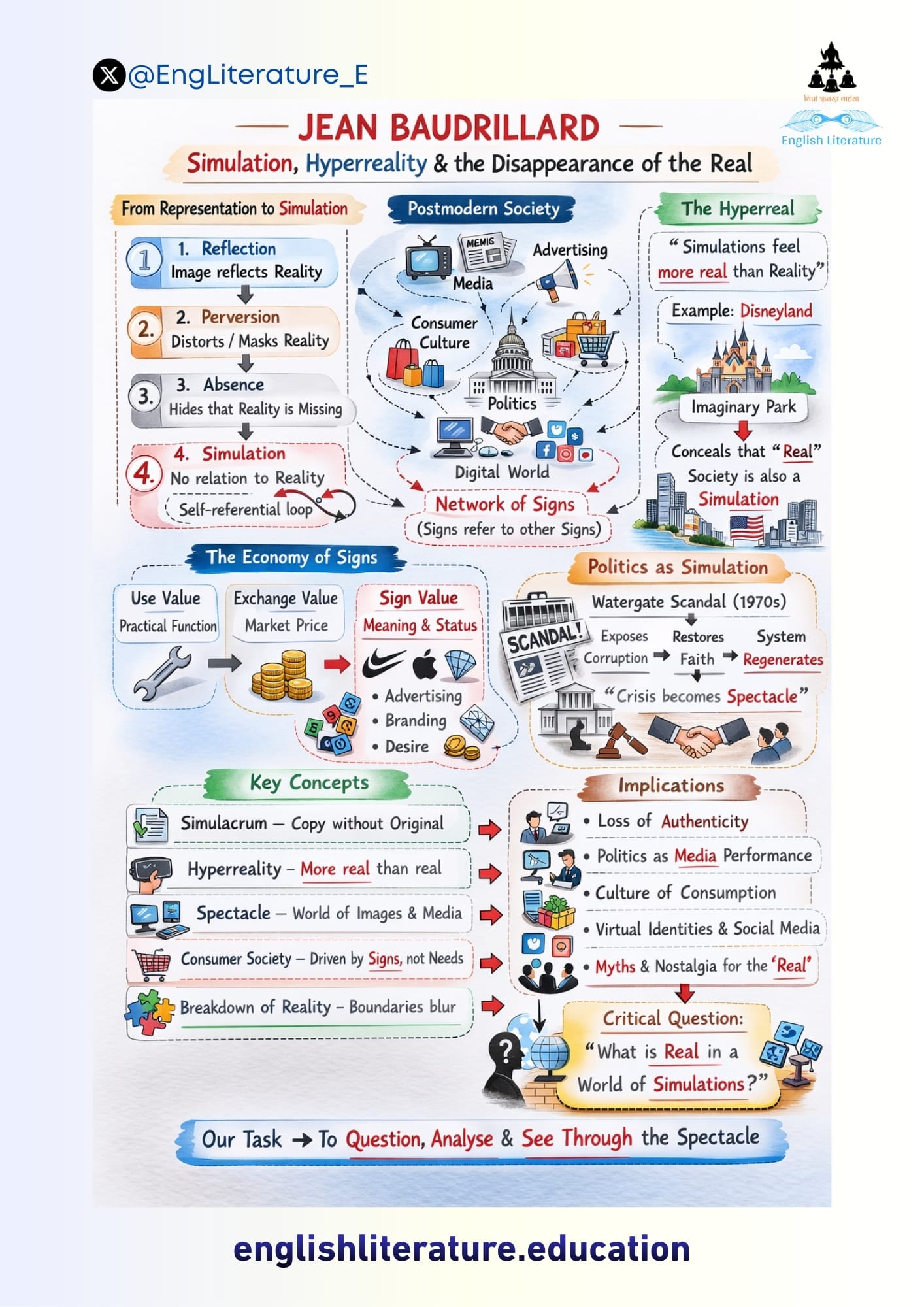
Baudrillard describes four historical stages in the relationship between image and reality:
Reflection of Reality
The image reflects a basic reality.
Example: A portrait that faithfully depicts a person.
Masking and Distortion
The image masks or distorts reality.
Example: Propaganda that alters truth but still refers to something real.
Masking the Absence of Reality
The image hides the fact that reality itself has disappeared.
Example: A reconstruction of a historical village where the original no longer exists.
Pure Simulation
The image has no relation to reality at all. It becomes a simulacrum, an independent copy without an original.
This final stage is crucial. In simulation, there is no “real” behind the image. The sign circulates within other signs. It refers only to other images.
Imagine social media. An influencer presents a lifestyle shaped by filters, editing and branding. The audience responds with likes, comments and shares. The “reality” of that lifestyle may not matter. What circulates is an image economy.
Baudrillard argues that contemporary society has reached this fourth stage. We are surrounded by simulacra, copies without originals.
2. The Hyperreal: When Reality Becomes More Real Than Real
One of Baudrillard’s most famous concepts is hyperreality.
Hyperreality is a condition in which simulations feel more real than reality itself. The boundary between real and artificial collapses.
Let us take a simple example. A theme restaurant that imitates a medieval castle may feel more “medieval” than any actual historical ruin. The artificial lighting, costumes and music produce a stronger emotional effect than authentic history.
The experience is intense, polished and carefully designed. It is more real than reality.
Baudrillard famously discusses Disneyland as the perfect model of simulation.
Why Disneyland?
At first glance, Disneyland looks imaginary. It presents pirates, fairy tales, futuristic worlds and cartoon characters. We think it is a fantasy.
But Baudrillard makes a startling claim: Disneyland exists to make us believe that the rest of America is real.
In his view, the entire social system, consisting of media, advertising, politics, and suburban life, is already structured like Disneyland. It is already a simulation filled with spectacle and controlled experience. By presenting itself as imaginary, Disneyland hides the fact that “real” America is equally constructed.
This is a powerful idea. It suggests that modern society is organised around spectacle rather than substance.
The Idea of “Childishness”
Disneyland appears childlike and innocent. But Baudrillard argues that this staged childishness conceals a broader infantilisation of adults in consumer culture. Adults consume fantasies, entertainment and packaged emotions.
In other words, the park’s artificial innocence hides the artificiality of the outside world. To be more precise, close to Baudrillard, a deception deliberately designed to make the widespread deception on a grand scale.
3. Politics as Simulation
Baudrillard extends his argument to politics. From society and social hierarchy to the political apparatus, he takes the theory a few steps ahead and proposes interesting observations.
Traditionally, we believe politics involves:
- Real power
- Real conflicts
- Real ideological struggles
But what if political events are also simulations?
The Case of Watergate
Consider the Watergate scandal.
The scandal led to the resignation of President Nixon. It appeared to confirm that democracy works. Corruption was exposed. Justice prevailed.
However, Baudrillard argues something different. He claims that the scandal functioned as a “scandal-effect.” By publicly denouncing corruption, the system regenerated faith in itself.
In simpler terms:
- The system exposes wrongdoing.
- The exposure proves the system is moral.
- The public regains trust.
But what if corruption is not an exception? What if the entire system is built on structural manipulation? Then the scandal becomes a theatrical performance that hides deeper problems.
Baudrillard suggests that power today produces signs of its own legitimacy rather than genuine transformation. Political debates, televised speeches and dramatic resignations become media events. They circulate as images.
Power simulates a crisis to prove it still exists.
This view may sound cynical. Yet it encourages us to question how media coverage shapes political meaning.
4. The Economy of Signs
To understand Baudrillard fully, we must examine his relationship with Marxism. It is essential to establish this connection before one can fully comprehend his theory of the economy of signs (and its space in society). Let us examine the prospects in phases:
From Use Value to Sign Value
Karl Marx distinguished between:
- Use value: the practical function of an object.
- Exchange value: its market price.
Baudrillard adds another dimension: sign value.
In consumer society, we often buy objects not for their practical use but for what they signify.
- A car may represent status.
- A branded phone may represent sophistication.
- A wedding ring represents commitment beyond its material worth.
Therefore, we often observe how things are marketed, branded and advertised to the masses. Advertising connects products to images of happiness, success and identity. We consume not objects but meanings.
This marks a shift from a production-based economy to a symbolic economy.
The End of Production?
Baudrillard argues that industrial production is no longer the centre of social life. Instead, we are dominated by image production—media, branding, entertainment and digital content.
Work itself changes meaning. It becomes part of lifestyle identity. People speak of “career fulfilment” or “work-life balance.” Labour is integrated into self-expression.
This does not mean factories disappear. Rather, symbolic systems dominate how we understand value.
In such a world, the classical Marxist focus on material production becomes insufficient. We must analyse sign systems.
Where do you stand after learning all these? Whom do you favour in this debate? Marx was right in his hours. Jean Baudrillard is more right in his hours as well as today, the era dominated by curated image-making, careful branding, and thoughtfully added status or value to objects.
5. Media and the “Gigantic Simulacrum”
Television, cinema, advertising and digital networks form what Baudrillard describes as a self-referential circuit of signs. An apparent example is the news. A news piece does not merely report events. It shapes them. A protest becomes meaningful only when televised. A disaster becomes global through media circulation.
Jean states that the system becomes “weightless” because meaning no longer depends on material grounding. Signs refer to other signs. Narratives repeat across platforms. We can understand it by another example.
Consider how viral trends operate. An event gains importance because it trends. It trends because it gains attention. The loop sustains itself. Where is the truth? What to believe? What is reliable? You may ask. You may be asking for a long time.
In such a world, distinguishing between authentic experience and mediated representation becomes difficult.
6. Postmodern Aesthetics and the Loss of the Real
Baudrillard’s thought aligns with broader postmodern theory. Critics such as Terry Eagleton observe that postmodern art no longer reflects reality in the traditional sense. Why? Because reality itself has become image-saturated. When a contemporary novel incorporates advertisements, television dialogue or fragmented narratives, it may be reflecting a world already fragmented by media.
Baudrillard also speaks of nostalgia. When societies sense the loss of authenticity, they produce myths of origin, such as retro fashions, heritage tourism, and revival movements.
We attempt to recreate the “true” or the “lived” because we feel something has vanished. The guilt of belatedness and an awareness of something broken kick in.
7. Important – Applying Baudrillard to Literature
As students of literature, how do we use Baudrillard? How can we use his thoughts and propositions within a literary framework?
Here are some guiding questions:
- Does the text present reality as stable, or as constructed?
- Do media images shape characters?
- Does the narrative blur the line between fiction and reality?
- Is authenticity questioned?
Postmodern novels often include:
- Pastiche
- Self-referential narration
- Media saturation
- Collapse of boundaries between high and popular culture
These features reflect a simulated cultural environment.
For example, dystopian fiction frequently depicts societies controlled by spectacle and propaganda. Such texts can be read through Baudrillard’s framework.
8. Strengths and Criticisms of Baudrillard
No serious study guide should avoid criticism. Therefore, here are some of the strengths and limitations ascribed to Jean Baudrillard’s theory:
Strengths
- He provides a powerful critique of consumer culture.
- He anticipates digital media and virtual reality.
- He encourages scepticism toward political spectacle.
- He expands Marxism into symbolic analysis.
Criticisms
- Some argue he exaggerates the disappearance of reality.
- Others claim he neglects material inequality and economic struggle.
- His writing style can be provocative and abstract.
Even if we disagree with him, his framework sharpens our awareness of media culture.
9. Baudrillard in the Digital Age
Although he wrote before social media became dominant, his ideas appear strikingly relevant today.
Virtual influencers, deepfake videos, curated online identities and immersive gaming environments all complicate the idea of authenticity.
When a digitally generated celebrity attracts millions of followers, what does “real” mean?
When political campaigns rely on image management and algorithmic targeting, are we witnessing simulation?
These are questions Baudrillard’s propositions compel us to ask. However, answers are not guaranteed!
Important: Question and Answer Section
Q1. What is a simulacrum?
A simulacrum is a copy without an original. It does not represent reality but functions independently as a sign.
Q2. What is hyperreality?
Hyperreality is a condition in which simulations feel more real than reality itself.
Q3. How does Baudrillard differ from Marx?
Marx focuses on material production and economic structures. Baudrillard argues that symbolic exchange and sign systems now dominate social life.
Q4. Why is Disneyland important in his theory?
Disneyland demonstrates how imaginary spaces conceal the simulated nature of the wider social system.
Q5. What is meant by the “scandal-effect”?
Public scandals can reinforce faith in the system by presenting corruption as an exception rather than a structural feature.
Quick Concept Summary
- Representation assumes a stable reality.
- Simulation replaces reality with self-referential signs.
- Hyperreality blurs real and artificial.
- Consumer society operates through sign value.
- Politics becomes spectacle.
Concluding Reflections
When I introduce Baudrillard to students, I often remind them not to read him as a prophet of doom. Instead, read him as a sharp cultural diagnostician.
He asks us to question:
- What do our images conceal?
- What does media amplify?
- What does the consumer desire replace?
Whether one fully accepts his argument or not, one cannot ignore the transformation of society into a network of signs, spectacles and symbolic exchanges.
As readers and critics, our responsibility is not to surrender to simulation, but to analyse it. Baudrillard provides the conceptual tools.
If literature once held a mirror to nature, we must now ask: is the mirror reflecting reality—or only another mirror?
That question remains at the heart of postmodern theory.
Dr Alok Mishra
Professor of English Literature
Department of English, Nava Nalanda Mahavihara (Nalanda)