Shakespeare!
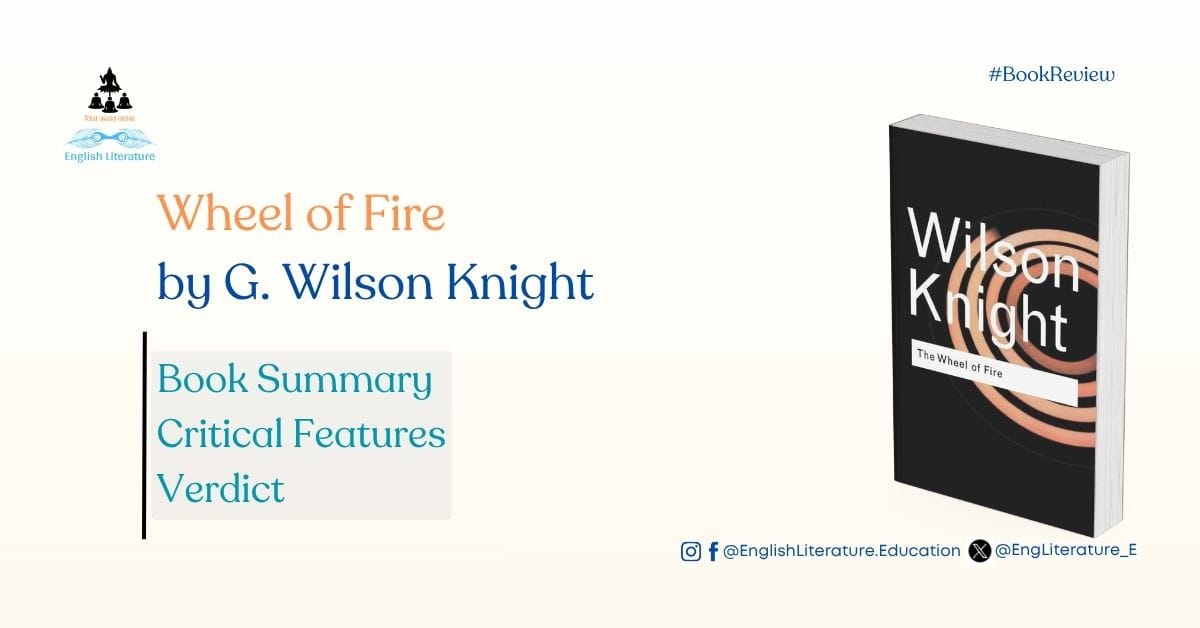
The word, as soon as an inspired student of English literature hears this name, brings many emotions to life. And I will conclude this romantic saga by surmising that merely hearing the name William Shakespeare must feel like a mini salvation to the new priests of the temple of English tragedies. Nevertheless, salvation has historically been troublesome to achieve. A Guru, in most cases, has made this daunting venture imaginable. (You may see I am wording my thoughts cautiously.) Who is the Guru to look for when the topic is William Shakespeare, the enigmatic playwright? Though scholarly readers and professors of literature will help us with many names, I will put G. Wilson Knight on the highest pedestal. Today’s article is a detailed book review of his most popular title – The Wheel of Fire.
Book Details
Title: The Wheel of Fire: Interpretations of Shakespearean Tragedy
Author: G. Wilson Knight
Publication Details: Routledge Classics Edition, 2001 (originally published in 1930)
ISBN: 0-415-25395-0
Genre: Literary Criticism
If I dare to evaluate the book’s worth and utility in the opening paragraph, I am fully aware it might be a treason to the vast intellect Knight must have put into this effort. However, to introduce you to this treasure of insightful interpretation, something has to be done.
The Book at a Glance
The Wheel of Fire does not study some of the greatest Elizabethan tragedies in isolation. It rather proposes that Shakespearean tragedy achieves its deepest meaning not through isolated plot events or by achieving realistic characterisation but through the creation of total imaginative universes in which character, imagery, atmosphere, action and metaphysical suggestion are fused to conjure a whole that surpasses the sensory appeal of literature and knocks at the doors of the subconscious or the spiritual, if I admit the lack of a proper word. Knight traces recurrent structures across Shakespeare’s tragedies. He highlights, especially, the tensions between love and hate, life and death, intuition and intellect, good and evil, nature and civilisation. Based on these recurring structures, the scholar argues that Shakespeare progressively develops and transforms these patterns. The tragedies consequently form not merely a sequence of dramatic stories but a vast imaginative and philosophical exploration of human consciousness, suffering, passion and the possibility of transcendence.
Detailed Review
G. Wilson Knight’s The Wheel of Fire: Interpretations of Shakespearean Tragedy belongs to that rare category of critical books which do not merely tell us what to think about literature, but alter the very manner in which we look at it. That is, to put it with better organisation of words, a book such as Knight’s helps readers graduate into full-fledged scholars (given that their wisdom has sharpened their critical and intellectual acumen in the classroom). First published by Oxford University Press in 1930, later substantially established through its 1949 fourth edition and subsequently carried into the Routledge editions, the book is a collection of insightful critical essays on Shakespeare’s major tragedies, introduced by T. S. Eliot. Its fifteen essays move through Hamlet, Troilus and Cressida, Measure for Measure, Othello, Julius Caesar, Macbeth, King Lear and Timon of Athens, and then widen their scope into questions of symbolic personification, Shakespearean metaphysics, Tolstoy’s criticism of Shakespeare and, finally, a reconsideration of Hamlet. At first glance, therefore, it appears to be another substantial volume of Shakespeare criticism. However, a closer reading reveals something much more ambitious. Knight is attempting nothing less than to recover the inner architecture of Shakespeare’s dramatic imagination, to identify the hidden correspondences by which character, image, atmosphere, action and philosophical suggestion become parts of a single artistic organism.
It is this ambition that makes The Wheel of Fire exhilarating and, at times, exasperating. A BA student? Please be reminded and requested: Knight is not interested in the Shakespeare of textbook summaries, nor in the Shakespeare who can be conveniently explained through biography, source study or conventional character criticism. He is after the Shakespeare who creates entire worlds of feeling and thought. His starting point is therefore methodological. The author passionately argues that a Shakespearean play must not be dismantled into convenient fragments and then judged according to the standards of ordinary life. It must first be encountered as an imaginative whole. Knight puts the matter with characteristic force: “We should regard each play as a visionary whole,” one “close-knit in personification, atmospheric suggestion, and direct poetic symbolism.” This is not a passing observation. It is the governing principle of the entire book. For Knight, a play is not simply a sequence of events. It is a field of relationships in which every image, every movement, every recurrent word and every apparently strange incident participates in a larger pattern.
The distinction matters because so much conventional criticism, even when intelligent, begins from the wrong end. It asks whether Iago’s motives are adequate, whether Macbeth behaves like a “real” man, whether Gloucester’s fall in King Lear is plausible, or whether Othello could actually speak in the elevated language Shakespeare gives him. Though it might appear, once again, convenient to doubt the author’s intention. However, Knight does not dismiss these questions merely because they are difficult. He dismisses them because they often fail to reach the actual source of the play’s power. The critic, he suggests, tears individual elements from their imaginative setting and then complains that they do not function satisfactorily outside it. The result is a kind of criticism that destroys the very thing it claims to explain. In one of his sharpest formulations, he argues that the critic selects those elements of Shakespeare that resemble ordinary life, subjects them to psychological analysis, and neglects the “true, the poetic, realities” of the work. There is something deeply relevant here even for contemporary reading. We are often encouraged to approach literature through the language of motivation, realism, representation and social context. Knight reminds us that literature creates its own reality before we begin to judge that reality by categories borrowed from elsewhere.
His great metaphor for interpretation is visual. The story gives us what he calls a “horizontal sight”, a line of events, a visible rock-line of cause and effect. Interpretation must rise above that line and see the play as a “panorama, spatialized”, tracing its “hills and vales and streams.” The metaphor is especially apt for Macbeth, but it describes Knight’s reading of Shakespeare as a whole. In Macbeth, darkness is not merely a background. Blood, sleep, animals, storms, prophecies, unnatural occurrences, political disorder and spiritual fear echo one another until the entire play becomes a single atmosphere of evil. As a tribute to the great bard himself, Macbeth’s setting appears to mutate into a giant bowl of troubling ocean harbouring a deadly vortex of unending chaos in its depth! Knight consequently reaches one of the most memorable sentences in the volume: “Macbeth is the apocalypse of evil.” The phrase has the force of a verdict, but its real importance lies in the method behind it. Knight is not claiming that Shakespeare has written a theological treatise on evil. He is saying that Macbeth makes evil imaginatively present, that it gives evil an entire universe in which fear and uncertainty become nearly tangible realities.
This is where Knight is at his most persuasive. He understands something that plot summaries invariably miss. Macbeth is not frightening merely because murders are committed. It is frightening because the whole natural and supernatural order of the play appears to have been disturbed. The witches, the darkness, the strange behaviour of the animals, the blood, the ghostly apparitions, the disturbed sleep, the prophetic ambiguities and the increasingly unstable consciousness of the protagonist all participate in one dramatic atmosphere. Knight insists that such a vision cannot be “accounted for in terms of ‘will’ and ‘causality’.” It speaks instead to “the responsive imagination”. This is an important critical distinction. There are literary experiences that explanation can illuminate but never exhaust. Knight’s finest pages understand that mystery is not the failure of interpretation. It is sometimes the very substance of the work.
His treatment of Hamlet is similarly revisionary. The conventional Shakespearean question has long been the question of delay. Why does Hamlet not act sooner? Why does a man who knows so much do so little? Knight shifts the centre of gravity altogether. The great theme of Hamlet is death. The Ghost, the Graveyard, Yorick’s skull, the dead Polonius, Ophelia’s madness, the final accumulation of corpses, the sexual disgust and the recurrent sense of bodily decay all belong to one imaginative structure. Hamlet is therefore not merely a prince required to avenge a murder. He is, in Knight’s unforgettable phrase, “the ambassador of death walking amid life.” The brilliance of this formulation is that it gathers together details that are often discussed separately. Hamlet’s melancholy, his morbidity, his coarse humour and his cruelty are no longer isolated psychological quirks. They are manifestations of an imagination in which death has become the dominant reality.
Knight pushes this insight further when he considers Ophelia. Sardonically, her love represents Hamlet’s last connection with life and purpose. That connection is shattered almost simultaneously with the burden imposed by the Ghost. Knight refuses to treat Hamlet’s encounter with Ophelia as merely one more episode in a romantic subplot. When she describes him as pale, disordered and seemingly released from hell to speak of horrors, Knight sees something more than calculated theatricality. This is where Knight’s critical tenacity comes alive! He lays bare what ordinary readers and fragmented critics might overlook. Hamlet’s madness has become the outward sign of an inward experience of spiritual death. One may disagree with the extremity of Knight’s formulation, but it is difficult to deny that he has made the play more coherent. The Ghost, Ophelia, the Graveyard and the final bloodshed are no longer separate compartments. They belong to the same architecture.
Troilus and Cressida receives another of Knight’s characteristic acts of rehabilitation. The play has often troubled readers because of its tonal instability, its mixture of romance, satire, military politics, cynicism and philosophical reflection. Knight regards precisely this mixture as evidence of its unity. Its central opposition is between intuition and intellect, romantic faith and analytical scepticism, individual allegiance and social calculation. Troilus believes in love as an absolute value, while the Greek world subjects everything to calculation, strategy, hierarchy and expediency. Cressida becomes the tragic point at which the infinite desire for constancy meets the finite conditions of human existence. Knight’s statement that Troilus and Cressida is a world in which “the infinite” is made “slave to limit” captures much of the tragedy in a single phrase. Love is beautiful, but the human world is not constructed to preserve beauty indefinitely. Time intervenes, circumstances intervene, social structures intervene, and what the individual experiences as absolute becomes vulnerable to the ordinary corruption of the finite world.
The same concern with moral absolutes governs Knight’s reading of Measure for Measure. Here the Shakespearean problem is less about romantic idealism than about judgement. The play’s relation to the Gospels is, for Knight, fundamental. Its central ethical principle is contained in the command, “Judge not, that ye be not judged.” The brilliance of the chapter lies in the way Knight refuses to leave the moral categories comfortably distributed. Angelo, Isabella, Lucio and the Duke represent different forms of moral consciousness, yet none can claim absolute authority over the rest. Angelo is not merely a hypocrite. He is a man whose conception of purity is so rigid that it becomes incapable of dealing with the actual complexity of desire. Isabella’s saintliness, similarly, becomes dangerous when it detaches itself from human sympathy. Her ultimate transformation is therefore a movement “from sanctity to humanity.” The idea becomes more striking when Knight observes that the final punishment of both Angelo and Lucio is essentially a discovery of themselves. Self-knowledge becomes “the supreme, perhaps the only, good.” What Knight sees in the play is not a crude opposition between virtue and vice, but a subtler Christian ethic in which humility, mercy and self-recognition are superior to moral self-certainty.
Perhaps the most aesthetically sensitive chapter is the one on Othello, especially in its attention to language. Knight understands that Shakespeare’s style is not decorative material added after the characters have been imagined. Style is part of character. Othello’s language is rich, concrete, exotic, full of named places, jewels, seas, celestial imagery and sharply delineated objects. Knight contrasts this with the more fluid and atmospheric imagery of Macbeth. In Othello, images remain almost like objects before the mind, solid and luminous. Iago is the antithesis of this imaginative abundance. “I am nothing if not critical,” he declares, and Knight seizes upon the line as a description of his entire philosophy. Othello believes in love, valour, honour and the romance of his own identity. Iago believes in the instability of all these things. He does not need to construct an alternative world. He merely needs to corrode the one Othello inhabits.
Yet Knight is too perceptive to let cynicism have the final word. Even after Desdemona’s death, Othello’s language regains its breadth. He speaks again in terms of stars, sun and moon, the globe and the immense beauty of the world. Iago has destroyed Othello’s domestic happiness, but he has not annihilated the imaginative source from which Othello’s language arose. This is a crucial aspect of Knight’s understanding of tragedy. Tragedy does not necessarily end in the triumph of destruction. It may allow the destructive force to win in the visible world while the deeper imaginative value survives.
His interpretation of King Lear is more unsettling still because Knight insists that comedy and grotesque humour are not accidental intrusions into a tragedy otherwise devoted to suffering. They are part of its deepest structure. “This recurring and vivid stress on the incongruous and the fantastic,” he writes, “is not a subsidiary element in King Lear: it is the very heart of the play.” The Fool, Edgar’s Poor Tom, Gloucester’s mock-suicide and Lear’s strange behaviour all create a tragic universe in which the terrible and the absurd continually confront each other. Knight’s point is not that we should laugh at Lear. Quite the contrary. He argues that the comic and tragic, because they both arise from profound incompatibilities, become even more powerful when they intersect. “A humour that treads the brink of tears” can deepen tragedy because it brings before us the grotesque disproportion between human suffering and the world that contains it.
That leads to perhaps the most disturbing idea in the book. King Lear does not finally reassure us that suffering has a clear cosmic purpose. The death of Cordelia is terrible precisely because it seems unnecessarily terrible. Knight writes that “the tragedy is most poignant in that it is purposeless, unreasonable.” This is an extraordinary claim to make about a play so often approached through moral, Christian or redemptive frameworks. Knight does not deny the movement toward humility and love, but he refuses to use that movement as a sentimental explanation for Cordelia’s death. Lear may be spiritually transformed, but the universe remains mysterious. The tragedy is therefore not weakened by the absence of a neatly legible divine justice. It is strengthened by Shakespeare’s willingness to confront the possibility that suffering is not always proportionate to desert.
The essay on The Lear Universe expands this argument beyond Lear himself. The entire play becomes a microcosm of humanity, “not England, but the world.” Knight’s attention to nature is particularly impressive. Animals, storms, flowers, winds and rural landscapes are not merely scenic details. They form a philosophical vocabulary through which Shakespeare asks what remains when civilisation is stripped away. Poor Tom’s nakedness and Lear’s madness bring the human being into intimate contact with the animal. Lear asks, in effect, what a man is beneath the external structures that civilisation supplies. “Unaccommodated man,” as Knight emphasises, becomes “such a poor, bare, forked animal.” Yet Knight does not romanticise nature. Edmund appeals to nature to justify selfishness, and this complicates any simplistic opposition between the natural and the civilised. For Knight, what makes man genuinely human is not mere appetite, but sympathy and selflessness.
The climax of this trajectory comes in Timon of Athens, where Knight finds the most complete expression of Shakespeare’s hate-theme. Timon begins as the personification of generosity. His wealth is inseparable from his emotional abundance. When his friends betray him, his love does not simply diminish. It reverses itself. Love becomes hate, generosity becomes a curse, society becomes corruption, and the finite world itself becomes intolerable. Knight therefore sees Timon’s withdrawal from Athens as a movement through successive layers of existence. Civilisation is rejected, then humanity, then nature itself, until Timon finally turns toward death. The distinction between Timon and Apemantus is particularly acute. Apemantus is a cynic because cynicism is his nature; Timon becomes a cynic because an extraordinary capacity for love has been betrayed. His hatred is therefore not emptiness. It is wounded abundance.
Knight’s treatment of gold is one of the finest examples of his symbolic method. Gold begins as a symbol of generosity and material abundance, but gradually becomes the visible sign of a society that values money more highly than love. Timon’s great discovery is that the social order has substituted economic value for spiritual value. Knight’s phrase that Athens has preferred “the gold of coins” to “the gold of love” captures the moral structure of the whole play. This symbolism also helps explain why Timon’s final movement toward death is not merely an act of despair. Knight regards death as the culmination of a passion for which the finite world is no longer an adequate container. “Nothing brings me all things,” Timon says, and Knight interprets this paradox as the final logic of his spiritual trajectory.
At this point the individual essays begin to merge into a single theory of Shakespearean imagination. Knight identifies recurrent patterns among Shakespeare’s major figures. Othello, Lear, Troilus and Timon, despite enormous differences, become variations upon a recurring structure in which noble humanity encounters a principle of love or spiritual value and is opposed by cynicism. He calls this process “symbolic personification”. I find this one of the most stimulating, though also one of the more debatable, aspects of the book. Knight can sometimes make Shakespeare appear to be repeating a symbolic formula with unusual consistency. Yet even where the theory becomes schematic, it teaches us to recognise genuine structural echoes. The cynicism of Thersites and Apemantus, the active destructiveness of Iago and Edmund, the idealising force embodied by Desdemona and Cordelia, the noble but vulnerable protagonists who respond to them, all begin to look like different manifestations of recurrent tensions in Shakespeare’s dramatic imagination.
The comparison with Tolstoy is similarly ambitious. Knight uses Tolstoy’s spiritual crisis to challenge the assumption that external circumstances explain inner life. Tolstoy was prosperous, successful and physically healthy when he experienced his crisis of meaning, and Knight uses this to complicate simplistic attempts to explain Shakespeare’s tragic period through biographical misery. More importantly, Tolstoy allows Knight to formulate the role of the infinite in Shakespeare. Finite things cannot adequately explain the meaning of finite existence. At some point, the mind reaches a limit beyond which either faith or some analogous intuition of infinity must enter. In Knight’s reading, Shakespearean tragedy makes that movement dramatically rather than doctrinally. Death, passion and love become ways in which the finite brushes against the infinite.
This explains why Knight’s metaphysical vocabulary can seem simultaneously old-fashioned and strangely fresh. He speaks of Hell, Purgatory, Paradise, infinity, spiritual reality and absolute evil, yet he is not simply reconstructing a medieval theology. He is trying to find a language adequate to the extraordinary intensity of Shakespeare’s imaginative effects. His formulation of the three Shakespearean universes is memorable: in Macbeth we experience Hell, in King Lear Purgatory, while Antony and Cleopatra gestures toward Paradise. Whether or not one accepts the categories in their full metaphysical sense, the comparative insight is powerful. Macbeth exists within a world dominated by fear and evil; Lear within a world of suffering and moral uncertainty; Antony and Cleopatra within a world where love achieves an almost transcendent fullness.
Knight’s response to Tolstoy’s attack on Shakespeare is therefore intellectually generous. He does not simply dismiss Tolstoy as a philistine. He recognises that Tolstoy’s objections to artificiality sometimes point toward precisely those aspects of Shakespeare that require deeper interpretation. Tolstoy is disturbed by Lear’s flowers, Edgar’s disguise, the storm, Gloucester’s fall and Othello’s elevated language. Knight replies that these are not embarrassments to be excused. They are clues to the imaginative structure of the plays. The flower crown that Tolstoy sees as an arbitrary embellishment becomes, in Knight’s reading, an intricate symbol joining madness, nature, suffering, innocence and spiritual transformation. Knight’s defence here is persuasive because it does not deny the apparent artificiality. It explains it.
There is also a useful critical irony in Knight’s treatment of Shakespearean “religion”. Tolstoy demands a religious essence in art, but believes Shakespeare lacks one. Knight agrees with Tolstoy that great drama should have an axis involving ultimate questions, yet he argues that Shakespeare’s religious vision is not to be found in explicit doctrine. It exists in the drama’s symbols, its treatment of death, its relation between finite action and infinite significance, and its recurring exploration of man’s relation to the unseen. In other words, Knight does not make Shakespeare religious by forcing theology upon him. He makes Shakespeare religious by showing how deeply the plays are concerned with questions theology has traditionally addressed.
The final essay, Hamlet Reconsidered, is valuable partly because it reveals Knight reconsidering Knight. He admits that his earlier essays on Hamlet had been “inadequate” and “misleading” in emphasis and attempts to extend rather than simply discard them. He is more cautious here about Hamlet’s madness and more alert to the complexity of his ethical position. Most importantly, he develops the idea of art as a form of action. Hamlet turns to the Players because theatre can do something that direct accusation cannot. It can make conscience reveal itself. Knight’s remarkable description of art as “approach, attack, and love, all in one” may be one of the most beautiful statements in the entire volume. It also reveals something about Knight’s own criticism. He approaches Shakespeare through sympathy, attacks conventional readings through intellectual argument, and tries to reveal a deeper order beneath the visible drama.
Yet The Wheel of Fire is not without its limitations, and a serious review should not conceal them. Knight sometimes loves his own system too much. His recurrent patterns of love, hate, intuition, intellect, noble humanity, cynicism and spiritual development can occasionally appear more consistent than Shakespeare’s plays themselves. The language of evolution and metaphysical hierarchy belongs distinctly to the intellectual climate in which Knight was writing. There are moments when symbolic interpretation threatens to flatten psychological complexity rather than deepen it. There is also a danger in regarding Shakespeare’s “progress” from Hamlet to Timon as a straightforward development of one spiritual mind. Such a model is compelling as criticism, but it remains a model. It should not be mistaken for a demonstrable map of Shakespeare’s private consciousness.
And yet these limitations scarcely diminish the importance of the book. Indeed, they may tell us something useful about the nature of ambitious criticism. Knight risks excess because he is unwilling to settle for the obvious. He is prepared to make a grand claim and then test it against dozens of scenes, images and verbal patterns. His criticism occasionally feels prophetic because he is always searching for a centre. In a period when literary studies can sometimes become fragmented into ever narrower specialisations, there is something intellectually refreshing about a critic who asks large questions without embarrassment. What is evil? What does death mean? Why does love become hatred? What happens when human beings encounter their own limits? How does a work of art create a world that seems larger than its plot? These are questions of literature, but also questions of life.
That is finally what makes The Wheel of Fire such a stimulating book to read, even when one disagrees with it. Knight does not allow Shakespeare to remain safely familiar. He takes the plays we think we know and asks us to look again. Hamlet is no longer merely the tragedy of indecision. Macbeth is not merely a drama of ambition. Othello is not merely a story of jealousy. King Lear is not merely an old king discovering the value of love. Timon of Athens is not merely the story of a disappointed benefactor who becomes a misanthrope. Each play becomes a particular universe, governed by its own imaginative laws, and yet each universe speaks to the others.
Perhaps Knight’s most enduring idea is that literature must be approached with both emotional sympathy and intellectual agility. A critic who sees only psychology misses symbolism. One who sees only symbolism misses human feeling. One who sees only ethics risks turning art into moral instruction. One who sees only history may lose the immediate imaginative force of the poem. Knight’s own criticism is strongest when all these faculties operate together. He does not simply say that Shakespeare is profound. He attempts to show how profundity is built into the structure of the plays.
That is why his sentence about the mosaic remains so apt: “the removing, or blurring, of a single stone in the mosaic will clearly lessen our chance of visualizing the whole design.” It is also a fitting description of Knight’s own book. Each essay is another stone in a larger design. Hamlet supplies death-consciousness, Troilus the conflict between value and intellect, Measure for Measure the inadequacy of judgement, Othello the collision of love and cynicism, Macbeth the metaphysics of evil, Lear the mystery of suffering, and Timon the terrifying reversal of love into hate. The later essays gather these fragments and attempt to see the whole image.
To finally end this exhaustive critique, The Wheel of Fire may occasionally seem excessive, even eccentric. But its best pages possess the rare ability to make criticism itself feel like discovery. It reminds us that a great literary work is not exhausted when we know its plot, identify its symbols or summarise its “themes”. A Shakespearean tragedy continues to live because it creates a field of meaning in which reason, emotion, image, mystery and moral consciousness remain in tension. Knight understood that better than most critics of his generation. He also understood that the task of criticism is not to extinguish mystery by overexplaining it, but to illuminate the structures through which mystery becomes perceptible. His great achievement in The Wheel of Fire is therefore not that he has solved Shakespeare. It is that he has made Shakespeare larger. And perhaps that is the highest compliment one can pay to a critic.
Dr Alok Mishra
Poet, Critic, and Professor of English Literature