The Faerie Queene, Book I: Introduction, Technical Features and Significance
Edmund Spenser (c.1552–1599) does stand among the major poets of the English Renaissance and occupies a particularly important position in the transition from medieval allegorical traditions to the self-conscious literary culture of Elizabethan England. In fact, because of many intellectual and creative reasons, he stands out! Born in London and educated at Merchant Taylors’ School and Pembroke Hall, Cambridge, Spenser developed an unusually wide intellectual range, drawing upon classical literature, medieval romance, Christian theology, humanist moral philosophy, and contemporary political culture. His literary career included The Shepheardes Calender (1579), Complaints, Amoretti, Epithalamion, and, above all, The Faerie Queene. He had already begun writing the latter by 1580, and its first three books were published in 1590. A substantially expanded edition containing Books I to VI appeared in 1596.
The Faerie Queene is conceived as a vast moral and national epic. Its title page announces twelve books “Fashioning XII. Morall vertues,” while Spenser’s Letter to Raleigh identifies its larger purpose as the formation of “a gentleman or noble person in vertuous and gentle discipline.” Arthur, presented before his kingship, is intended as the exemplary knight in whom these virtues will ultimately be perfected. The poem, consequently, abundantly combines romance, epic, allegory, Christian didacticism, chivalric narrative, political symbolism, and moral philosophy. The poet’s ambition lies in a craft with a method not simply to explain virtue abstractly, but to embody virtue and vice through persons, adventures, landscapes, objects, temptations, conflicts, and symbolic encounters.
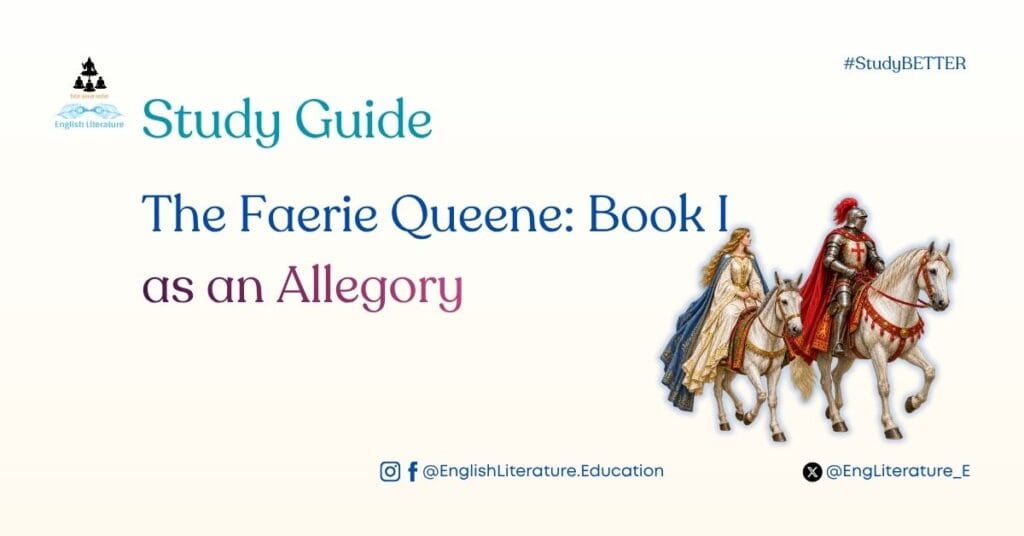
Book I, entitled “The Legend of the Knight of the Red Crosse, or Of Holinesse,” is the poem’s most coherent individual moral narrative. Its twelve cantos trace Redcrosse Knight’s movement through error, temptation, deception, pride, despair and, finally, spiritual restoration. Una represents truth and faithful guidance, while Archimago, Duessa, Errour, Orgoglio and Despair dramatise different forms of spiritual and moral distortion. The House of Holiness provides the crucial counter-movement to these destructive forces, culminating in repentance, charity, contemplation and renewed strength. The dragon episode then gives the narrative its climactic external form, transforming inward spiritual conflict into heroic combat. The book therefore presents holiness not as an abstract quality but as a process in which human will cooperates with divine grace to achieve righteous goals.
Technically, Spenser’s achievement is equally significant. The poem employs the Spenserian stanza, a distinctive nine-line structure whose first eight lines are generally iambic pentameter and whose concluding ninth line is an alexandrine, a six-stress line that gives the stanza its characteristic expansive close. The opening of Book I also demonstrates Spenser’s deliberate positioning of himself within the epic tradition, particularly through engagement with Virgil and Ariosto. The prefatory proems to the individual books are themselves an innovative structural device, for which the edition notes that Spenser had no direct classical or Italian epic precedent.
The lasting significance of The Faerie Queene lies in this synthesis of poetry, ethics, theology, politics and imaginative world-making. For more than four centuries it has remained central to English literary study precisely because it belongs intensely to its Elizabethan moment while continually generating new interpretations. The poem is therefore not merely an allegory to be decoded, but an elaborate symbolic universe in which individual stanzas derive meaning from their relation to the larger structure. Book I, in particular, remains indispensable because it offers Spenser’s most sustained meditation on the formation of the moral self, the instability of appearances, the danger of false doctrine, and the indispensable relation between human virtue and divine grace.
The Faerie Queene, Book I: Summary and Insightful Commentary
“The Legend of the Knight of the Red Crosse, or Of Holinesse,”
Canto I: The Redcrosse Knight, Una, Errour and Archimago
Book I opens with the Redcrosse Knight travelling through an unfamiliar landscape in the company of Una, a noble virgin whose distressed parents await rescue from a terrible dragon. From the beginning, Spenser makes the adventure simultaneously physical and allegorical. Redcrosse represents a developing Christian holiness, while Una embodies truth, unity and the true faith. Their journey soon leads them into the Wandering Wood, where Redcrosse encounters Errour, a grotesque creature surrounded by serpents and poisonous offspring. The combat culminates in her destruction, but the episode establishes a recurrent principle of the poem: spiritual error can only be defeated through a combination of courage and faith. Their subsequent meeting with the apparently holy hermit, Archimago, introduces the opposite possibility, namely evil disguised as sanctity. His religious appearance conceals deception and magical power. Through dreams and fabricated appearances, he persuades Redcrosse to doubt Una. Thus the canto establishes Book I’s central epistemological problem: the hero must learn to distinguish truth from seductive appearance. The episode prepares the larger movement from innocence through error toward spiritual knowledge.
Canto II: Duessa, Sansfoy and Fradubio
The second canto develops the consequences of Redcrosse’s susceptibility to deception. Having abandoned Una because of Archimago’s fabricated evidence, he encounters Sansfoy, whose very name signifies faithlessness. After defeating him, Redcrosse accepts Duessa, disguised as Fidessa, as his companion. Spenser constructs Duessa as the embodiment of duplicity: she appears beautiful, noble and vulnerable, yet every aspect of her identity is counterfeit. The episode therefore intensifies the poem’s opposition between appearance and reality. Duessa’s ability to manipulate Redcrosse demonstrates that physical courage does not guarantee moral discernment. The Fradubio episode deepens this lesson. Once a knight, Fradubio has been transformed into a tree through the machinations of an enchantress after allowing himself to be deceived by appearances. His condition becomes an allegory of the loss of humanity through the surrender of judgement and faith. Redcrosse hears the testimony but does not fully understand its implications because he remains under Duessa’s influence. The canto therefore presents error not simply as ignorance but as a condition actively produced by seductive falsehood.
Canto III: Una, the Lion, Kirkrapine and Sansloy
Separated from Redcrosse, Una continues her journey with remarkable constancy. Her solitude allows Spenser to develop her symbolic identity independently of the knight. She is truth in adversity, and her innocence attracts the protection of the lion, whose natural ferocity is transformed into loyal guardianship in her presence. The episode is significant because an animal recognises what the morally confused Redcrosse has failed to recognise. Una next encounters the grotesque household of Corceca, Abessa and Kirkrapine. Corceca’s physical blindness becomes an emblem of spiritual blindness, while Kirkrapine, whose name literally suggests a robber of the Church, represents religious corruption and sacrilege. Spenser thus juxtaposes true religion with its distorted forms. The canto culminates in the arrival of Sansloy, whose name signifies lawlessness. He kills the lion and carries Una away, while Satyrane later intervenes. Una’s earlier request for mercy also gives the canto an ethical dimension: chivalry is not simply the exercise of force but the disciplined protection of innocence. The canto repeatedly contrasts truth, fidelity and mercy with violence, lust, blindness and religious corruption.
Canto IV: The House of Pride and the Seven Deadly Sins
The fourth canto is one of the central allegorical episodes of Book I. Redcrosse Knight and Duessa arrive at the House of Pride, a magnificent but structurally weak palace whose splendour conceals corruption. Lucifera presides over this artificial court. She is outwardly magnificent, yet her authority is illegitimate because she has usurped power through pride and tyranny. Her mirror symbolises self-absorption, while her upward gaze reveals her desire to exceed legitimate human limits. The spectacular procession of the Seven Deadly Sins then gives visible form to moral corruption. Idleness, Gluttony, Lechery, Avarice, Envy and Wrath are not merely abstract concepts but grotesquely embodied dispositions. Their physical appearance, clothing, animals and behaviour dramatise the psychological consequences of vice. Particularly striking is Avarice, who possesses wealth yet experiences perpetual poverty of desire, and Wrath, whose uncontrolled violence finally turns into remorse. The House of Pride therefore represents more than individual vanity. It is a social and political structure sustained by interconnected moral failures. Spenser’s allegory suggests that vice reproduces itself institutionally, while apparent magnificence may conceal profound spiritual emptiness.
Canto V: Sansjoy, Duessa and the Underworld
The fifth canto brings Redcrosse into combat with Sansjoy, brother of Sansfoy and an embodiment of vengeance. The duel is at once a chivalric confrontation and a continuation of the moral consequences generated by faithlessness. Redcrosse initially falls into danger, but his faith revives and enables him to withstand his opponent. Spenser nevertheless refuses to make physical victory equivalent to spiritual perfection. The wounded Sansjoy is carried away by Night, who descends with him into the classical underworld. Here Spenser brings together Christian and classical traditions. Figures such as Cerberus, Ixion, Sisyphus and Tantalus inhabit a moral landscape governed by punishment, while Aesculapius, unable to heal himself, symbolises the limits of human knowledge and power. The episode is important because it broadens the poem’s moral universe beyond specifically Christian imagery without abandoning its Christian framework. Darkness repeatedly represents ignorance, sin and spiritual alienation, while the returning sun signals the endurance of divine order. The canto consequently develops the opposition between light and darkness that runs throughout Book I and links physical combat to the larger struggle between spiritual truth and moral corruption.
Canto VI: Una, Satyrane and Providence
Canto VI returns the narrative to Una, whose vulnerability exposes the destructive force of lawless desire. Sansloy’s attempted assault upon her is interrupted by the intervention of Fauns and Satyrs. Spenser gives the episode a theological significance by presenting Una’s deliverance as the operation of providence. Her salvation does not arise solely from human agency; grace can create a path of escape when no obvious means exists. The Satyrs initially appear uncivilised, but Una educates them in “Trew sacred lore”. It is significant to note that her role consequently expands from passive embodiment of truth to active teacher and civilising presence. Satyrane, the son of a satyr and a human woman, occupies the boundary between nature and civilisation. His physical vigour, association with wild animals and instinctive heroism make him an unusual but important counterpart to the more conventionally trained Redcrosse. The canto also develops the theme of deceptive appearances through Archimago’s renewed intervention. He pretends to be a pilgrim and fabricates a story about Redcrosse. The later conflict between Satyrane and Sansloy returns the narrative to the opposition between disciplined strength and lawless violence.
Canto VII: Orgoglio and the Arrival of Prince Arthur
The seventh canto marks a decisive reversal in Redcrosse’s fortunes. After prolonged wandering, he and Duessa rest beside a fountain whose waters, though apparently clear and refreshing, weaken him. The episode is allegorical because the apparent source of restoration becomes a source of vulnerability. Redcrosse is subsequently confronted and defeated by the giant Orgoglio. His fall is not adequately explained by the simple notion that he represents pride. The supplied edition itself cautions against reducing Orgoglio to a single moral label and stresses the complexity of the knight’s vulnerability, including his physical and spiritual exhaustion. Orgoglio imprisons Redcrosse in an underground dungeon, where the heroic identity established at the beginning of the poem appears to collapse completely. Una, meanwhile, encounters Prince Arthur, whose entrance introduces a new kind of heroic power. Arthur’s magnificent armour, weapons and bearing are described at length, making him one of the grandest figures in Book I. Unlike Redcrosse, Arthur appears already integrated into a higher conception of virtue. His arrival prepares the narrative for rescue and establishes the principle that grace may operate through another human conduit.
Canto VIII: Arthur’s Victory and Redcrosse’s Liberation
Canto VIII centres on Prince Arthur’s confrontation with Orgoglio. Arthur enters the giant’s territory not merely as a powerful warrior but as a figure of disciplined magnificence. His victory over Orgoglio contrasts sharply with Redcrosse’s earlier defeat and therefore exposes the limitations of the young knight’s development. Duessa, who has prospered through deception, is also confronted with the consequences of Arthur’s intervention. Arthur’s shield, which possesses extraordinary brightness when unveiled, reinforces Spenser’s persistent symbolism of light as a manifestation of truth and higher knowledge. Redcrosse is eventually released from captivity, but liberation does not mean that his moral education has ended. He remains psychologically vulnerable and spiritually incomplete. The canto is consequently best understood as a movement from bondage toward renewed possibility. Arthur functions as an instrument of providence and as an image of a more mature form of virtue. The rescue also reorders the narrative: Una’s truth, Arthur’s magnificence and Redcrosse’s unfinished holiness are brought together. The heroic quest therefore becomes increasingly communal rather than individual. Redcrosse cannot achieve perfection by isolated physical courage. His development depends upon truth, friendship, grace and the assistance of a superior moral example.
Canto IX: Arthur, Despair and the Crisis of Hope
Canto IX begins with the renewed companionship of Arthur and Redcrosse. Their exchange of gifts is symbolically significant. Arthur gives Redcrosse a healing substance, while Redcrosse gives Arthur a book containing the Saviour’s Testament. Physical healing and spiritual salvation are thus placed in reciprocal relation. The central movement of the canto, however, is Redcrosse’s encounter with Despair. Trevisan’s story introduces a psychological landscape in which guilt, fear and hopelessness gradually undermine rational judgement. Despair uses fragments of biblical and moral reasoning to persuade Redcrosse that continued life is itself a burden. The episode therefore becomes an extended examination of suicide, divine judgement, sin and the abuse of religious argument. Despair’s rhetoric is compelling precisely because it contains truths distorted into destructive conclusions. Redcrosse almost accepts the argument because his conscience is already wounded. Una’s intervention becomes crucial because she restores the possibility of hope. The canto thus establishes a decisive distinction between legitimate penitence and destructive despair. Christian consciousness requires recognition of sin, but such recognition must culminate in repentance and reliance upon grace rather than annihilation.
Canto X: The House of Holiness, Repentance and Contemplation
Canto X provides the spiritual centre of Book I. After the destructive experience of the House of Pride and the crisis of Despair, Redcrosse enters the House of Holiness. Spenser begins by insisting that human strength is insufficient against spiritual enemies and that good ultimately depends upon divine grace. The household is governed by Caelia, mother of Fidelia, Speranza and Charissa, embodiments of Faith, Hope and Charity. Fidelia instructs Redcrosse in the knowledge of God, grace, justice and free will, while Speranza teaches him to sustain hope. Patience, Penance, Remorse and Repentance subsequently participate in his moral and spiritual restoration. The treatment is deliberately physical: repentance is represented through fasting, bodily discipline and suffering, making inner transformation visible. Mercy then guides Redcrosse along the narrow way and teaches him charitable action. The canto culminates in the figure of Contemplation, whose physical blindness contrasts with his extraordinary spiritual vision. He reveals the celestial order and the New Jerusalem, but reminds Redcrosse that earthly duty must be completed before heavenly rest can be attained.
Canto XI: Redcrosse and the Dragon
Canto XI brings Redcrosse to the final and greatest conflict of Book I. He returns with Una to her native land, described in imagery suggestive of an Edenic condition threatened by the forces of sin. The dragon represents evil on an apocalyptic scale, combining biblical, classical and mythological traditions in a single monstrous form. Spenser’s description emphasises its immense size, brass scales, poisoned breath, wings, tail and fiery power. The combat unfolds over three days and repeatedly brings the knight close to defeat. The turning point occurs when Redcrosse falls into the Well of Life. Its waters heal disease, cleanse sin and restore life, making the well a powerful figure for baptism, regeneration and divine grace. Renewed, Redcrosse returns to battle and eventually kills the dragon. The victory, however, is deliberately attributed both to the knight and to divine power working through him. The dragon’s destruction therefore cannot be interpreted as a triumph of autonomous human strength. It is the culmination of a process in which courage, faith, repentance, grace and spiritual renewal have gradually been united.
Canto XII: Restoration, Truth, Exposure of Duessa and Betrothal
The final canto brings Book I to its narrative and symbolic resolution. Spenser opens with the familiar metaphor of the poet’s and the heroine’s journey as a sea voyage. The safe harbour represents temporary completion rather than absolute finality. The death of the dragon brings liberation to Una’s parents and subjects, and the kingdom celebrates the restoration of freedom. Redcrosse’s perception of Una also changes: she is no longer merely the distressed lady he accompanied at the beginning, but a figure whose beauty and spiritual significance he can properly apprehend. Duessa, however, makes one last attempt to reclaim him through a forged accusation of broken faith. Her letter repeats the central pattern of counterfeit identity and deceptive appearance that has governed much of the poem. Una exposes the deception, and Archimago is finally revealed as its agent. The conclusion moves toward sacred betrothal, combining romantic, ecclesiastical and political symbolism. Yet the ending is not merely a marriage conclusion. Redcrosse’s spiritual qualification has prepared him for further service, and the journey toward perfection continues. The canto therefore closes the first stage of a larger pilgrimage from error toward truth, holiness and responsible action.
The Broader Intellectual Movement of Book I
Taken as a whole, Book I is much more than the story of a knight who travels through a series of adventures. Its deeper structure is a pilgrimage from error towards salvation under the operation of grace. The supplied edition explicitly distinguishes this movement from the later Protestant allegory of Bunyan: Redcrosse’s quest remains rooted in the human condition of this world, where spiritual development takes place through trial, failure, repentance and renewed action.
The major stages may therefore be understood as:
Errour → Deception → Faithlessness → Pride → Violence → Fall → Despair → Repentance → Holiness → Contemplation → Regeneration → Victory → Truth.
This progression also explains why Spenser repeatedly employs particular images. Light and darkness become modes of spiritual knowledge and ignorance. Roads and journeys represent moral choice. Wells and trees signify both fall and restoration. Armour and weapons repeatedly acquire theological meanings. Physical beauty may signify truth, but it may equally become a mask for corruption. Names such as Sansfoy, Sansjoy, Sansloy and Duessa are themselves miniature allegories, yet Spenser’s characters are rarely exhausted by their names. The edition’s discussion of Orgoglio is particularly useful here because it warns against reducing Spenser’s characters to simplistic one-to-one allegorical equations.
The ultimate lesson of Book I is therefore not simply that virtue defeats vice. Spenser presents holiness as a process of moral formation. Redcrosse repeatedly mistakes appearance for reality, relies upon inadequate forms of strength, falls into despair and must be educated by others. His eventual victory becomes meaningful because he has passed through error, suffering, penitence and spiritual instruction. The dragon is defeated at the end, but Redcrosse’s education is not complete. Indeed, his next obligation remains to serve the Faerie Queene. As Contemplation insists, the desire for heavenly rest cannot become an excuse for abandoning earthly duty.
This is what gives Book I its enduring intellectual force. It is simultaneously a chivalric romance, Christian allegory, psychological narrative, moral philosophy, political poem and contemplative meditation on the difficulty of knowing truth in a world dominated by appearances.
Important Stanzas from Book I, all 12 Cantos
| Stanzas | Significant Episodes |
| —————- | ————————————————– |
| I.i.1–5 | Redcrosse, Una, mission, Christian symbolism |
| I.i.18–20 | Faith, Error, false doctrine |
| I.i.29–36 | Archimago and false holiness |
| I.i.45–55 | Dream, deception, appearance vs truth |
| I.ii.10–19 | Sansfoy, Duessa, faithlessness |
| I.ii.30–37 | Fradubio, transformation, loss of faith |
| I.iii.1–9 | Una and the lion |
| I.iii.16–20 | Kirkrapine, Corceca, religious corruption |
| I.iii.33–44 | Sansloy, lion’s death, Una |
| I.iv.8–13 | Lucifera |
| I.iv.18–35 | Seven Deadly Sins |
| I.iv.38–46 | Sansjoy and Duessa |
| I.v.1–16 | Redcrosse–Sansjoy combat |
| I.v.20–44 | Night, Hell, Aesculapius |
| I.vi.1–9 | Una’s rescue and providence |
| I.vi.20–32 | Satyrane and sacred lore |
| I.vi.40–48 | Sansloy–Satyrane conflict |
| I.vii.8–15 | Orgoglio and Redcrosse’s fall |
| I.vii.29–36 | Arthur’s appearance and magnificence |
| I.vii.38–51 | Arthur’s rescue mission |
| I.viii.1–18 | Arthur vs Orgoglio |
| I.viii.29–41 | Arthur’s significance |
| I.ix.18–19 | Arthur/Redcrosse gifts |
| I.ix.37–53 | Despair, suicide, hope and grace |
| I.x.1–4 | Human weakness and divine grace |
| I.x.10–19 | Fidelia, Speranza, faith, hope, sacred learning |
| I.x.20–29 | Repentance, Patience, Penance |
| I.x.30–45 | Charissa, Mercy, works of charity |
| I.x.46–47 | Contemplation |
| I.x.48–63 | New Jerusalem, heaven, earthly duty |
| I.xi.1–9 | Dragon and apocalyptic evil |
| I.xi.29–34 | Well of Life and regeneration |
| I.xi.35–45 | Dragon battle, sword and spiritual power |
| I.xi.46–50 | Tree of Life, Fall and healing |
| I.xi.52–55 | Dragon’s destruction, victory through divine power |
| I.xii.1–4 | Ship/voyage motif |
| I.xii.20–23 | Una’s true identity |
| I.xii.24–34 | Duessa’s accusation and exposure |
| I.xii.35–42 | Archimago’s defeat, sacred marriage and closure |
Thanks for reading this study guide. Links to other articles in this study guide will be added below.
Dr Alok Mishra
Teaching English Literature, Department of English, Nava Nalanda Mahavihara